
The Evolution of ESP32 Web Serving in Arduino Core
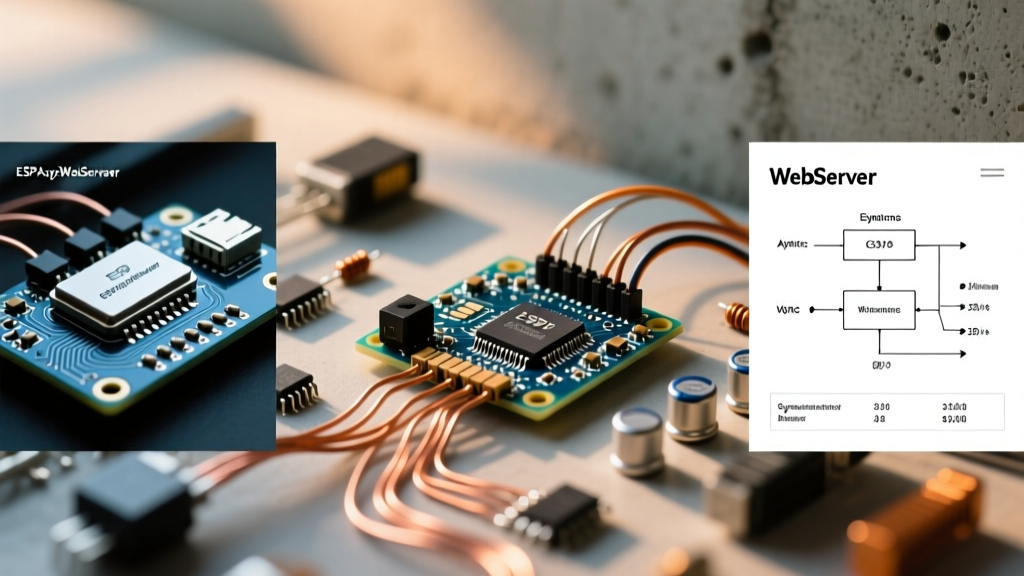
When engineering IoT dashboards, local configuration portals, or real-time telemetry endpoints, selecting the correct esp32 webserver library is the most critical architectural decision you will make. Unlike the single-core ESP8266, the ESP32 features a dual-core Xtensa LX6 microcontroller running FreeRTOS. However, many developers inadvertently cripple this multicore advantage by relying on blocking, synchronous HTTP libraries. This deep dive dissects the underlying mechanics of the native synchronous WebServer.h versus the asynchronous powerhouse ESPAsyncWebServer, analyzing heap allocation, LwIP stack constraints, and real-world failure modes in Arduino Core v3.x.
Native WebServer.h: The Synchronous Bottleneck
The native ESP32 WebServer library bundled with the Arduino core is a wrapper around a basic TCP listener. It operates on a polling mechanism. To process incoming HTTP requests, you must call server.handleClient() inside your main loop().
How the Blocking Loop Impacts Sensor Reading
Because handleClient() is synchronous, it processes one TCP packet at a time. If a client requests a 50KB JavaScript file from your SPIFFS/LittleFS partition, the ESP32 must read the file in chunks and push it to the network buffer. During this transfer, the main loop() is entirely blocked. If you are simultaneously polling an I2C BME280 sensor or reading a high-frequency interrupt, your sensor data will drop or buffer overflow. Furthermore, if a single HTTP transaction stalls due to a poor Wi-Fi connection and exceeds the FreeRTOS Task Watchdog Timer (WDT) limit—typically 1 to 2 seconds—the ESP32 will trigger a Guru Meditation Error and hard-reset.
ESPAsyncWebServer: The Asynchronous Standard
To bypass the limitations of the main loop, the community-standard ESPAsyncWebServer leverages the ESP-IDF's underlying asynchronous TCP stack. Instead of polling, it utilizes FreeRTOS tasks and event-driven callbacks. When an HTTP request arrives, the LwIP (Lightweight IP) stack triggers an interrupt, and the AsyncTCP library handles the handshake and data transfer in a background task, completely freeing your main loop() for mission-critical logic.
Event-Driven Architecture and Task Pinning
By utilizing AsyncWebServer, you map URIs to specific callback functions. More importantly, the underlying AsyncTCP library runs on Core 0 (the protocol CPU), while your Arduino loop() runs on Core 1 (the application CPU). This hardware-level separation ensures that serving a heavy web interface never introduces latency into your motor control or PID loop algorithms.
Head-to-Head Benchmark: Memory and Concurrency
Understanding the memory footprint and connection limits of your chosen esp32 webserver implementation is vital for production firmware. The ESP32's LwIP stack is constrained by CONFIG_LWIP_MAX_SOCKETS (default 10) and available SRAM.
| Metric | Native WebServer.h (Sync) | ESPAsyncWebServer (Async) |
|---|---|---|
| Concurrency | 1 (Sequential processing) | Up to 8-12 (Parallel handling) |
| Main Loop Blocking | Yes (High latency risk) | No (Zero blocking) |
| WebSocket Support | No (Requires 3rd party lib) | Native, highly optimized |
| Heap Overhead per Conn. | ~4KB - 6KB | ~8KB - 12KB (due to Async buffers) |
| Arduino Core v3.x Status | Fully Supported | Requires maintained forks (e.g., mathieucarbou) |
Real-World Failure Modes and Heap Fragmentation
The most common reason an esp32 webserver crashes after 48 hours of uptime is not a logic error, but heap fragmentation. The ESP32 allocates memory in contiguous blocks. When clients connect and disconnect, the C++ String class dynamically allocates and deallocates memory for HTTP headers and URI parsing.
Mitigating the "Guru Meditation Error"
Over time, the heap becomes fragmented like Swiss cheese. A new HTTP request arrives, the server attempts to allocate a 2KB contiguous block for a response buffer, fails, and panics.
Pro-Tip: Never use theIf the largest free block drops below 4KB while total free heap remains high, you are experiencing severe fragmentation.Stringobject for HTTP response bodies in a production esp32 webserver. Instead, useconst char*stored in PROGMEM, or stream data directly from LittleFS using chunked responses. Monitor your heap health by periodically loggingheap_caps_get_free_size(MALLOC_CAP_8BIT)andheap_caps_get_largest_free_block(MALLOC_CAP_8BIT).
The Arduino Core v3.x Compatibility Crisis
With the release of Arduino ESP32 Core v3.0.0, Espressif updated the underlying ESP-IDF to v5.1. This update unified the networking stack but broke the original me-no-dev/ESPAsyncWebServer repository due to deprecated FreeRTOS APIs and changes in the AsyncTCP layer. Developers must now use actively maintained forks, such as the ESP-IDF native HTTP server or community forks like mathieucarbou/ESPAsyncWebServer, which patch the async TCP task stack sizes and WDT configurations for the newer IDF.
Serving Static Assets: LittleFS and Gzip Compression
A modern IoT dashboard relies on heavy CSS frameworks and JavaScript bundles. Serving these via a microcontroller requires aggressive optimization. Both libraries support LittleFS, but the async library handles cache-control headers and gzip decompression far more efficiently.
When configuring your server to serve a compiled React or Vue.js frontend, always pre-compress your .html, .css, and .js files into .gz formats using a build script. You can then instruct the esp32 webserver to serve the compressed file while sending the Content-Encoding: gzip header. This reduces a 200KB payload to roughly 45KB, drastically reducing TCP window exhaustion and transmission time over 2.4GHz Wi-Fi.
Verdict: Which Library Should You Compile?
If you are building a simple, single-purpose configuration captive portal (CaptivePortal) that is only accessed once during device provisioning, the native synchronous WebServer.h is sufficient and requires zero external dependencies. However, for any device requiring continuous uptime, real-time WebSocket telemetry, or serving complex web interfaces while simultaneously managing hardware interrupts, ESPAsyncWebServer (via a Core v3.x compatible fork) is mandatory. By offloading the TCP stack to Core 0 and utilizing event-driven callbacks, you respect the ESP32's hardware architecture and ensure rock-solid firmware stability.