
The 2026 Landscape of Starter Electronics
Selecting the right arduino uno beginner kit is the most critical hardware decision a new embedded systems hobbyist will make. The market has matured significantly, and the gap between premium first-party hardware and third-party clone ecosystems has narrowed in some areas while widening in others. In 2026, the fundamental architecture of the classic Uno R3 remains the gold standard for learning 5V logic, AVR microcontrollers, and basic peripheral interfacing. However, the accessories bundled with these boards dictate your actual learning experience.
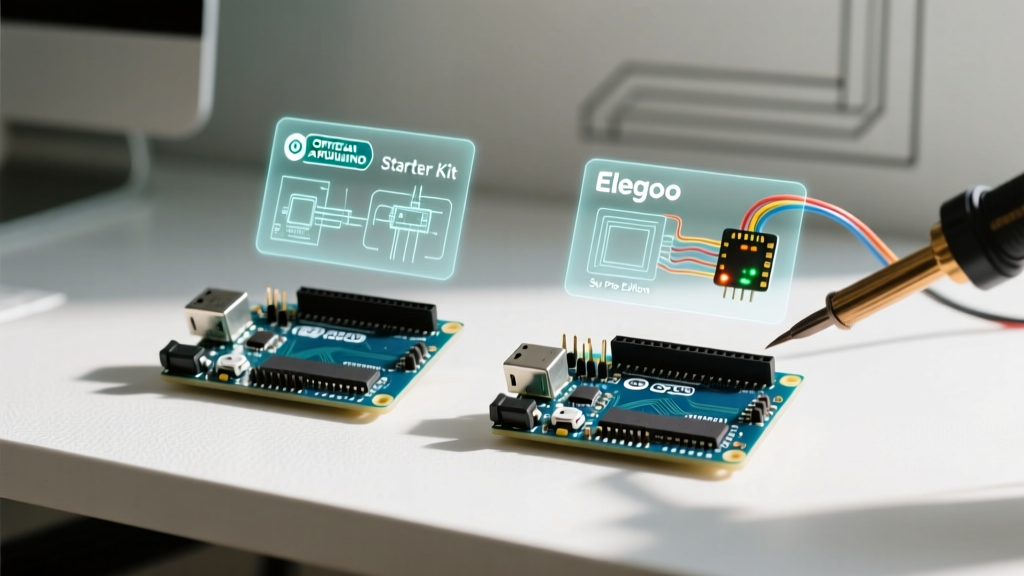
At ElectricalFlux, we teardown, stress-test, and evaluate the actual silicon and passive components included in starter bundles. Today, we are putting the Official Arduino Starter Kit head-to-head against the community-favorite Elegoo Super Starter Kit for UNO R3. We will analyze component tolerances, breadboard contact resistance, USB-to-serial silicon, and real-world failure modes to help you choose the right platform.
Contender 1: The Official Arduino Starter Kit
Priced consistently around $119.99 in 2026, the Official Arduino Starter Kit (Model K000007) is the premium entry point. It ships in a high-quality, reusable cardboard clamshell and includes a genuine Arduino Uno R3 Rev3 board.
Silicon and Board Quality
The genuine Uno R3 features the ATmega328P-PU microcontroller in a DIP-28 socket, paired with an ATmega16U2-MU acting as the USB-to-serial bridge. The 16U2 is a native USB controller, meaning the board enumerates instantly on Windows, macOS, and Linux without requiring third-party driver installations. The power delivery relies on a high-quality NCP1117 5V linear regulator, capable of safely dissipating heat when powering moderate sensor loads.
The 'Projects Book' Advantage
"Hardware is only half the battle. The 170-page Projects Book included in the official kit remains the most pedagogically sound introduction to C++ embedded programming available in physical print."
The guided projects move logically from basic digital output (LEDs) to complex analog input and motor control. The code is thoroughly commented, and the circuit diagrams follow strict official Arduino documentation standards, ensuring you learn proper schematic reading rather than just copying Fritzing breadboard layouts.
Contender 2: Elegoo Super Starter Kit for UNO R3
Retailing between $35.00 and $42.00 depending on seasonal sales, the Elegoo Super Starter Kit is the undisputed volume leader. It includes an Elegoo-branded UNO R3 clone and a massive plastic storage case overflowing with components.
Component Volume vs. Quality Trade-offs
Elegoo wins purely on mass. You receive a motor driver module (L293D), a relay module, an LCD1602 display, and hundreds of passive components. However, the underlying material science tells a different story. The Elegoo UNO R3 replaces the expensive ATmega16U2 USB bridge with the CH340G chip. While the CH340G is highly reliable, it requires specific driver attention on older operating systems, though Windows 11 and 12 now include native CH340 drivers out-of-the-box.
A Surprise Win: Resistor Tolerances
Interestingly, Elegoo ships with 1/4W metal film resistors rated at 1% tolerance. The official Arduino kit traditionally ships with 5% carbon film resistors. For projects involving precision voltage dividers or analog sensor calibration, the Elegoo kit actually provides superior passive components.
Head-to-Head Component Matrix
| Feature | Official Arduino Kit ($119) | Elegoo Super Kit ($39) | Winner |
|---|---|---|---|
| MCU Board | Genuine Uno R3 (ATmega16U2) | Clone Uno R3 (CH340G) | Official |
| Breadboard Contacts | Nickel-plated beryllium copper | Phosphor bronze / Steel mix | Official |
| Jumper Wires | Pure Copper (Stranded) | Copper-Clad Aluminum (CCA) | Official |
| Resistors | Carbon Film (5% Tolerance) | Metal Film (1% Tolerance) | Elegoo |
| Documentation | 170-page Physical Book | PDF via Download Link | Official |
| Component Volume | ~100 parts (Curated) | ~300+ parts (Bulk) | Elegoo |
Real-World Failure Modes & Edge Cases
When evaluating an arduino uno beginner kit, you must consider how the hardware behaves after three months of continuous breadboarding and un-plugging. This is where budget kits reveal their hidden costs.
Breadboard Contact Resistance Degradation
According to SparkFun's engineering guidelines, a healthy breadboard should exhibit less than 50mΩ of contact resistance. The official kit's breadboard maintains roughly 25mΩ even after repeated wire insertions. The Elegoo breadboard, however, frequently measures upwards of 120mΩ to 180mΩ on the power rails after moderate use. This high resistance causes localized voltage drops, leading to mysterious brownout resets on the ATmega328P when drawing currents above 150mA.
Jumper Wire Fatigue
The Elegoo kit utilizes Copper-Clad Aluminum (CCA) for its male-to-male jumper wires. CCA is brittle. If you bend a CCA wire more than 10-15 times at the crimp joint, the internal aluminum core snaps, resulting in an open circuit that is notoriously difficult to troubleshoot for a beginner. The official kit uses pure stranded copper, which withstands hundreds of bend cycles without internal fracturing.
The 5V Regulator Thermal Throttling
Beginners often attempt to power high-draw components (like multiple servos or long LED strips) directly from the Uno's 5V pin. The genuine Arduino board's NCP1117 regulator has robust thermal shutdown protection. Many clone boards use unbranded, counterfeit linear regulators that lack proper thermal rollback, leading to catastrophic silicon failure and melted plastic headers if you exceed a 300mA draw on the 5V rail.
Which Arduino Uno Beginner Kit Should You Buy?
Your purchasing decision should be dictated by your end goal and your tolerance for hardware troubleshooting.
Buy the Official Arduino Starter Kit If:
- You are an educator or buying for a classroom: The reliability of the genuine hardware and the physical project book minimizes technical support overhead.
- You value your time over upfront cost: You will not lose hours debugging ghost-in-the-machine errors caused by cheap breadboard contacts or broken CCA jumper wires.
- You want native plug-and-play USB: The ATmega16U2 ensures zero driver friction across all operating systems.
Buy the Elegoo Super Starter Kit If:
- You are on a strict budget: At roughly $40, the sheer volume of sensors (RFID, ultrasonic, temperature, LCDs) provides immense value.
- You already know how to troubleshoot: If you own a multimeter and know how to verify continuity and download the latest CH340 drivers from Elegoo, the clone board will serve you perfectly well for 95% of beginner projects.
- You plan to permanently solder your final projects: If you intend to move components off the breadboard and onto custom PCBs quickly, the lower-quality breadboard and jumper wires won't matter in the long run.
Frequently Asked Questions
Is the Elegoo Uno R3 fully compatible with official Arduino shields?
Yes. The Elegoo board strictly adheres to the physical footprint and pinout of the official Uno R3. All standard shields, from the Motor Shield to the Ethernet Shield, will physically fit and function correctly, provided the shield does not rely on the specific firmware of the ATmega16U2 USB chip for specialized MIDI or keyboard emulation.
Can I upgrade the Elegoo kit's breadboard later?
Absolutely. The most common upgrade path for budget kit users is to retain the Elegoo microcontroller and sensors but purchase a premium, bus-bar equipped breadboard (like those from Busboard Prototype Systems) and a set of pure copper silicone-sleeved jumper wires. This $15 upgrade eliminates the primary failure points of the budget kit.
Does the Uno R4 make these kits obsolete?
While the Arduino Uno R4 WiFi and Minima offer 32-bit ARM Cortex-M4 power, the classic 8-bit AVR architecture of the Uno R3 remains the superior starting point for learning fundamental timing, direct port manipulation, and basic 5V logic. The R3 kits reviewed here remain the most relevant entry points for foundational electronics education in 2026.