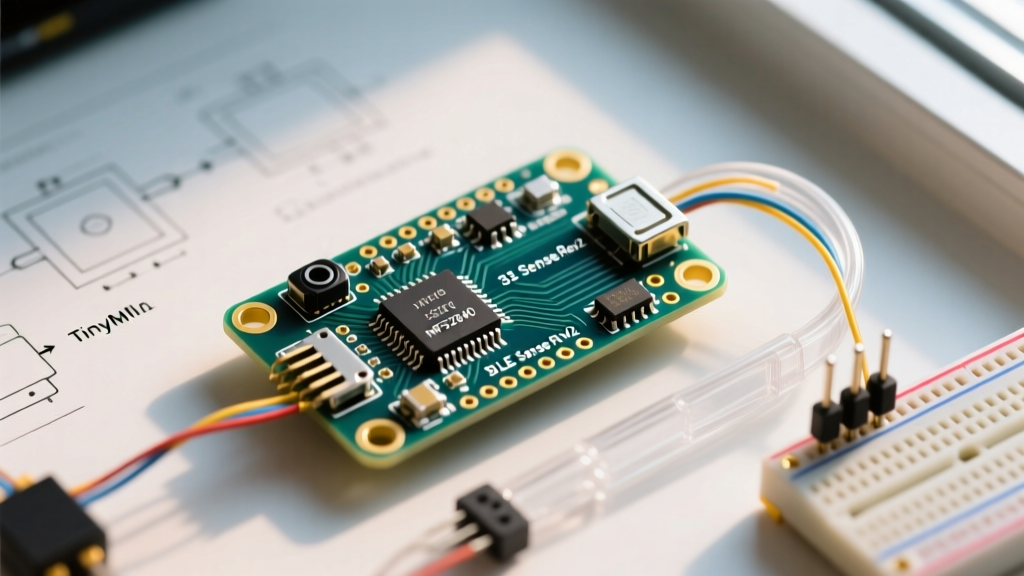

When evaluating microcontrollers for Edge AI, sensor fusion, and low-power IoT deployments, the Arduino Nano 33 BLE Sense Rev2 frequently emerges as a top contender. However, the transition from the original Rev1 to the Rev2 iteration introduced critical hardware changes that directly impact firmware compatibility and project suitability. This analysis dissects the board's architecture, real-world power consumption, and specific use-case viability to help you determine if it is the right foundation for your next embedded project.
The "Rev2" Hardware Shift: What Changed and Why It Matters
The most crucial detail for embedded engineers to understand about the Nano 33 BLE Sense Rev2 is the IMU (Inertial Measurement Unit) substitution. Due to global supply chain constraints, Arduino replaced the STMicroelectronics LSM9DS1 used in Rev1 with a dual-chip Bosch solution: the BMI270 6-axis IMU and the BMM150 3-axis magnetometer.
This is not merely a drop-in replacement; it fundamentally alters how you approach sensor fusion. The BMI270 features a dedicated hardware FIFO buffer and built-in step-counting/gesture recognition accelerators that the LSM9DS1 lacked. However, if you are porting legacy code or using older Arduino LSM9DS1 libraries, your firmware will fail to compile or return null I2C addresses. You must migrate to the Arduino_BMI270_BMM150 library. On the positive side, the Bosch chipset offers superior noise density (0.14 mg/√Hz for the accelerometer) compared to its predecessor, making it vastly superior for high-frequency vibration analysis and predictive maintenance TinyML models.
Project Suitability Matrix
Not every project benefits from the Nano 33 BLE Sense Rev2's specific sensor payload and nRF52840 SoC. Below is a suitability matrix based on real-world deployment scenarios.
| Project Category | Suitability Score | Technical Justification |
|---|---|---|
| TinyML Keyword Spotting | 9.5/10 | Integrated MP34DT05 PDM microphone and Cortex-M4F DSP instructions allow 16kHz audio sampling without external ADCs. |
| Wearable Gesture Control | 9.0/10 | BMI270 hardware accelerators and ultra-low BLE advertising current make it ideal for battery-powered wearables. |
| Environmental Data Logging | 7.5/10 | LPS22HB and HTS221 are accurate, but the lack of an onboard SD card slot requires external SPI wiring, increasing footprint. |
| High-Speed Motor Control | 4.0/10 | >nRF52840 lacks dedicated hardware PWM channels optimized for high-frequency dead-time insertion required by BLDC motors.|
| 5V Legacy Sensor Integration | 2.0/10 | Strict 3.3V logic. The nRF52840 GPIO pins are not 5V tolerant; level shifters are mandatory, ruining the compact form factor. |
Edge AI and TinyML Capabilities
The heart of the board is the Nordic nRF52840, featuring an ARM Cortex-M4F processor clocked at 64 MHz with 1MB of Flash and 256KB of SRAM. When deploying TensorFlow Lite for Microcontrollers, memory management is your primary bottleneck. A standard quantized (INT8) neural network for acoustic event detection typically consumes 40KB to 80KB of Flash and 15KB of SRAM for tensor arenas.
Expert Tip: When capturing audio via the onboard MP34DT05 MEMS microphone using the PDM library, avoid allocating large dynamic buffers in yourloop(). Instead, pre-allocate a staticint16_tbuffer in the global scope to prevent heap fragmentation, which will cause hard faults during extended Edge AI inference cycles.
For vision-based TinyML, the board lacks a camera interface, making it unsuitable for image classification. However, for multimodal sensor fusion—combining audio spectrograms with 9-axis IMU data to detect complex physical anomalies (e.g., identifying a specific machine failing by its sound and vibration signature)—the Nano 33 BLE Sense Rev2 is arguably the best off-the-shelf development platform available.
Power Profiling: Real-World Current Draw
Marketing materials often quote theoretical sleep currents, but real-world IoT deployments require precise power budgeting. The nRF52840 supports an onboard DC/DC converter, which drastically reduces power consumption compared to using the internal LDO regulator, provided you supply the correct inductors on your custom carrier board (if moving past the prototyping phase).
- Active Mode (CPU at 64MHz, Sensors Polling): ~6.5 mA
- BLE Connected (Advertising + 50ms Connection Interval): ~2.1 mA average
- System ON Idle (RAM retained, no BLE): ~1.5 µA
- System OFF (Deep Sleep): ~10 nA (Requires external GPIO interrupt or RTC to wake)
If your project relies on a CR2032 coin cell (approx. 220 mAh), running continuous BLE advertising and 10Hz IMU sampling will drain the battery in roughly 3 weeks. To achieve multi-year battery life, you must utilize the nRF52840's System OFF mode and rely on the BMI270's internal FIFO and interrupt pins to wake the main SoC only when a specific motion threshold is crossed.
When to Avoid This Board (Anti-Patterns)
Despite its impressive sensor suite, the Arduino Nano 33 BLE Sense Rev2 is not a universal solution. Avoid this board if your project involves:
- Direct 5V Logic Interfacing: Connecting standard 5V I2C/SPI sensors (like older Adafruit breakouts) directly to the Nano's pins will permanently destroy the nRF52840 SoC. You must use bidirectional logic level shifters (e.g., Texas Instruments TXS0108E), which adds BOM cost and PCB real estate.
- High-Bandwidth Data Streaming: While the board has BLE 5.0, the throughput is limited by the ATT MTU size and connection interval. Streaming raw 16kHz audio over BLE in real-time is highly prone to packet loss. Use it for edge inference (sending only the classification result) rather than raw data streaming.
- Cost-Sensitive Mass Production: At a retail price hovering between $48.00 and $55.00 USD, it is an excellent prototyping tool. However, for manufacturing runs exceeding 500 units, designing a custom PCB around a bare nRF52840 module (like the Raytac MDBT50Q) and sourcing discrete sensors will reduce your BOM cost by over 60%.
Frequently Asked Questions
Can I use the standard ArduinoBLE library with Rev2?
Yes. The underlying Nina W10 module from the original Nano 33 IoT is not present here; instead, the nRF52840 handles BLE natively. The ArduinoBLE library is fully optimized for the Nordic SoftDevice controller running on this chip, allowing straightforward peripheral and central role configurations.
Does the Rev2 support Mbed OS or Zephyr?
While the Arduino IDE uses an Mbed OS abstraction layer under the hood for the Nano 33 BLE series, advanced users can bypass the Arduino bootloader and flash Zephyr RTOS directly via the SWD test points using a J-Link debugger. This is highly recommended for industrial deployments requiring deterministic real-time scheduling and advanced power management states.
How do I calibrate the BMM150 magnetometer?
Unlike the accelerometer, the magnetometer requires hard-iron and soft-iron calibration to account for PCB trace interference. You must implement a figure-eight calibration routine in your firmware, capturing the min/max raw values across all three axes to calculate the offset and scaling factors before feeding the data into an AHRS (Attitude and Heading Reference System) algorithm like Madgwick or Mahony.