
The Hidden Danger: Why Your Multimeter Choice Matters
Electrical troubleshooting always begins with one critical, life-saving question: is the circuit actually dead? Learning how to check for power with a multimeter is the most fundamental skill for any DIYer, electrician, or electronics hobbyist. However, the technique is only half the equation. The tool you use to verify the absence of voltage is just as important as the procedure itself. According to OSHA's electrical safety data, improper testing equipment and faulty multimeters are recurring factors in arc flash incidents and electrical shocks.
When you place a multimeter across a live 240V residential split-phase or a 480V industrial panel, you are essentially creating a controlled short circuit through the meter's internal impedance. If the meter lacks the proper transient voltage protection, a voltage spike can cause the internal components to vaporize, turning the plastic casing into shrapnel. This buying guide will not only teach you the exact protocol for checking power but also break down the specific multimeter architectures you need to buy in 2026 to ensure you survive the test.
Decoding CAT Ratings: The First Line of Defense
Before purchasing a meter to check for voltage, you must understand Measurement Category (CAT) ratings. The CAT rating dictates the meter's ability to withstand transient voltage spikes (like lightning strikes or heavy motor switching) at specific points in the electrical distribution system.
- CAT II: Local level, standard wall outlets, and plug-in appliances. (Not recommended for main panel work).
- CAT III: Distribution level, including fixed motors, lighting systems, and the feed side of breaker panels. This is the minimum requirement for most residential and commercial power checks.
- CAT IV: Primary supply level, utility meters, and the line side of the main service entrance. Essential for industrial and heavy commercial troubleshooting.
As detailed in Fluke's comprehensive safety guidelines, a CAT III 600V meter is specifically engineered with internal blast shields, isolated input jacks, and high-energy fuses to protect the user if a transient spike occurs while checking for power at a breaker panel.
The Live-Dead-Live Protocol: How to Check for Power Safely
Never trust a multimeter reading on a target circuit without first verifying the meter's operational integrity. The industry-standard procedure, heavily emphasized in NFPA 70E safety standards, is the Live-Dead-Live test.
Phase 1: Visual and Functional Inspection
Before touching any probes, inspect your test leads. Look for cracked insulation, exposed wire strands, or worn probe tips. Ensure the leads are plugged into the correct jacks (Common and V/Ω). Inserting the lead into the Ampere (A) jack while testing for voltage will create a dead short, resulting in an immediate arc flash and a destroyed meter.
Phase 2: The Three-Step Verification
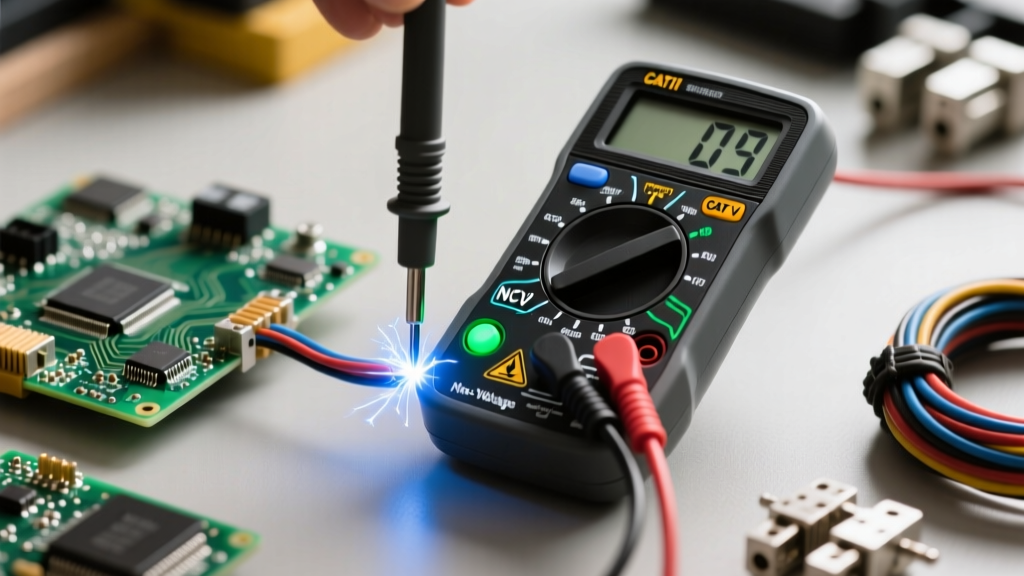
- LIVE (Known Source): Set your multimeter to AC Voltage (V~). Test the probes on a known live circuit, such as a standard wall outlet or a dedicated voltage verification unit. The meter should read the expected voltage (e.g., 120V or 230V).
- DEAD (Target Circuit): Move to the circuit you intend to work on. Test Phase-to-Neutral, Phase-to-Ground, and Phase-to-Phase (if applicable). The meter must read 0V or a negligible millivolt ghost reading.
- LIVE (Known Source Again): Return to the original known live source. Verify the meter still reads correctly. This confirms the internal fuse or circuitry didn't fail silently during the 'Dead' test.
2026 Multimeter Buying Matrix: Top Models for Voltage Detection
Choosing the right tool depends on your specific environment. Below is a comparison of the top multimeters optimized for safe power verification in 2026, balancing safety features, readability, and price.
| Model | Approx. Price | CAT Rating | LoZ Mode | NCV Feature | Best Use Case |
|---|---|---|---|---|---|
| Fluke 117 | $210 | CAT III 600V | Yes | Yes (VoltAlert) | Professional Residential & Commercial |
| Brymen BM235 | $135 | CAT III 600V | Yes | No | Advanced DIY & HVAC Technicians |
| Klein Tools MM400 | $45 | CAT III 600V | No | No | Budget DIY & Basic Electronics |
| Fluke 87V MAX | $450 | CAT III 1000V / CAT IV 600V | Yes | No | Heavy Industrial & Outdoor Panels |
Eradicating Ghost Voltages: The LoZ Imperative
One of the most confusing experiences when learning how to check for power with a multimeter is encountering a 'ghost voltage.' You might test a disconnected wire and see a reading of 40V to 90V AC, leading you to believe the circuit is still live. This is caused by capacitive coupling, where an adjacent live wire induces a small electromagnetic field in the dead wire.
Because standard digital multimeters have a very high input impedance (typically 10 Megohms), they cannot draw enough current to dissipate this coupled energy, resulting in a false positive voltage reading. This is where the LoZ (Low Impedance) feature becomes a mandatory buying criterion for 2026.
When you engage LoZ mode (available on the Fluke 117 and Brymen BM235), the meter drops its internal impedance to roughly 3 kilohms. This creates a small load that bleeds off the capacitive ghost voltage, dropping the reading to a true 0V. If you are buying a multimeter specifically to verify dead circuits in multi-gang switch boxes or dense conduit runs, a meter without LoZ will cost you hours of unnecessary troubleshooting.
Beyond the Basics: Probe Quality and HRC Fusing
The multimeter body is only as safe as its weakest link. When evaluating a purchase, look past the digital display and examine the internal protection and external accessories.
High Rupturing Capacity (HRC) Fuses
Cheap multimeters use standard glass fuses. If you accidentally test voltage with the leads in the current (Amps) jacks, a glass fuse will shatter instantly, allowing an arc flash to travel through the meter and into your hands. Premium meters use HRC ceramic fuses filled with sand. When subjected to a massive short circuit, the sand absorbs the explosive energy and quenches the arc, saving your life. Always verify that replacement HRC fuses are available and affordable for the model you choose.
Test Lead Insulation and Wear Indicators
Look for test leads with double-layered silicone insulation. High-quality leads feature a contrasting inner color (like white or red) beneath a black outer sheath. If the outer sheath gets nicked or worn down from probing rough terminal blocks, the inner color shows through, providing a visual warning that the lead is compromised and must be replaced immediately.
Final Verdict: Equipping Yourself for Live Circuits
Mastering how to check for power with a multimeter requires a synthesis of disciplined methodology and reliable hardware. For the casual DIYer replacing a standard receptacle, the Klein Tools MM400 offers adequate CAT III protection, provided you strictly adhere to the Live-Dead-Live protocol and understand the limitations of high-impedance ghost voltages.
However, for professional electricians, HVAC technicians, and serious hobbyists working inside crowded breaker panels, the Fluke 117 remains the undisputed gold standard for 2026. Its integrated VoltAlert NCV (Non-Contact Voltage) sensor allows you to identify the hot conductor before you even unscrew the terminal cover, while the AutoVolt and LoZ features eliminate the guesswork and false positives that plague lesser meters. Invest in a meter that protects you from the invisible hazards of the grid, and never bypass the Live-Dead-Live test.