
The Hidden Dangers of Cheap Voltage Testers
When you are troubleshooting a tripped breaker or designing a custom microcontroller power supply, the ability to accurately measure electrical potential is non-negotiable. However, the market is flooded with substandard tools that prioritize low cost over basic safety and measurement integrity. A reliable volts multimeter is not just a device that displays a number; it is a calibrated safety instrument designed to protect you from arc flashes, transient spikes, and catastrophic failure modes.
Many beginners make the mistake of purchasing a generic $15 meter from an online marketplace, only to find that it reads "ghost" voltages on dead circuits, fails to measure non-linear AC waveforms accurately, or lacks the internal high-rupturing-capacity (HRC) fuses required to prevent an explosion during a short circuit. According to OSHA Electrical Safety Standards, using improperly rated testing equipment is a leading contributor to workplace electrical injuries. This buying guide will dissect the technical specifications that actually matter in 2026, helping you select a volts multimeter that matches your specific trade, hobby, or professional requirement.
Decoding CAT Ratings: Where Are You Measuring Volts?
The most critical specification on any multimeter is its Measurement Category (CAT) rating. This rating does not merely indicate the maximum steady-state voltage the meter can handle; it defines the meter's ability to survive high-energy transient voltage spikes (impulses) that occur in different electrical environments.
CAT II vs. CAT III vs. CAT IV: The Transient Spike Reality
- CAT II (Local Level): Designed for single-phase receptacle connected loads. Think household appliances, portable tools, and standard 120V/240V outlets. A CAT II 600V meter is sufficient for basic home DIY electronics and appliance repair.
- CAT III (Distribution Level): Required for three-phase distribution, including single-phase commercial lighting and hardwired equipment in commercial buildings. This is the minimum standard for professional electricians working inside distribution panels and motor controls.
- CAT IV (Primary Supply Level): Necessary for measurements at the primary supply level, such as utility connections, outdoor service entrances, and the line side of the main breaker. CAT IV meters feature the highest impedance and arc-quenching capabilities.
As detailed in the Fluke CAT Rating Guide, a CAT III 600V meter is tested to withstand an 8,000V transient spike, whereas a CAT II 600V meter is only tested for a 4,000V spike. If you are measuring volts at a main service panel, using a CAT II meter can result in internal arcing, melting the probes and severely burning the user.
True RMS and LoZ: Eliminating 'Ghost' Voltage
Measuring DC voltage is relatively straightforward, but AC voltage measurement introduces significant complexities, particularly in modern electrical systems filled with non-linear loads like LED drivers, variable frequency drives (VFDs), and switching power supplies.
Why True RMS is Mandatory
Cheaper multimeters use an "average-responding" circuit that assumes a perfect sine wave. They measure the average value and multiply it by a form factor (1.111) to estimate the RMS (Root Mean Square) voltage. If the waveform is distorted by a VFD or a dimmer switch, an average-responding meter will display wildly inaccurate readings—sometimes off by 20% to 40%. A True RMS volts multimeter utilizes an internal thermal or computational RMS converter to calculate the actual heating value of the complex waveform, ensuring precision regardless of harmonic distortion.
Low Impedance (LoZ) Mode and Capacitive Coupling
Have you ever tested a wire you knew was disconnected, only to see a reading of 40V to 80V AC? This is "ghost voltage," caused by capacitive coupling between adjacent energized and de-energized wires running in the same conduit. Standard multimeters have a high input impedance (typically 10 Megohms), which makes them sensitive enough to detect these harmless induced voltages, leading to dangerous misdiagnoses.
Premium meters feature a LoZ (Low Impedance) mode. When engaged, the meter drops its internal impedance to roughly 3 kilohms. This creates a small load that safely bleeds off the capacitive ghost voltage, dropping the display to a true 0.0V and confirming the circuit is genuinely dead.
2026 Volts Multimeter Comparison Matrix
To help you navigate the market, we have evaluated three distinct tiers of multimeters based on safety, accuracy, and real-world utility. Below is a structured comparison of the top contenders for different user profiles.
| Model | CAT Rating | True RMS | LoZ Mode | Approx Price | Best Application |
|---|---|---|---|---|---|
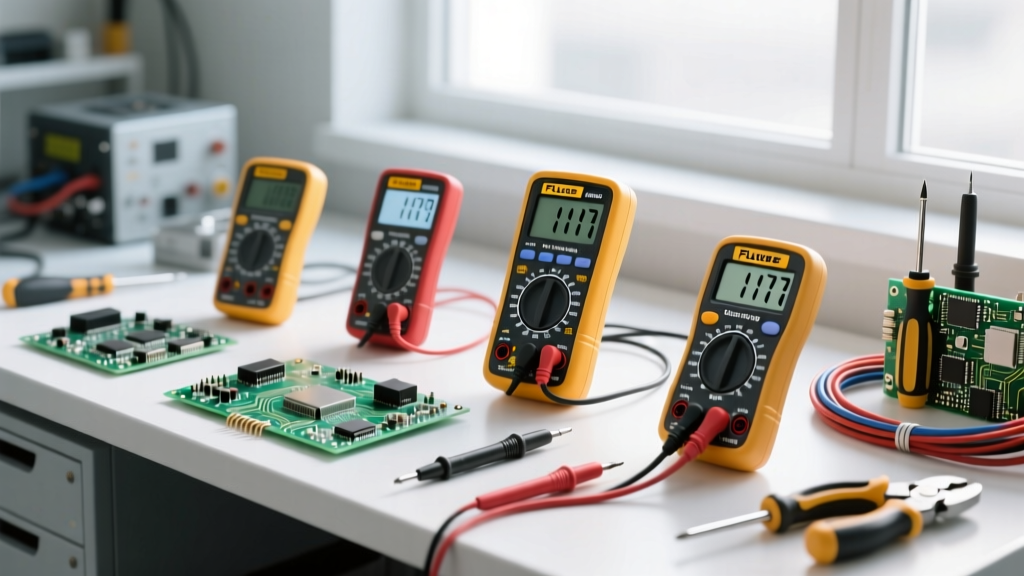
| Fluke 117 | CAT III 600V | Yes | Yes (AutoVolt) | $210 | Pro Electricians & HVAC |
| Brymen BM235 | CAT III 600V / CAT IV 300V | Yes | No | $115 | Electronics & Advanced DIY |
| Klein Tools MM400 | CAT III 600V | Yes | No | $45 | Homeowners & Beginners |
Deep Dive: The Contenders
Fluke 117 Electricians True RMS Multimeter: The undisputed workhorse for commercial electricians. Its standout feature is VoltAlert, a non-contact voltage detector built into the tip, and AutoVolt, which automatically switches between AC and DC while utilizing low impedance to eliminate ghost readings. The build quality and HRC fuse protection make it a lifetime investment.
Brymen BM235: Highly regarded in the electrical engineering and teardown communities (frequently praised by experts like EEVblog). It offers incredible build quality, dual CAT ratings, and a microamp range for sensitive electronics troubleshooting, all at a mid-tier price point. It lacks LoZ, making it less ideal for commercial wiring but perfect for bench electronics.
Klein Tools MM400: An excellent entry-level True RMS meter. While it lacks the advanced safety shutters and LoZ capabilities of the Fluke, it provides reliable CAT III protection for household troubleshooting, automotive 12V systems, and basic DIY wiring projects. You can view more entry-level options in the Klein Tools Multimeter Lineup.
Test Lead Anatomy and HRC Fuse Protection
A volts multimeter is only as safe and accurate as its weakest link. For voltage measurement, the test leads and internal fusing are paramount.
The Myth of the Glass Fuse
Never purchase a multimeter that uses standard 5x20mm glass fuses for its high-current or voltage protection circuits. Glass fuses cannot contain the explosive energy of a high-fault short circuit. If you accidentally leave your leads in the "Amps" jack and connect them across a 240V mains supply, a glass fuse will shatter, ionizing the air inside the meter and creating a sustained plasma arc that can result in a catastrophic explosion in your hands.
Professional-grade meters utilize High Rupturing Capacity (HRC) fuses. These are ceramic-bodied fuses filled with specialized quartz sand. When the internal element vaporizes during a short circuit, the sand instantly absorbs the thermal energy and quenches the arc, safely containing the blast within the fuse body.
Silicone Leads and Shrouded Connectors
Ensure your chosen meter comes with, or is paired with, double-insulated silicone test leads. PVC leads become brittle in cold weather and can melt if they brush against a hot soldering iron or a warm heat sink. Furthermore, look for leads with removable shrouds (like the Fluke TL285 or equivalent). When measuring volts on a crowded terminal block, you slide the shroud up to expose only 4mm of the metal tip, drastically reducing the chance of an accidental short between adjacent phases.
Final Verdict: Matching the Meter to Your Trade
Selecting the right volts multimeter requires an honest assessment of your working environment. If you are opening commercial panels, troubleshooting three-phase motor controls, or working in environments where ghost voltages and harmonic distortion are prevalent, the Fluke 117 is an absolute necessity. The LoZ feature alone will save you hours of chasing phantom electrical faults.
For the electronics hobbyist, Arduino developer, or audio engineer who needs high precision, microamp sensitivity, and robust transient protection without the premium price tag, the Brymen BM235 remains the best-kept secret in the industry. Finally, for the homeowner hanging a smart thermostat or checking a car battery, the Klein MM400 provides accessible True RMS accuracy without overwhelming you with features you will never use.
Remember, when measuring electrical potential, you are not just buying a display; you are buying the assurance that the tool in your hand will not become a liability when the circuit behaves unpredictably. Invest in proper CAT ratings, demand True RMS, and respect the physics of the grid.