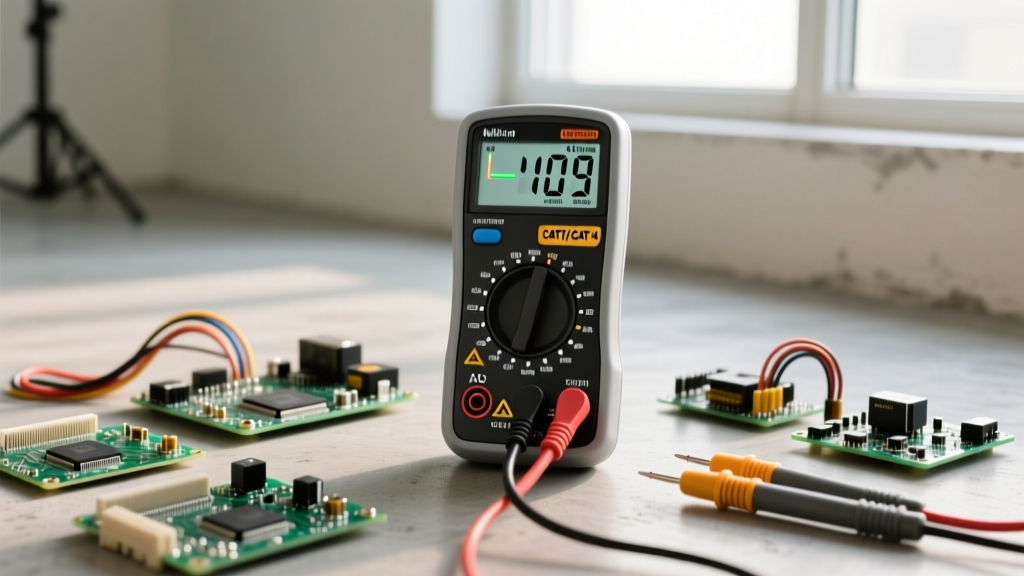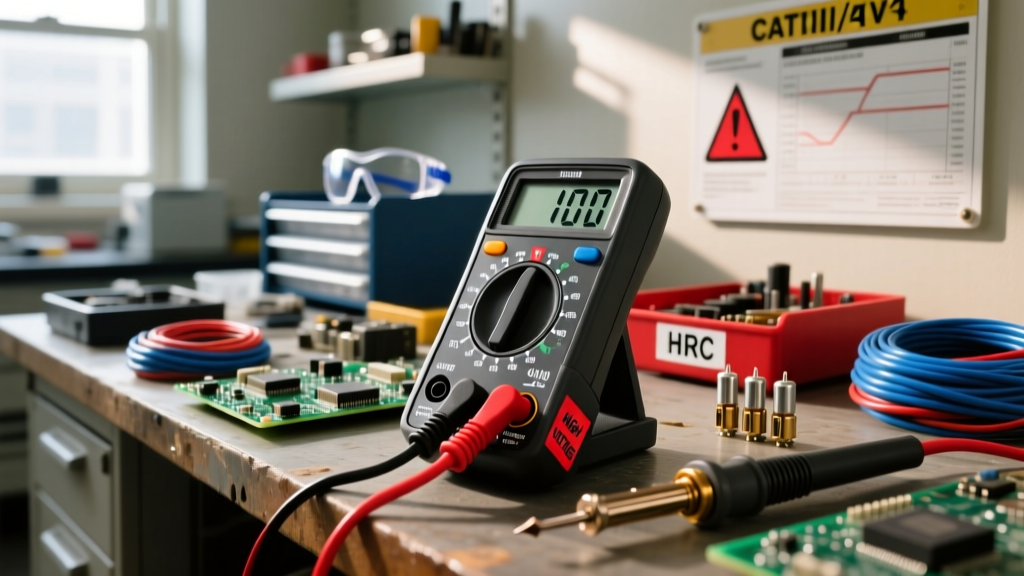

Every electronics workbench, automotive garage, and electrician’s pouch relies on a basic multimeter. Whether you are troubleshooting a 5V microcontroller circuit or diagnosing a 240V residential HVAC contactor, the multimeter is your primary window into the invisible world of electrical potential and current. However, treating a basic multimeter as a foolproof, invincible tool is a leading cause of severe arc flash injuries, destroyed test equipment, and catastrophic circuit failures. According to OSHA Electrical Safety Guidelines, improper use of testing equipment accounts for a significant percentage of electrical diagnostic injuries. This guide dives deep into the engineering realities of multimeter safety, exploring the hidden dangers of CAT ratings, internal fusing metallurgy, and the standard operating procedures required to keep yourself and your circuits safe.
Decoding CAT Ratings and the IEC 61010-1 Standard
The most misunderstood specification on any basic multimeter is the Category (CAT) rating. Many hobbyists and junior technicians falsely assume that a CAT II 600V rating and a CAT III 600V rating are functionally identical because they share the same maximum continuous voltage. In reality, the IEC 61010-1 standard dictates that CAT ratings define a meter’s ability to survive transient overvoltage impulses—sudden, massive spikes in voltage caused by lightning strikes, inductive load switching, or motor kickbacks.
The Physics of Transient Impulses
When you measure a standard 120V AC wall outlet, you are not just dealing with 120V RMS. You are connected to a grid capable of delivering thousands of volts in a microsecond spike if a heavy industrial motor down the line shuts off. The IEC 61010-1 standard mandates specific impulse withstand tests based on the source impedance of the environment:
- CAT II (600V): Tested to withstand a 4000V impulse. Designed for single-phase receptacle connected loads (appliances, portable tools).
- CAT III (600V): Tested to withstand a 6000V impulse. Designed for fixed three-phase distribution, lighting systems, and feeder panels.
- CAT IV (600V): Tested to withstand an 8000V impulse. Designed for primary supply levels, utility meters, and outdoor service entrances.
Using an unrated or CAT II basic multimeter on a CAT III industrial distribution panel is a severe safety violation. If a transient spike occurs, the internal air gaps of the cheap meter will ionize, creating a sustained plasma arc that can cause the meter to explode in your hands. Always match your meter’s CAT rating to the highest energy environment you plan to enter.
The Fatal 'Amps-to-Volts' Mistake
The single most destructive mistake made with a basic multimeter is leaving the red test probe in the 10A (Ampere) port and subsequently attempting to measure voltage across a live circuit. To understand why this is so dangerous, you must understand the internal architecture of the meter’s current measurement shunt.
When you switch your dial to measure voltage, the multimeter places a very high impedance (typically 10 Megohms) between the probes, drawing virtually zero current. However, to measure current, the meter routes the signal through an internal shunt resistor. In the 10A port, this shunt is designed to have near-zero resistance (often around 0.01 ohms) to prevent voltage drop in the circuit being tested.
If you place a 0.01-ohm shunt directly across a 120V AC mains outlet, Ohm’s Law (I = V/R) dictates a theoretical current draw of 12,000 Amps. You have effectively created a dead short with zero current-limiting protection. In a budget basic multimeter lacking proper input protection, this results in an instantaneous arc flash. The copper traces vaporize, the plastic casing shatters, and molten shrapnel is directed toward the user’s face and hands. As highlighted in Fluke’s Multimeter Safety Guide, this specific user error is responsible for the majority of catastrophic meter failures in the field.
Internal Fusing: HRC vs. Glass Cartridge
How does a multimeter survive the 'Amps-to-Volts' mistake? The answer lies in the internal fuse. However, not all fuses are created equal, and the type of fuse inside your basic multimeter is a primary indicator of its true safety profile.
The Danger of Glass Fuses
Cheap, sub-$20 multimeters almost universally use standard 250V glass cartridge fuses. While these fuses will blow under normal overcurrent conditions, they are entirely inadequate for high-energy industrial faults. When a glass fuse blows under a massive 120V/240V dead short, the internal filament vaporizes, but the glass tube shatters. The ionized metal vapor inside the tube acts as a conductor, allowing the electrical arc to sustain itself across the broken glass, effectively turning the fuse into a sustained incendiary device inside the meter.
The Necessity of Sand-Filled HRC Fuses
Professional-grade basic multimeters utilize High Rupture Capacity (HRC) fuses. These fuses are encased in high-strength ceramic or melamine tubes and are densely packed with specialized silica sand. When the fuse element vaporizes during a massive fault, the intense heat melts the surrounding sand into glass. This glass matrix instantly extinguishes the plasma arc, safely containing the explosive energy within the ceramic body. If you are working on anything beyond low-voltage DC hobby circuits, an HRC-fused meter is a non-negotiable safety requirement.
Safety Feature Comparison: Budget vs. Professional Basic Multimeters
To illustrate the drastic differences in internal safety engineering, review the comparison chart below detailing three common tiers of basic multimeters found in the wild.
| Model Tier | Example Model | CAT Rating | Fuse Type | Input Protection |
|---|---|---|---|---|
| Budget Hobbyist | Generic DT830B ($12) | None / Unverified | Fast-Acting Glass | None |
| Mid-Range DIY | Klein Tools MM400 ($45) | CAT III 600V | Ceramic (Non-HRC) | Basic PTC Thermistor |
| Professional Basic | Fluke 115 ($180) | CAT III 600V / CAT IV 300V | Sand-Filled HRC | Independent Fusing & MOVs |
Probe Integrity and Insulation Degradation
The test leads are the only physical barrier between your hands and the voltage source. Most basic multimeters ship with standard PVC-insulated leads. While adequate for basic electronics, PVC insulation becomes brittle over time, cracks in cold environments, and melts instantly if it accidentally brushes against a hot soldering iron or a recently reflowed SMD component.
For rigorous safety, upgrade to silicone-insulated test leads. Silicone is highly flexible, resistant to extreme temperature fluctuations, and will not melt or burn through if exposed to incidental heat. Furthermore, inspect your probe tips daily. Worn probe tips can slip off a test point and short adjacent pins on a microcontroller or, worse, slip off a busbar and cause a phase-to-phase short. Always ensure your probes feature integrated, slidable finger guards to prevent your fingers from sliding past the safe gripping zone and touching the exposed metal shaft.
Standard Operating Procedure: The Live-Dead-Live Protocol
When working on energized circuits, NFPA 70E and OSHA regulations mandate strict verification protocols. Relying solely on a basic multimeter’s digital readout is insufficient, as a dead battery or a blown internal fuse can cause the meter to read '0.00V' on a genuinely lethal 480V circuit. To comply with NFPA 70E Electrical Safety Standards, you must strictly adhere to the Live-Dead-Live testing method:
- Live (Verify the Meter): Test your multimeter on a known, verified live voltage source (such as a dedicated outlet tester or a known-good receptacle) to confirm the meter and leads are functioning correctly.
- Dead (Test the Target): Test the target circuit or equipment to verify the absence of voltage. Test phase-to-phase, phase-to-ground, and neutral-to-ground.
- Live (Re-Verify the Meter): Immediately return to the known live source and test the meter again. This proves that the meter did not fail or lose power during the critical Dead test.
By integrating this protocol into your daily workflow, you eliminate the risk of false-negative readings and ensure that your basic multimeter remains a tool of precision and safety, rather than a vector for catastrophic injury. Treat your equipment with respect, understand its internal limitations, and never bypass the fundamental laws of electrical safety.