
Defining the Core: What Makes a Component Active?
Before analyzing the macroeconomic forces shaping the active electronic components market in 2026, we must ground ourselves in the fundamentals. In electronics, components are broadly classified into two categories: passive and active. Passive components (resistors, capacitors, inductors) cannot introduce net energy into a circuit; they can only store, dissipate, or release it. Active components, conversely, require an external power source to operate and possess the unique ability to amplify signals, switch currents, or control electron flow dynamically.
The foundational building blocks of the active market include:
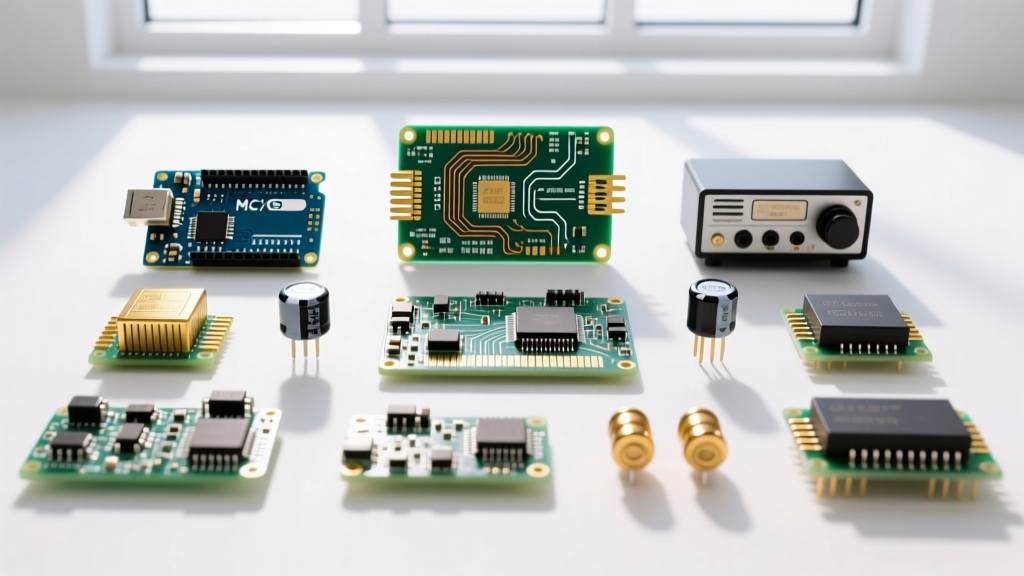
- Transistors: Bipolar Junction Transistors (BJTs), Metal-Oxide-Semiconductor Field-Effect Transistors (MOSFETs), and Insulated-Gate Bipolar Transistors (IGBTs).
- Integrated Circuits (ICs): Microcontrollers (MCUs), Digital Signal Processors (DSPs), Application-Specific Integrated Circuits (ASICs), and operational amplifiers.
- Optoelectronics: Laser diodes, photodetectors, and advanced LED drivers.
- Thyristors & Diodes: Silicon Controlled Rectifiers (SCRs) and Schottky diodes used for power rectification.
While passive components dictate signal conditioning and power filtering, active components are the 'brains' and 'muscles' of any modern PCB. Consequently, the active electronic components market is highly sensitive to technological paradigm shifts, geopolitical supply chain constraints, and raw material availability.
The 2026 Market Landscape: Bifurcation and Boom
As of 2026, the active electronic components market is defined by a stark bifurcation. According to data from the World Semiconductor Trade Statistics (WSTS), the global semiconductor market has surpassed the $650 billion mark, but this growth is not evenly distributed. We are witnessing a massive divergence between legacy-node discretes and advanced-node logic.
The AI and Edge Computing Catalyst
The insatiable demand for AI accelerators has monopolized advanced lithography nodes (3nm and 2nm). Foundries like TSMC and Samsung are prioritizing high-margin AI chips, which has indirectly squeezed capacity for mid-tier microcontrollers and FPGAs that share packaging and testing resources. For DIY engineers and small-batch manufacturers, this means that while a basic ATmega328P remains cheap and abundant, advanced edge-AI MCUs (like the NXP i.MX RT crossover series) frequently experience localized stockouts and 12-to-16-week lead times.
The Power Electronics Revolution: SiC and GaN
The most significant fundamental shift in the active market is the transition from silicon-based power switches to Wide Bandgap (WBG) materials. Silicon Carbide (SiC) and Gallium Nitride (GaN) are no longer niche; they are standard in 2026 EV powertrains, solar inverters, and high-density server power supplies. A standard silicon MOSFET like the IRF540N might cost $0.80, but a 900V SiC MOSFET (such as the Wolfspeed C3M0030090D) commands $12.00 to $18.00. Despite the premium, the reduction in switching losses and thermal management costs makes WBG components indispensable in modern high-power design.
Component Category Matrix: 2026 Sourcing Realities
To navigate the market effectively, engineers must understand the current lead times, pricing pressures, and primary demand drivers across different active component families.
| Component Category | 2026 Primary Demand Driver | Avg. Lead Time (Authorized) | Pricing Trend (YoY) |
|---|---|---|---|
| Standard Logic & Discretes | Automotive ECUs, IoT Sensors | 8 - 12 Weeks | Stable / Slight Decrease |
| 32-bit ARM MCUs | Industrial Automation, Drones | 14 - 20 Weeks | Stable |
| Power Management ICs (PMICs) | Edge Servers, Telecom | 16 - 24 Weeks | Moderate Increase |
| SiC / GaN Power Transistors | EV Inverters, Fast Chargers | 20 - 30 Weeks | Decreasing (Yield Improvements) |
| AI Accelerators / High-End FPGAs | Data Centers, Autonomous Systems | 30 - 52+ Weeks | High Increase |
Supply Chain Realities: Navigating the Gray Market
A critical fundamental lesson for any hardware designer is understanding the risks of the unauthorized or 'gray' market. When authorized distributors like Mouser, DigiKey, or Farnell show 'Out of Stock,' the temptation to source from unverified online marketplaces is high. In 2026, counterfeit active components remain a severe threat, particularly for high-value analog ICs and power regulators.
How Counterfeiters Operate
Modern counterfeiters do not simply build fake chips; they recycle e-waste. They desolder used components from discarded PCBs, sand off the original laser markings, re-tin the leads to look new, and print fake part numbers. A common failure mode in the field involves a remarked linear regulator (e.g., a fake TI LMR33630) that lacks the internal thermal shutdown circuitry, leading to catastrophic PCB fires under load.
Expert Sourcing Rule: Always verify your supplier via the Electronic Components Industry Association (ECIA) authorized distributor search. If you must use a broker for obsolete parts, mandate third-party testing, including X-ray inspection for die paddle alignment and decapsulation (using fuming nitric acid to expose the silicon die and verify the manufacturer's microscopic laser logo).
Strategic Design: Future-Proofing Your PCBs
To survive the volatility of the active electronic components market, design engineers must adopt 'multi-source' or 'drop-in replacement' strategies during the schematic capture phase. Relying on a single, highly specific active part is a recipe for production delays.
Designing for Pin-Compatibility
When designing power stages or microcontroller boards, allocate footprint space that accommodates multiple vendors. For example, if your design requires a 3.3V Low Dropout Regulator (LDO), choose a SOT-23-5 package that is pin-compatible across Texas Instruments, Microchip, and Diodes Inc. This allows your contract manufacturer (CM) to swap parts based on real-time inventory without requiring a PCB respin.
Software Abstraction for MCUs
Hardware abstraction layers (HAL) are no longer just for enterprise software. If you are designing a consumer IoT device, write your firmware using an RTOS and abstract the hardware layer so that if the STM32F4 series faces a 30-week shortage, you can pivot to a GD32 or an ESP32-S3 with minimal firmware rewriting. The market rewards designers who decouple their core logic from specific silicon vendors.
Manufacturing and Geopolitical Shifts
The physical manufacturing of active components is undergoing a massive geographic redistribution. Driven by the US CHIPS Act and the European Chips Act, new fabrication plants (fabs) are coming online in Arizona, Texas, and Germany throughout 2026 and 2027. However, as noted by SEMI (Semiconductor Equipment and Materials International), building a fab is only half the battle; the backend packaging and testing (OSAT) infrastructure remains heavily concentrated in Asia. This bottleneck in advanced packaging (like 2.5D/3D chiplets) is the primary constraint for high-performance active components today.
Frequently Asked Questions (FAQ)
Are passive components affected by the same market forces as active ones?
While both are subject to raw material costs (like palladium for MLCCs), passive components generally have shorter manufacturing cycle times (4-8 weeks) and lower barriers to entry. Active components require multi-billion-dollar fabs and months of processing, making their supply curves much more inelastic.
How can a hobbyist safely buy active components in 2026?
Hobbyists should stick strictly to authorized distributors (DigiKey, Mouser, Newark, LCSC's official direct store). Avoid third-party sellers on Amazon or eBay for critical ICs, as the risk of receiving remarked, out-of-spec, or degraded silicon is exceptionally high.
Will GaN and SiC eventually replace standard Silicon MOSFETs?
No. While Wide Bandgap materials dominate high-frequency and high-voltage applications, standard silicon MOSFETs remain vastly superior in cost-effectiveness for low-voltage, low-frequency applications (like basic 5V/12V switching). The market will sustain both chemistries for decades.
Conclusion
The active electronic components market in 2026 is a complex ecosystem driven by AI, electrification, and geopolitical realignment. By mastering the fundamentals of component physics, understanding the macro-level supply chain dynamics, and employing defensive, multi-source PCB design strategies, engineers and makers can build resilient hardware that withstands market volatility. Success in modern electronics requires treating component sourcing not as an afterthought, but as a core pillar of the engineering design process.