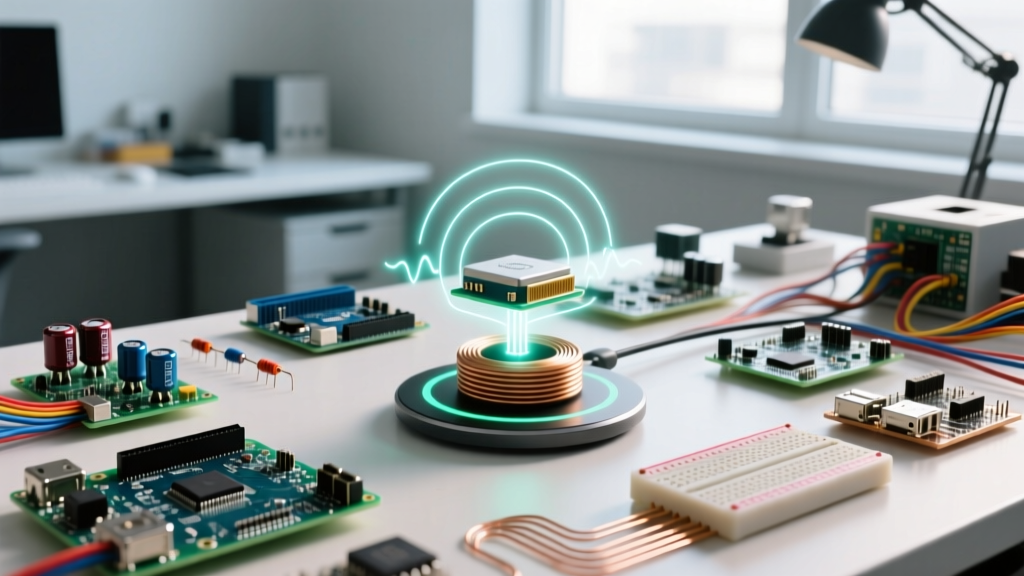

Can electricity be transmitted wirelessly? Yes. Wireless electricity transmission is the transfer of electrical energy from a power source to an electrical load without physical conductors, primarily utilizing electromagnetic induction, magnetic resonance, or radio frequency radiation. In a real circuit, replacing a hardwired connection with a wireless link eliminates physical contact wear and allows for hermetic sealing, but it fundamentally changes the design by introducing coupling coefficient dependencies, strict alignment tolerances, and unavoidable thermal losses. People most commonly confuse near-field magnetic coupling (which powers your phone and electric toothbrush) with far-field radiative transmission (beaming microwaves or lasers across a room), which remains highly inefficient and largely experimental.
The Core Methods of Wireless Power Transfer
Wireless power transfer (WPT) is not a single monolithic technology. The physics governing the transfer dictate the effective range, efficiency ceiling, and maximum power delivery. Engineers select the method based on the spatial gap between the transmitter (TX) and receiver (RX) coils or antennas. Below is a data-dense breakdown of how the primary methods stack up in real-world applications.
| Method | Operating Range | Typical Efficiency | Max Practical Power | Primary Use Case |
|---|---|---|---|---|
| Inductive (Near-Field) | 0 - 10 mm | 70% - 90% | 15W (Consumer) / 3.6kW (EV) | Smartphones, electric toothbrushes, basic EV pads |
| Magnetic Resonance | 10 mm - 250 mm | 80% - 95% | 11kW (Light EV) / 500W (Tools) | SAE J2954 EV charging, industrial robotics, cordless power tools |
| Radio Frequency (RF) | 1 m - 10+ m | < 1% - 5% | 1W - 5W (Harvesting) | RFID tags, IoT sensor wake-up, ultra-low power wearables |
| Optical / Laser | 10 m - 100+ km | 20% - 40% (Line of Sight) | 100W+ (Experimental) | Space-based solar beaming, drone mid-flight charging (Lab scale) |
The Physics of Coupling and Efficiency Loss
The primary penalty for wireless transmission is efficiency loss, which manifests as heat. In a hardwired circuit, electrons flow through a low-resistance copper path. In an inductive wireless circuit, energy is transferred via an alternating magnetic field. If the TX and RX coils are not perfectly aligned, or if the air gap increases, the coupling coefficient (k) drops, and magnetic flux leaks into the surrounding environment rather than crossing the gap.
Let us look at a concrete numeric example comparing a 15W Qi-certified wireless smartphone charger against a 15W USB-C Power Delivery (PD) wired connection to understand the thermal reality.
- Wired (USB-C PD): The wall adapter outputs 15W. With high-quality copper cabling and an efficient onboard Power Management IC (PMIC), the transfer efficiency is roughly 95%. The battery receives ~14.25W. The system loses 0.75W, which dissipates as barely noticeable warmth across the cable and phone chassis.
- Wireless (Qi Inductive): To push 15W into the receiver coil, the transmitter coil must draw significantly more power from the wall to overcome flux leakage and eddy currents induced in the phone's aluminum or steel chassis. The end-to-end efficiency (wall-to-battery) drops to roughly 65%. To deliver 15W to the battery, the transmitter draws ~23W from the wall. The system loses 8W. That 8W of wasted energy manifests as concentrated heat directly against the lithium-ion cell.
This 8W thermal penalty is exactly why wireless charging triggers battery thermal throttling, slows down charge times, and degrades long-term cell health faster than wired charging. To mitigate this, modern Qi2 implementations use active cooling fans in the TX pad and precise magnetic alignment rings to maximize the coupling coefficient.
Where You Meet This in Practice
Wireless power is no longer a parlor trick; it is engineered into critical infrastructure and high-reliability systems where physical connectors are a liability.
Electric Vehicles (SAE J2954)
While consumer EV charging relies on heavy, liquid-cooled cables, wireless EV charging uses magnetic resonance. According to the SAE J2954 standard, light-duty vehicles can accept up to 11kW wirelessly. Because resonance allows for a larger air gap (typically 100mm to 250mm to account for vehicle ground clearance and suspension compression), it achieves 85% to 93% efficiency. This enables automated fleet charging, where autonomous taxis simply park over a pad without requiring robotic arms to plug in a physical connector.
Medical Implants
Active implantable medical devices (AIMDs) like pacemakers and neurostimulators require hermetic titanium encapsulation to prevent bodily fluids from corroding the electronics. Running a physical wire through the skin creates a permanent pathway for infection. Inductive WPT allows these devices to be recharged transcutaneously (through the skin) using a wearable external TX coil, maintaining a sterile biological barrier.
Industrial Automation and Robotics
In automated guided vehicles (AGVs) and rotary indexing tables, physical slip rings and drag chains wear out, generate conductive dust, and require maintenance. WiTricity magnetic resonance technology and similar resonant inductive systems allow power to be transferred across rotating joints or through sealed plastic housings in washdown environments (IP69K rated), completely eliminating mechanical contact wear.
Common Misconceptions and Far-Field Limits
The most persistent myth in WPT is the idea of 'room-scale' wireless power, where a single transmitter on the ceiling beams usable wattage to any device in the room. This confuses near-field inductive coupling with far-field RF radiation.
In the far-field, RF energy obeys the inverse-square law. If you double the distance between the transmitter and the receiver, the power density drops to 25%. To safely beam 5W of power across a 5-meter room using 2.4 GHz or 5 GHz microwave frequencies, the transmitter would need to output hundreds of watts. This would wildly exceed FCC and ICNIRP Specific Absorption Rate (SAR) limits for human exposure, effectively cooking the water molecules in anyone walking through the beam.
Consequently, true room-scale WPT is currently limited to microwatt-level energy harvesting—enough to wake up a low-power IoT sensor or trickle-charge an e-ink display, but entirely useless for charging a smartphone or running a laptop. High-power wireless transmission over long distances remains strictly confined to line-of-sight laser or microwave links in aerospace and military applications, where human exposure can be strictly controlled.
Frequently Asked Questions
Does wireless charging damage my phone battery?
Not directly, but the heat generated by the 20-30% efficiency loss accelerates lithium-ion degradation. Keeping your phone cool (e.g., removing thick cases, using a pad with an active cooling fan) mitigates this risk.
Can wireless power transfer work through metal?
Standard inductive charging (Qi) fails through thick metal because the alternating magnetic field induces eddy currents in the metal, which block the field and generate dangerous heat. However, specific low-frequency magnetic resonance systems can be tuned to transfer power through thin metallic barriers or specialized metamaterial shielding.
What is the difference between Qi and Qi2?
Qi relies on flat coil alignment, where misalignment causes massive efficiency drops. Qi2 introduces a magnetic alignment profile (similar to Apple's MagSafe), physically snapping the TX and RX coils into perfect alignment, ensuring a higher coupling coefficient and more consistent 15W delivery.


