
AC (alternating current) voltage is an electrical potential difference that periodically reverses direction and changes its magnitude continuously with time, typically following a sinusoidal waveform. When you ask "what is an AC voltage" on a jobsite or at the workbench, you are really asking about how this reversing potential transfers power, stresses insulation, and dictates the test equipment you need to measure it safely.
The Core Definition: How AC Voltage Behaves
Unlike DC voltage, which maintains a constant polarity and magnitude (like a battery pushing electrons in a single direction), AC voltage alternates. Think of a two-person crosscut handsaw: one person pulls while the other pushes, then they reverse. Both the push and the pull do the work of cutting the wood. Similarly, in an AC circuit, electrons do not travel in a continuous loop from the power plant to your house; they slosh back and forth in place, transferring energy through the alternating electromagnetic field.
In North America, this reversal happens 60 times a second (60 Hz), while in Europe and much of the rest of the world, it happens 50 times a second (50 Hz). The voltage starts at zero, rises to a positive peak, falls back through zero to a negative peak, and returns to zero, completing one full cycle.
RMS vs. Peak: The Numbers That Actually Matter
The most critical concept in AC theory is that the number printed on the wall plate is not the maximum voltage the wire actually sees. In a real installation, the distinction between RMS and peak AC voltage changes two critical design parameters: thermal sizing (based on RMS) and dielectric insulation (based on Peak).
Worked Numeric Example: The 120V Wall Outlet
Let us break down the exact voltages present in a standard North American residential branch circuit:
- Nominal RMS Voltage: 120V AC. This is the Root Mean Square value. It represents the equivalent DC voltage that would produce the exact same heating effect in a resistive load (like a space heater). Breakers and wire ampacity are sized based on this RMS heating value.
- Peak Voltage: 169.7V. Calculated as $V_{peak} = V_{rms} \times \sqrt{2}$ (120 × 1.414). This is the absolute maximum voltage the insulation must withstand at the crest of the sine wave.
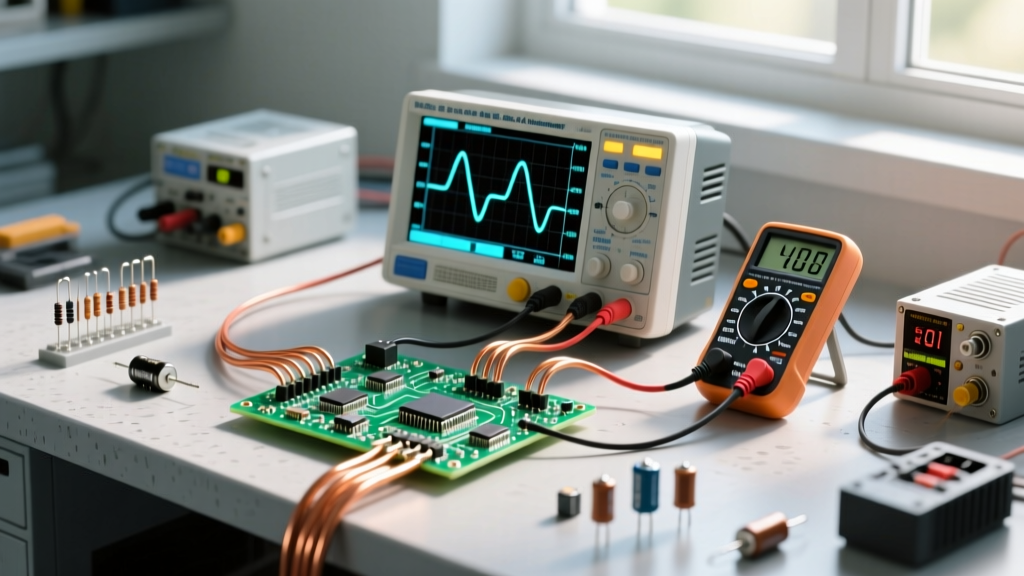
- Peak-to-Peak Voltage: 339.4V. The total voltage swing from the positive peak to the negative peak ($169.7 \times 2$). This is the value you will see when measuring with an oscilloscope.
Where You Meet AC Voltage in Practice
AC voltage is not just the mains power in your walls. You will encounter it across several distinct domains in electrical and electronics work:
- Mains Power Distribution: 120V/240V (North America) or 230V/400V (Europe). This is the primary domain of electricians, involving NM-B cable, THHN in conduit, and panelboards.
- Audio Signals: Audio is essentially low-voltage AC. Line-level signals are roughly 1V AC, while speaker-level outputs from an amplifier can swing 30V to 50V AC. Here, frequency response and waveform distortion matter far more than raw power.
- Motor Drives and VFDs: Variable Frequency Drives synthesize AC voltage for 3-phase motors using high-frequency Pulse Width Modulation (PWM). The output is a choppy, high-dV/dt AC waveform that can cause insulation breakdown in standard motors if they are not inverter-duty rated.
- Control Circuits: 24V AC is the standard for HVAC thermostats, irrigation solenoids, and industrial control transformers because it is class II (low voltage) and inherently limits fault currents.
Common Confusions: What AC Voltage Is Not
When troubleshooting, misinterpreting AC voltage values leads to blown components and misdiagnosed circuits. Watch out for these specific traps:
Confusion 1: Equating Multimeter Readings with Peak Voltage.
A standard digital multimeter (DMM) displays the RMS value, not the peak. If your meter reads 240V AC on a dryer outlet, the actual peak voltage hitting the control board's capacitors is nearly 340V. Designing filter capacitors based on the meter's RMS reading will result in catastrophic dielectric failure.
Confusion 2: The "Average" Voltage Fallacy.
People often ask what the "average" AC voltage is. Mathematically, the true average of a pure sine wave over one complete cycle is exactly 0V, because the positive half perfectly cancels out the negative half. When technicians refer to the "average" of an AC waveform, they are usually referring to the rectified average (the average of the absolute values), which is roughly 0.9 times the RMS value for a pure sine wave. Do not confuse rectified average with RMS.
Confusion 3: True RMS vs. Average-Responding Meters.
Cheap multimeters do not actually calculate RMS. They measure the rectified average and multiply it by a fixed constant (1.11) to display an RMS number. This only works for perfect sine waves. If you measure the AC voltage output of a modern switching power supply or a dimmer circuit with an average-responding meter, the reading will be wildly inaccurate. For non-linear loads, you must use a True RMS meter as detailed by Fluke's engineering guidelines.
Decision Path: Selecting Your AC Measurement Tool
Choosing the right tool to measure AC voltage depends entirely on the waveform characteristics of your target circuit. Use this decision tree to select the correct equipment, terminating in a specific, reliable model for your bench or truck.
| Application Scenario | Waveform Characteristic | Required Tool Category | Concrete Pick (Model) |
|---|---|---|---|
| Standard residential mains (60Hz), basic HVAC, linear loads | Pure sine wave, low harmonic distortion | True RMS Digital Multimeter (CAT III/IV) | Fluke 117 True RMS Multimeter |
| Industrial VFDs, switching power supplies, LED drivers | High harmonic distortion, non-linear, high-frequency noise | True RMS DMM with Low-Pass Filter | Fluke 87V Industrial Multimeter |
| Debugging PWM synthesis, transient hunting, audio phase, or VFD carrier frequencies | High-frequency, non-repetitive, complex or chopped waveforms | Digital Storage Oscilloscope (DSO) with high-voltage differential probe | Rigol DS1054Z 50MHz Oscilloscope |
Default Recommendation: If you only buy one tool for general electrical and electronics work, buy the Fluke 117. Its True RMS capability, non-contact voltage detection (VoltAlert), and low-impedance (LoZ) mode to eliminate ghost voltages make it the definitive baseline for AC voltage measurement.
FAQ: Quick Answers on AC Voltage
Why is AC used instead of DC for the power grid?
Historically, AC won the "War of the Currents" because transformers allow AC voltage to be easily stepped up to hundreds of thousands of volts for efficient long-distance transmission (minimizing $I^2R$ heating losses), and then stepped down to 120V/240V for safe consumer use. While modern High-Voltage DC (HVDC) is now used for specific ultra-long-distance point-to-point links, AC remains the standard for grid distribution due to the simplicity and robustness of AC transformers and switchgear.
Can I use a DC-rated capacitor on an AC circuit?
Generally, no. A capacitor rated for 100V DC may fail catastrophically if subjected to 50V AC. AC voltage continuously reverses polarity, which causes dielectric heating and stress that DC-rated electrolytic capacitors are not designed to handle. Furthermore, the AC peak voltage must be considered. Always use capacitors specifically rated for AC applications (like X2 or Y2 safety capacitors for mains filtering) or ensure your DC film capacitors have a voltage rating at least double the AC peak voltage.
What happens if I measure AC voltage with my multimeter set to DC?
If you probe a standard 120V AC outlet with your meter set to DC voltage, the meter will typically read close to 0V (or display a fluctuating, meaningless low number). This is because the DC setting measures the mathematical average of the incoming signal, and the average of a symmetrical AC sine wave is zero. This will not damage a modern, properly fused CAT-rated multimeter, but it will give you a false sense of security if you are using the meter to verify a circuit is de-energized. Always test AC circuits with the meter set to AC.
For a deeper dive into the mathematics of AC waveforms and phasor diagrams, refer to the Alternating Current textbook chapter on All About Circuits. Understanding the exact nature of the AC voltage you are working with is the difference between a circuit that runs for decades and one that fails on the first power cycle.