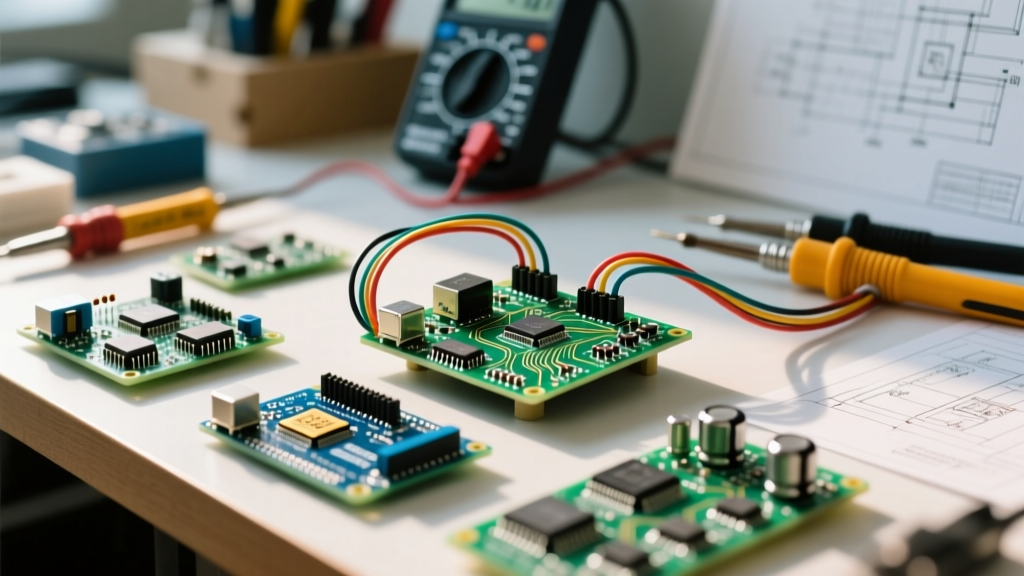
At its core, we use electricity to convert electrical potential energy into three specific types of useful work: thermal heat, electromagnetic mechanical force, and electrochemical or informational state changes. In a real circuit or installation, electricity changes the invisible flow of electrons into tangible physical action—spinning a rotor, heating a nichrome coil, or flipping a silicon logic gate from 0 to 1. While the utility company simply delivers electrons, the load dictates the job. People commonly confuse the delivery of electricity (voltage and current) with the work it performs, mistakenly assuming all 120V outlets provide the exact same functional utility regardless of the load's power factor, inrush characteristics, or continuous duty cycle.
The Three Fundamental Jobs of Electrical Energy
According to the U.S. Energy Information Administration (EIA), residential and commercial sectors consume billions of kilowatt-hours annually, but that raw energy is ultimately routed into three distinct physical phenomena at the point of use. Understanding these categories is critical for sizing wire, selecting breakers, and debugging circuits.
| Work Type | Physical Principle | Common Components | Circuit Design Impact |
|---|---|---|---|
| Thermal | Joule heating (I²R losses) | Space heaters, toasters, soldering irons, incandescent bulbs | High continuous current; requires strict wire ampacity and 125% NEC derating. |
| Electromagnetic | Lorentz force & magnetic induction | AC/DC motors, solenoids, relays, transformers | High inrush current (LRA); requires breakers with magnetic trip curves to tolerate startup spikes. |
| Informational / Electrochemical | Semiconductor switching & redox reactions | Microcontrollers, LEDs, Li-ion battery charging, logic gates | Low current, high sensitivity to voltage ripple, noise, and precise regulation. |
Worked Numeric Example: Sizing for Thermal vs. Electromagnetic Loads
To see how the purpose of the electricity changes your hardware selection, let us compare two common 120V, 60Hz loads: a 1500W ceramic space heater (thermal) and a 1/2 HP table saw motor (electromagnetic). We will assume copper conductors in the 75°C ampacity column.
1. The Thermal Load (1500W Heater)
- Running Current: P = V × I. Therefore, 1500W / 120V = 12.5 Amps.
- Power Factor: 1.0 (purely resistive).
- Inrush Current: Negligible. Cold resistance is slightly lower, but no massive spike.
- Sizing Outcome: Because a space heater is a continuous load (runs for 3+ hours), NEC Article 210.20 requires the breaker to be rated at 125% of the load. 12.5A × 1.25 = 15.625A. A standard 15A breaker will eventually trip from thermal fatigue. You must use a 20A breaker and 12 AWG wire.
2. The Electromagnetic Load (1/2 HP Motor)
- Running Current: 1/2 HP is roughly 373W mechanical output. Assuming 75% efficiency and a 0.8 power factor, electrical input is ~621W. 621W / 120V = 5.2 Amps.
- Inrush Current (LRA): Induction motors draw up to 600% of running current to establish the magnetic field. 5.2A × 6 = 31.2 Amps for a fraction of a second.
- Sizing Outcome: A standard 15A thermal-magnetic breaker is designed to tolerate brief magnetic spikes. 14 AWG wire (rated 15A) and a 15A breaker are perfectly fine here, as the running current is only 5.2A and the inrush is too brief to heat the wire or trip the thermal element of the breaker.
Where You Meet This in Practice
On the maker bench, you rarely deal with just one type of electrical work; you chain them together. Consider a DIY automated greenhouse vent system:
- Informational: An ESP32-WROOM-32 reads a BME280 sensor via I2C (3.3V logic, drawing ~80mA). The electricity here is used strictly to represent data states (1s and 0s).
- Electromagnetic: When the temperature hits 85°F, the ESP32 triggers a GPIO pin HIGH, driving an optocoupler and a logic-level MOSFET. This switches 12V at 2A to a linear actuator (a DC motor with a leadscrew) to physically push the window open.
- Thermal: The 12V-to-5V buck converter powering the ESP32 operates at 85% efficiency. The 15% loss is dissipated as waste heat. If you are pulling 1A at 5V (5W output), the converter must dissipate roughly 0.88W as thermal energy, requiring a small heatsink to prevent silicon thermal shutdown.
Recognizing which type of work is happening at each node dictates your PCB trace widths, your wire gauge, and your thermal management strategy.
Real-World Scenario Walkthrough: The Tripped Breaker Mystery
Let us look at a real-world failure where a DIYer misunderstood how different electrical work types interact on a single branch circuit.
The Setup: A hobbyist sets up a woodshop in a garage. They plug a 1500W electric heater (thermal) and a 15A-rated shop vacuum (electromagnetic/universal motor) into the same standard 15A, 120V duplex receptacle. It is a cold morning, so the heater is running while they start cutting wood.
The Numbers:
- Heater draw: 12.5A (continuous).
- Shop vac draw: 11A running, but universal motors have a high startup surge of roughly 3x, hitting ~33A for 200 milliseconds.
- Total running current if both operate simultaneously: 23.5A.
The Outcome: The hobbyist turns on the shop vac. The 15A breaker trips instantly with a loud snap, plunging the shop into darkness. The hobbyist resets it, turns on just the heater, and 20 minutes later, the breaker trips again, this time without the vac running.
What Went Wrong:
The DIYer treated electricity as a generic "power pool" rather than respecting the specific physical limits of the breaker's dual-trip mechanism.
- The First Trip (Magnetic): When the vac started, the combined instantaneous surge (12.5A + 33A = 45.5A) exceeded the breaker's magnetic trip threshold (usually 5x to 10x the rated current, or 75A-150A for a standard breaker, but the thermal element was already pre-heated by the 12.5A continuous load, lowering the magnetic trip point).
- The Second Trip (Thermal): A 15A breaker is physically designed to trip at 100% of its rating if held indefinitely, but NEC rules require continuous loads to be limited to 80% of the breaker rating (12A on a 15A breaker). The 12.5A heater slowly heated the bimetallic strip inside the breaker over 20 minutes until it mechanically unlatched.
The Fix: Move the heater to a dedicated 20A circuit with 12 AWG wire, respecting the continuous thermal limits of the breaker, and leave the electromagnetic tools on the 15A circuit where their brief inrush currents are safely tolerated.
Common Confusions: Power, Energy, and Signal
When asking what we use electricity for, beginners often conflate three distinct concepts:
- Signal vs. Power: A 5V USB cable carrying I2C data and a 5V power supply driving a 10A Peltier cooler both use 5 volts. However, the USB cable uses electricity for informational work (where current is measured in milliamps and impedance matching matters), while the Peltier uses it for thermal work (where current is massive and voltage drop across thin wires causes catastrophic performance loss).
- Power (Watts) vs. Energy (Watt-hours): Power is the rate at which work is done right now (like the speedometer on a car). Energy is the total work completed over time (like the odometer). A 100W soldering iron used for 6 minutes consumes the exact same electrical energy (10 Wh) as a 10W LED bulb left on for an hour. You pay your utility for energy, but you size your wires for power.
- AC vs. DC Utility: We use AC primarily for efficient long-distance transmission and driving heavy electromagnetic/thermal loads via transformers. We use DC for informational work (microchips require steady, unidirectional voltage to maintain logic states) and electrochemical work (batteries can only store and release energy via direct current).
FAQ: Practical Electricity Applications
Why do LEDs get hot if they are "informational/light" devices and not heaters?
LEDs are technically optoelectronic devices. While their primary purpose is to emit photons (light), the semiconductor junction is not 100% efficient. Typically, 30% to 40% of the electrical energy is converted to light, while the rest is converted to thermal energy (heat) at the die. If you do not provide a thermal path (heatsink) to move that heat away, the junction temperature rises, shifting the color wavelength and eventually destroying the silicon.
Can I use a standard dimmer switch on a power tool or vacuum?
Absolutely not. Standard TRIAC-based dimmers are designed exclusively for resistive thermal loads (incandescent bulbs) or specifically rated magnetic loads (dimmable LED drivers). Plugging an electromagnetic universal motor (like a vacuum) into a lighting dimmer will cause the chopped AC waveform to destroy the motor's windings and likely cause the dimmer's TRIAC to short-circuit and catch fire.
How does electricity perform electrochemical work in a DIY project?
When you charge a LiFePO4 battery pack or run an electrolysis cell to generate hydrogen, you are using electricity to force non-spontaneous chemical reactions. This requires precise constant-current/constant-voltage (CC/CV) regulation. Unlike a thermal heater that just consumes whatever current Ohm's Law dictates, electrochemical loads will draw excessive current and vent dangerous gases if the voltage exceeds the cell's specific chemical threshold (e.g., 3.65V per LiFePO4 cell).