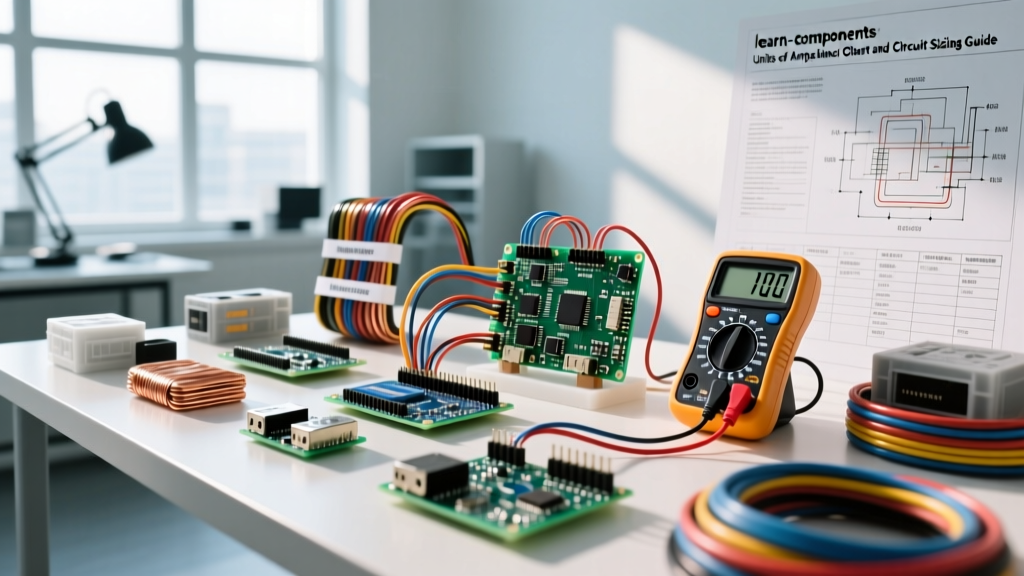

An ampere (amp) is the standard SI unit of electrical current, measuring the flow rate of one coulomb of electrical charge per second through a conductor. In a real circuit or installation, the amp value dictates everything physical: it determines your wire gauge (AWG), the thermal rating of your PCB traces, the trip threshold of your breaker, and the physical size of your heat sinks. Beginners most commonly confuse amps (the volume of flow) with volts (the pressure pushing the flow) or watts (the total work being done), and critically, they often mistake a motor's peak startup amps for its continuous running amps, leading to undersized breakers that nuisance-trip.
To visualize this, use the standard water pipe analogy: volts represent the water pressure from the pump, but amps represent the actual gallons per minute flowing through the pipe. A high-pressure system (high voltage) pushing a tiny trickle of water (low amps) delivers less total volume than a low-pressure river (low voltage) moving massive amounts of water (high amps). According to the National Institute of Standards and Technology (NIST), the ampere is one of the seven base SI units, anchoring all electrical calculations from microchip design to high-voltage transmission.
The Ampere Scale: From Microamps to Kiloamps
Current spans massive orders of magnitude depending on the domain. A neural signal in your brain operates in nanoamps, while a spot welder pulls kiloamps. When reading schematics or datasheets, you will rarely see the word 'ampere' spelled out; instead, you will see metric prefixes. Here is the definitive conversion scale you will encounter on the bench and the jobsite.
| Unit Name | Symbol | Multiplier | Decimal Equivalent | Typical Real-World Application |
|---|---|---|---|---|
| Microamp | µA | 10^-6 | 0.000001 A | ESP32 deep sleep current, CMOS logic gate leakage |
| Milliamp | mA | 10^-3 | 0.001 A | Arduino GPIO pin limits (20-40mA), LED forward current |
| Ampere | A | 10^0 | 1.0 A | Standard household branch circuits, 12V automotive accessories |
| Kiloamp | kA | 10^3 | 1,000 A | Utility fault currents, breaker interrupting ratings (e.g., 10kA IC) |
Worked Numeric Example: Sizing for a 1,500W Space Heater
Let's translate units of amps into a physical installation. You are wiring a dedicated 120V outlet for a 1,500W ceramic space heater in a workshop. What size wire and breaker do you need?
Step 1: Calculate the base amps.
Using the power formula (I = P / V), divide the wattage by the nominal voltage.
1,500W / 120V = 12.5 Amps
Step 2: Apply the continuous load rule.
Under NEC Article 210.20(A), if a load is expected to run for 3 hours or more (a continuous load), you must multiply the calculated amps by 125% to prevent the breaker from thermal-fatiguing and nuisance-tripping.
12.5A × 1.25 = 15.625 Amps
Step 3: Select the breaker and wire.
You cannot use a 15A breaker, as 15.625A exceeds its continuous rating. You must step up to the next standard breaker size, which is 20A. For a 20A breaker, NEC 310.16 requires a minimum of 12 AWG copper wire (rated for 20A in the 60°C column for standard NM-B cable terminations).
Where You Meet This in Practice
Understanding the units of amps isn't just about household wiring; it dictates component survival across three major DIY domains.
1. Multimeter Fuses and the 'mA' Jack Trap
Every digital multimeter has two current jacks: one labeled 'mA/µA' and one labeled '10A'. The mA jack is protected by a delicate internal fuse (usually rated for 0.4A or 0.5A). If you plug your probes into the mA jack and attempt to measure a 2A laptop power supply draw, you will instantly blow the internal fuse. Always start on the 10A jack, read the value, and only switch to the mA jack if the reading is below 0.4A and you need higher resolution.
2. PCB Trace Widths and Thermal Limits
On a printed circuit board, copper traces act as microscopic wires. According to the IPC-2152 standard, pushing 1 Amp through a standard 1 oz copper trace requires a minimum width of roughly 10 to 12 mils for internal layers to keep the temperature rise below 10°C. If you design a motor driver board and route 5 Amps through a 10-mil trace, the copper will act as a heating element, delaminating the FR4 fiberglass and destroying the board. Use an online trace width calculator and pour extra copper or add solder jumper wires for high-amp paths.
3. Battery C-Ratings and BMS Limits
When building LiFePO4 or 18650 lithium packs, capacity is measured in Amp-hours (Ah), but discharge capability is measured in Amps. A 3,000mAh (3Ah) cell with a 1C discharge rate can only safely deliver 3 Amps continuously. If your drone pulls 15 Amps, that cell will overheat and vent. You must parallel cells or select high-drain cells (like the Sony VTC6, rated for 15A continuous) to meet the amp demand without triggering the Battery Management System (BMS) overcurrent protection.
Decision Path: Selecting Wire and Breaker for Your Amp Load
Use this decision framework to translate your calculated amp load into physical materials. This assumes standard copper conductors, 120V/240V AC residential or light commercial environments, and ambient temperatures not exceeding 86°F (30°C).
| If Your Calculated Continuous Load Is... | Then Select This Wire (Copper) | And This Breaker / Protection |
|---|---|---|
| < 500 mA (Electronics / LEDs) | 24 AWG to 28 AWG stranded | 0.5A or 1A fast-blow glass fuse |
| 1A to 12A (Lighting / Small Appliances) | 14 AWG NM-B or THHN | 15A standard or AFCI breaker |
| 12.1A to 16A (Heaters / Microwaves) | 12 AWG NM-B or THHN | 20A standard or AFCI breaker |
| 16.1A to 24A (Window AC / Welders) | 10 AWG THHN in conduit | 30A standard breaker |
| > 24A (Subpanels / EV Chargers) | Calculate per NEC 310.16 tables | Consult AHJ / Licensed Electrician |
| Default Safe Pick (General 120V DIY) | 12 AWG Copper Wire | 20A Breaker |
Frequently Asked Questions About Amp Units
Why does my multimeter read '0.00' when I try to measure current?
To measure amps, the multimeter must become part of the circuit. You cannot measure current in parallel like you do with voltage. You must break the circuit and place the meter in series so the current flows through the meter's internal shunt resistor. Furthermore, ensure your probes are plugged into the correct amp jacks, not the voltage (VΩ) jacks, or the meter will read zero (or blow a fuse if placed in parallel across a voltage source).
What is the difference between 'Amp-hours' (Ah) and 'Amps' (A)?
Amps measure the instantaneous rate of flow, while Amp-hours measure total capacity over time. A 100Ah battery can theoretically deliver 1 Amp for 100 hours, or 10 Amps for 10 hours. However, due to Peukert's Law in lead-acid batteries (and internal resistance in lithium), pulling higher amps reduces the effective total Ah capacity. Always size your battery bank based on the continuous amp draw, not just the Ah rating.
Do I need to worry about 'Peak Amps' vs 'RMS Amps'?
Yes, especially with AC motors and compressors. A refrigerator compressor might draw 2 Amps RMS (continuous running current) but pull 12 Amps peak (Locked Rotor Amps) for a fraction of a second during startup. Standard thermal-magnetic breakers are designed to tolerate this brief magnetic spike without tripping. However, if you are sizing an inverter or a smart relay, you must ensure the component's peak surge rating exceeds the motor's startup amps, or the inverter will fault out every time the compressor kicks on.


