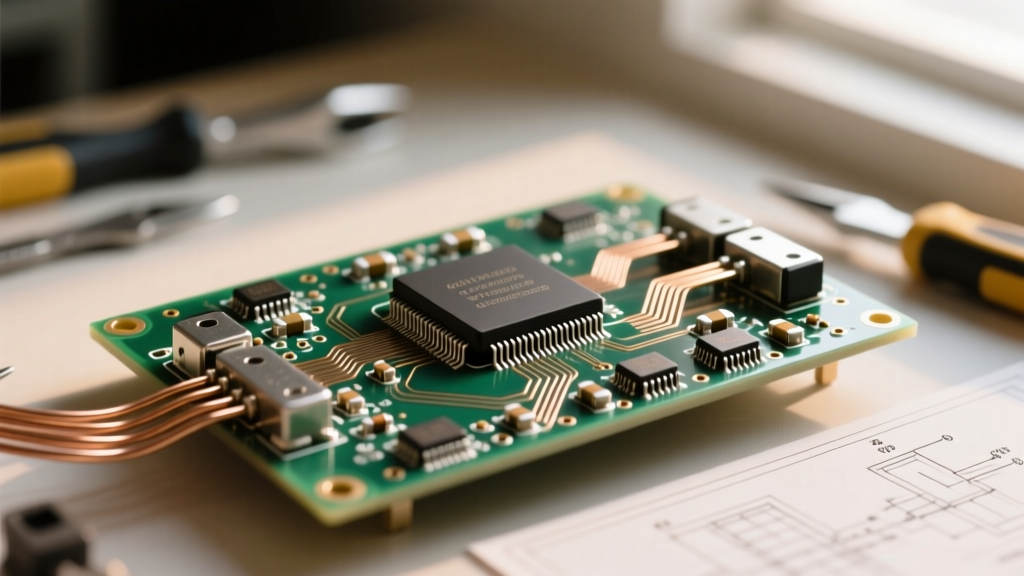
The unit of amperage is the ampere (commonly shortened to 'amp' and symbolized as A), which measures the rate of electron flow through a conductor, defined precisely as one coulomb of electrical charge passing a specific point in one second. When you look at a circuit, amperage is the single most critical variable for determining physical hardware requirements because it directly dictates wire thickness, heat generation, and overcurrent protection sizing. While voltage represents the potential to do work, it is the unit of amperage that actually performs the work and creates the thermal stress in your components.
What the Unit of Amperage Actually Measures
In 2019, the scientific community updated the NIST definition of the ampere to anchor it to a fixed numerical value of the elementary charge ($e$). In practical bench and jobsite terms, however, we still treat it as the volume of electrical current moving through a path.
The most common mistake hobbyists and DIYers make is confusing amperage with voltage or wattage. Voltage (Volts) is the electrical pressure pushing the electrons, while wattage (Watts) is the total rate of energy consumption or work performed. Amperage is strictly the flow rate. To use the standard water analogy: if voltage is the water pressure in your municipal supply line, the unit of amperage is the actual volume of water (gallons per minute) flowing out of the hose.
Amperage dictates the physical mass of copper required to carry a load safely. As current increases, resistive heating ($I^2R$) increases exponentially. If you push 25 amps through a 14 AWG wire designed for 15 amps, the copper will overheat, melt the insulation, and start a fire long before the wire acts as a fuse. Therefore, higher amperage demands thicker wire (a lower AWG number) and larger overcurrent protective devices.
Current is measured in several scales depending on the application:
- Amperes (A): Used for mains wiring, appliances, and high-power DC systems (e.g., a 15A branch circuit or a 40A EV charger).
- Milliamperes (mA): One-thousandth of an amp. Used for control circuits, LEDs, and microcontrollers (e.g., an ESP32 drawing 80mA).
- Microamperes (µA): One-millionth of an amp. Used for deep-sleep modes and sensor quiescent currents (e.g., a CMOS chip drawing 2µA in standby).
Worked Numeric Example: Branch Circuit Sizing
To understand how the unit of amperage drives real-world installation decisions, let's size a dedicated 120V outlet for a 1,500W portable space heater. This is a classic scenario where ignoring continuous load rules leads to nuisance tripping or melted receptacles.
First, we calculate the baseline current using Ohm's Law derivative ($I = P / V$):
1,500W / 120V = 12.5 Amps
At 12.5A, it seems logical to wire this to a standard 15-amp breaker using 14 AWG NM-B (Romex) cable, since 12.5 is less than 15. However, the National Electrical Code (NEC) classifies a space heater as a 'continuous load' because it is expected to run for three hours or more. NEC Article 210.20(A) requires continuous loads to be derated to 125% of the breaker's rating.
| Parameter | Standard 15A Circuit | Dedicated 20A Circuit (Required) |
|---|---|---|
| Baseline Load | 12.5 Amps | 12.5 Amps |
| Continuous Load Multiplier (125%) | 15.625 Amps | 15.625 Amps |
| Breaker Size Needed | Fails (Exceeds 15A limit) | 20 Amp Breaker |
| Minimum Copper Wire (60°C Column) | N/A (Unsafe) | 12 AWG NM-B |
| Receptacle Type | 15A Duplex | 20A Receptacle (or 15A on a 20A circuit per NEC 210.21(B)(3)) |
Because 15.625A exceeds the 15A breaker limit, you must step up to a 20A breaker. Consequently, you must upgrade the wire from 14 AWG to 12 AWG copper to match the breaker's ampacity. This single calculation shows how the unit of amperage directly dictates the materials you buy at the hardware store.
Where You Meet This in Practice
You will encounter current measurements constantly, whether you are debugging a PCB on the bench or troubleshooting a subpanel in the garage. Here is how amperage manifests in daily electrical work:
Multimeter Fuses and Measurement Technique
To measure the unit of amperage with a standard digital multimeter (DMM), you must break the circuit and place the meter in series so the current flows through the meter's internal shunt resistor. A classic bench mistake is leaving the DMM probes in the current jacks and then probing a voltage source in parallel. This creates a dead short through the meter's shunt, instantly blowing the internal fuse—or worse, vaporizing the shunt and destroying the meter. Always verify your probe positions before testing. High-end meters use a high-breaking-capacity (HBC) ceramic 10A fuse to prevent catastrophic arc flashes, while cheap meters use glass fuses that can literally explode inside the casing.
Component Datasheets and Microcontrollers
When designing embedded systems, tracking milliamps is critical for power budgeting. For example, an ESP32-WROOM-32 module might draw 240mA during peak WiFi transmission but only 10µA in deep sleep. If you are sizing a LiFePO4 battery pack and a low-dropout (LDO) voltage regulator for this project, you must calculate the quiescent current (the amps the regulator consumes just to stay on) to ensure your battery doesn't drain while the device is asleep.
Battery Discharge and C-Ratings
In DC power systems, amperage defines how fast you can safely pull energy from a battery. Lithium cells use a 'C-rating' to express maximum continuous discharge current. A 18650 cell with a 2,500mAh capacity and a 1C rating can safely deliver 2.5 amps continuously. If your drone's motors demand 15 amps, you must either use cells with a higher C-rating (like a 20C LiPo pack) or wire multiple cells in parallel to divide the amperage load across them.
Frequently Asked Questions About the Unit of Amperage
Is the unit of amperage the same as watts?
No. Amperage measures the flow rate of electrons (current), while watts measure the total power consumed or produced. They are related by the formula Watts = Volts × Amps. For example, a 120V circuit drawing 10 amps consumes 1,200 watts. A 12V DC circuit drawing 100 amps also consumes 1,200 watts. The amperage is vastly different, but the total power (watts) is identical.
How do you convert the unit of amperage to volts?
You cannot directly convert amps to volts because they measure fundamentally different physical properties. However, if you know the resistance of the circuit, you can calculate the voltage drop using Ohm's Law ($V = I imes R$). For instance, if 5 amps of current flows through a wire with 0.2 ohms of resistance, the voltage drop across that specific wire is 1 volt.
Why do multimeters blow fuses when measuring the unit of amperage?
Multimeters blow fuses during current measurements almost exclusively because the user places the meter in parallel with a voltage source instead of in series with the load. The amperage measurement jacks on a DMM have very low internal resistance (often less than 0.1 ohms) to avoid altering the circuit being tested. When placed across a voltage source, this low resistance creates a massive short circuit, driving hundreds of amps through the meter and instantly blowing the protective fuse.
What is the difference between amps and amp-hours?
Amps measure the instantaneous rate of current flow right now. Amp-hours (Ah) measure the total capacity or volume of electrical charge a battery can store and deliver over time. Think of amps as the speedometer in your car (miles per hour), and amp-hours as the fuel tank capacity (gallons). A 100Ah battery can theoretically deliver 1 amp for 100 hours, or 10 amps for 10 hours, before it is fully depleted.