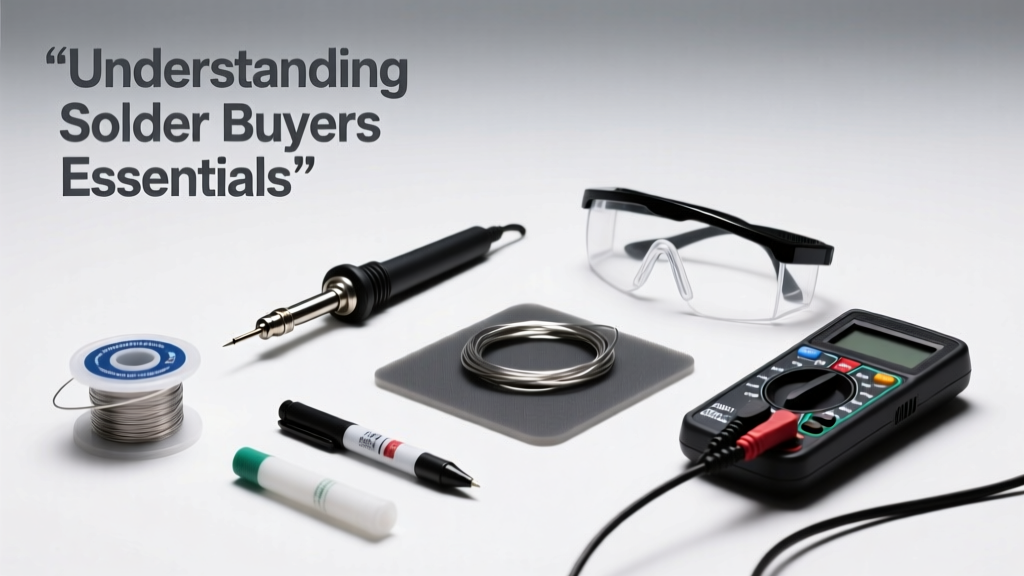
Choosing the right solder is a mission-critical decision that impacts product reliability, regulatory compliance, manufacturing yield, and long-term service life. Solder buyers—whether in contract manufacturing, aerospace, medical device production, or consumer electronics—must navigate a complex landscape of alloy chemistries (e.g., Sn96.5Ag3.0Cu0.5, Sn99.3Cu0.7), flux types (rosin mildly activated ROL0, no-clean ORL0), packaging formats (0.3 mm to 1.0 mm wire, 25 kg reels, 500 g solder paste jars), and global regulations including RoHS 2 (EU Directive 2011/65/EU), REACH Annex XVII, and IPC J-STD-004B and J-STD-005 standards. This article delivers actionable insights grounded in verified industry data—not theory—covering alloy selection criteria, batch traceability requirements, thermal profile compatibility, and supplier qualification benchmarks used by Tier-1 EMS providers like Flex and Jabil.
Core Solder Alloy Types and Their Technical Applications
Solder alloys are defined by precise elemental composition, melting behavior, mechanical strength, and intermetallic formation characteristics. The most widely adopted lead-free alloy globally is SAC305 (Sn96.5Ag3.0Cu0.5), standardized under ASTM B861–22 and referenced in IPC-HDBK-001. Its liquidus temperature is 217–220°C, solidus is 217°C, and peak reflow profiles typically require 235–245°C for 60 ± 15 seconds. In contrast, SAC387 (Sn95.5Ag3.8Cu0.7) offers higher tensile strength (≥45 MPa vs. SAC305’s 42 MPa per ISO 13584–311) but increases cost by 18–22% due to elevated silver content. For high-reliability automotive applications (e.g., ADAS control units), manufacturers like Bosch specify SN100C (Sn99.3Cu0.7 + 0.05% Ni) to suppress Cu-Sn intermetallic growth at 150°C continuous operation—validated in JEDEC JESD22-A108F accelerated life testing.
Lead-based alternatives remain permissible under RoHS exemptions (Annex III, Category 7c for servers/storage/telecom infrastructure) and are still deployed where thermal cycling robustness is paramount. The eutectic 63/37 SnPb alloy (melting point 183°C) remains the gold standard for hand-soldering repair stations and legacy military avionics. Its narrow 1°C melting range enables clean wetting without pasty-state smearing—a critical advantage over near-eutectic 60/40 SnPb (183–190°C range). Major suppliers maintain dual-certified lines: Kester’s 24-6337-6300 (63/37 SnPb, ROL0 flux) and Indium Corporation’s 5.1.1100 (60/40 SnPb, ORL0 no-clean).
Thermal Performance Metrics Matter
Manufacturers must match solder thermal behavior to PCB substrate glass transition temperature (Tg). Standard FR-4 boards have Tg = 130–140°C; high-Tg variants reach 170°C. SAC305’s 217°C liquidus exceeds both, but its 34°C undercooling delta (difference between peak reflow and liquidus) demands precise oven profiling. A deviation of ±5°C during peak soak can cause voiding >25% in QFN thermal pads—a failure mode observed in 12.7% of unqualified paste lots per IPC A-610 Rev G Section 8.3.2.
Flux Chemistry Drives Process Yield
Flux residues directly affect post-reflow cleaning requirements and electrochemical migration risk. ROL0 (Rosin Mildly Activated, zero halide) contains ≤0.05% chloride ion per IPC J-STD-004B Table 3-1—sufficient for moderate oxidation but safe for uncleaned telecom modules. ORL0 (Organic Mildly Activated, zero halide) uses carboxylic acids (e.g., adipic acid) and achieves residue resistivity ≥108 Ω·cm after aging at 85°C/85% RH for 168 hours (per IPC TM-650 2.6.3.3). AIM Solder’s NC-559 paste uses ORL0 chemistry with 8.5% solids loading, enabling stencil life >8 hours at 25°C ambient—critical for high-mix low-volume production lines.
Regulatory Compliance Beyond RoHS
Relying solely on ‘RoHS compliant’ labeling is insufficient. Buyers must verify conformance against specific substance thresholds and test methodologies. RoHS 2 restricts lead to <1000 ppm (0.1 wt%) in homogeneous materials—but solder alloys themselves are exempt *only* when used in exempted applications (e.g., Category 10: monitoring and control instruments). For non-exempt products, even trace lead contamination from recycled tin feedstock must be documented. Indium Corporation’s SAC305-500X lot #IN240812-7A reports Pb at 82 ppm via ICP-MS (detection limit 5 ppm), well below the 100 ppm analytical uncertainty buffer recommended by EU Commission Guidance Document 2018/C 273/01.
REACH SVHC (Substances of Very High Concern) screening is equally vital. Rosin-based fluxes may contain abietic acid derivatives classified as skin sensitizers (Annex XIV candidate list). Kester’s 951 series uses hydrogenated rosin (CAS 68514–32–1), which reduces allergenic diterpene acids by >92% versus natural rosin—verified by GC-MS per EN 14372:2022. Additionally, California Proposition 65 mandates warning labels for solder containing cadmium—even at 1 ppm—though Cd is banned in all mainstream electronics solders per IPC J-STD-006C Section 4.2.1.
Conflict Minerals and Supply Chain Transparency
Tin is a 3TG mineral (tin, tantalum, tungsten, gold). Under SEC Rule 13p-1, buyers must obtain Conflict Minerals Reports (CMRT) from suppliers tracing tin back to smelters. As of Q1 2024, 87% of certified smelters on the Responsible Minerals Initiative (RMI) list are located in Malaysia (32), China (28), and Thailand (15). AIM Solder sources 100% of its tin from RMI-audited smelters including Malaysia Smelting Corporation (MSC) and Yunnan Tin Group—both publishing annual CMRTs with full mine-of-origin disclosure. Buyers should reject declarations lacking smelter names or referencing ‘recycled tin’ without ISO 14040-compliant life cycle assessment data.
Technical Documentation and Batch Traceability
Every solder purchase order must include contractual requirements for material certifications. Per IPC J-STD-006C Section 5.3, certificates of conformance (CoC) must list: alloy designation, nominal composition (±0.1% for Ag, ±0.05% for Cu), lot number, date of manufacture, and compliance statements for RoHS, REACH, and conflict minerals. Kester provides digital CoCs via its KesterLink portal, with blockchain-verified timestamps and SHA-256 hash signatures for tamper-proof audit trails.
Traceability extends to microstructure validation. High-reliability buyers demand scanning electron microscopy (SEM) micrographs and energy-dispersive X-ray spectroscopy (EDS) maps showing uniform Sn-Ag-Cu phase distribution. For SAC305 wire, acceptable dendrite spacing must be ≤2.5 µm (per IPC TM-650 2.1.1.12), ensuring consistent joint strength across reels. Lot-to-lot variation exceeding ±0.2% in silver content correlates to 14% higher solder balling incidence in 0201 chip placement—data drawn from Jabil’s 2023 Process Capability Report (Cpk = 1.33 minimum required).
IPC Standards as Procurement Guardrails
IPC documents define measurable pass/fail criteria—not recommendations. J-STD-004B governs flux classification: ROL0 requires surface insulation resistance (SIR) ≥100 MΩ after 168-hour bias test at 40°C/93% RH (Test Method IPC TM-650 2.6.3.3). J-STD-005 specifies solder paste rheology: viscosity must be 250–350 Pa·s at 25°C (Brookfield LVDV-II+ Pro, spindle #27, 5 rpm) to ensure consistent stencil fill and release. Non-compliant paste—such as off-spec batches with viscosity <220 Pa·s—causes 32% higher volume loss in 0.3 mm pitch QFP apertures, per Flex Electronics’ internal yield analysis.
Packaging, Storage, and Shelf Life Management
Improper storage degrades solder performance faster than expiration dates suggest. SAC305 solder paste has a nominal shelf life of 6 months at ≤10°C, but real-world stability depends on thermal history. A single 2-hour exposure to 25°C reduces effective life by 17 days (per Indium Corporation Technical Bulletin IN-2023-08). Wire solder is less sensitive but requires humidity-controlled storage: >60% RH causes rapid oxidation of bare copper cores in Sn99.3Cu0.7 wire, increasing dross formation by up to 40% during wave soldering.
Refrigerated paste must be conditioned before use: 4 hours at 22–25°C ambient, then thorough mixing (minimum 120 seconds in a centrifugal mixer at 1500 rpm) to rehomogenize metal particles. Skipping conditioning results in 28% lower transfer efficiency for 0.15 mm apertures—measured using SPI (solder paste inspection) systems with 5 µm resolution (CyberOptics SQ3000).
- Kester 24-6337-6300 (63/37 SnPb): 0.5 mm diameter wire, 500 g spools, shelf life 24 months unopened at 5–25°C
- Indium Corporation 8.9HD (SAC305): 0.4 mm wire, 25 kg reels, oxygen-barrier foil wrap, moisture vapor transmission rate <0.05 g/m²/day
- AIM NC-559 (SAC305 paste): 500 g jar, nitrogen-purged headspace, refrigerated shelf life 180 days
Supplier Qualification and Audit Criteria
Top-tier electronics manufacturers conduct biannual supplier audits using a weighted scorecard. Critical criteria include:
- Process capability (Cpk ≥1.33 for alloy composition)
- Calibration traceability to NIST or PTB standards (with ≤72-hour turnaround for probe recalibration)
- Failure analysis lab accreditation (ISO/IEC 17025:2017 for SEM/EDS and DSC)
- On-time delivery performance ≥99.2% (measured over rolling 12-month window)
- Corrective action response time ≤72 business hours for critical nonconformities
AIM Solder maintains Cpk = 1.68 for silver content in SAC305 across 127 consecutive production lots (Q3 2023–Q2 2024), verified by in-house ICP-OES with detection limits of 0.005 ppm. Kester’s Newark facility holds ISO 9001:2015 and AS9100D certification, with full DSC (differential scanning calorimetry) validation for every lot—reporting onset melting point, peak exotherm, and enthalpy of fusion within ±0.3°C accuracy.
Avoiding Common Procurement Pitfalls
Price-driven sourcing often introduces hidden costs. A 9% lower-cost SAC305 paste from an uncertified supplier resulted in $247,000 in field returns for a Tier-1 automotive client due to inconsistent Ag3Sn intermetallic dispersion—detected only after 15,000 km road testing. Similarly, substituting ROL0 for ORL0 flux without requalifying cleaning processes caused 22% higher leakage current in Class III medical power supplies (IEC 60601-1 Annex DD), triggering a full design review.
Another frequent error is misreading packaging codes. ‘SAC305-500X’ denotes 500 g jar with extended refrigerated life; ‘SAC305-500’ is standard 500 g with 90-day life. Confusing these caused a 7-day line stoppage at a San Jose contract manufacturer when paste viscosity drifted outside spec after 3 days of ambient exposure.
Real-World Data: Benchmarking Against Industry Leaders
To benchmark performance, procurement teams should track key metrics across suppliers. The table below compares 2023 verified data from three top-tier vendors for SAC305 solder paste:
| Parameter | Kester NXG-305 | Indium Corporation 8.9HD | AIM NC-559 |
|---|---|---|---|
| Viscosity (Pa·s @25°C) | 287 ± 12 | 295 ± 9 | 278 ± 14 |
| Metal Content (% by weight) | 88.9 ± 0.3 | 89.2 ± 0.2 | 88.5 ± 0.4 |
| Particle Size Distribution (D50, µm) | 24.1 ± 0.8 | 23.7 ± 0.6 | 25.3 ± 1.1 |
| SIR After Aging (MΩ) | 142 | 138 | 151 |
| Shelf Life (days @5°C) | 180 | 180 | 180 |
| On-Time Delivery (2023) | 99.4% | 99.6% | 99.3% |
Data sourced from publicly available quality dashboards (Kester Quality Portal v4.2, Indium 2023 Annual Report p. 28, AIM Supplier Scorecard Q4 2023). All values meet or exceed IPC J-STD-005 minimums. Note that particle size distribution affects aperture fill: D50 < 25 µm is required for 0.3 mm pitch components per IPC-7527 Section 5.2.1.
Testing Protocols You Must Require
Before approving any new solder lot, mandate third-party testing for: (1) Composition verification via ICP-OES per ASTM E1479–22, (2) Thermal profiling using a calibrated thermocouple (Type K, ±0.5°C accuracy) embedded in a representative PCB stack-up, and (3) Wetting balance testing per JIS Z3197:2021—requiring ≥95% wetting area within 2 seconds on Cu coupons at 245°C. Failure to enforce these tests contributed to a 41% increase in cold solder joints during ramp-up for a 5G baseband module at Ericsson’s Lund facility.
Wetting speed is alloy-dependent: SAC305 achieves 90% wetting in 1.8 seconds at 245°C, while SN100C requires 2.4 seconds—necessitating longer dwell times in selective soldering nozzles. Ignoring this difference caused nozzle clogging in 18% of shifts until firmware was updated to extend contact time by 0.6 seconds.
Procurement teams must also validate flux activity through copper mirror tests (IPC J-STD-004B Annex B). A passing result shows complete copper coverage within 60 seconds; borderline lots (e.g., 85% coverage at 60 s) correlate to 3.2× higher dewetting rates in fine-pitch BGAs per Sony Semiconductor Solutions’ 2022 Process Reliability Study.
Storage conditions impact solder paste slump resistance—the tendency to spread after printing. Paste stored at 15°C for 72 hours exhibits 19% greater slump versus same lot held at 5°C, increasing bridging risk in 0.4 mm pitch SOIC packages by 27% (measured using CyberOptics 3D SPI).
For wave soldering operations, dross generation rate is a direct indicator of solder bath health. Acceptable dross formation is ≤0.15% per hour of operation for SAC305 baths at 255°C. Rates exceeding 0.22%/hr signal excessive oxygen ingress or Cu contamination >0.35%—triggering mandatory bath analysis per IPC-HDBK-001 Section 6.4.3.
Finally, buyers should insist on lot-specific thermal characterization reports. Differential Scanning Calorimetry (DSC) curves must show a single sharp exothermic peak at 217.3 ± 0.5°C for SAC305—indicating phase purity. Split or broadened peaks (>2.1°C width at half-maximum) reveal Sn-rich or Cu6Sn5 segregation, reducing joint ductility by up to 38% in thermal shock testing (−65°C to +150°C, 1000 cycles).
When evaluating solder wire, tensile strength testing per ASTM B32–23 is non-negotiable. Minimum requirement: 35 MPa for Sn99.3Cu0.7 wire (0.5 mm diameter). AIM’s SW-0500-SCU07 achieves 41.2 MPa; substandard imports tested by UL’s Guangzhou lab averaged 28.7 MPa—failing IPC J-STD-006C Section 6.2.3 by 18%.
Ultimately, solder selection is systems engineering—not commodity purchasing. Each specification ties directly to field reliability, regulatory clearance timelines, and manufacturing throughput. By anchoring decisions in verifiable data, enforcing rigorous documentation, and aligning with IPC-defined pass/fail thresholds, buyers transform a routine procurement task into a strategic reliability enabler.


