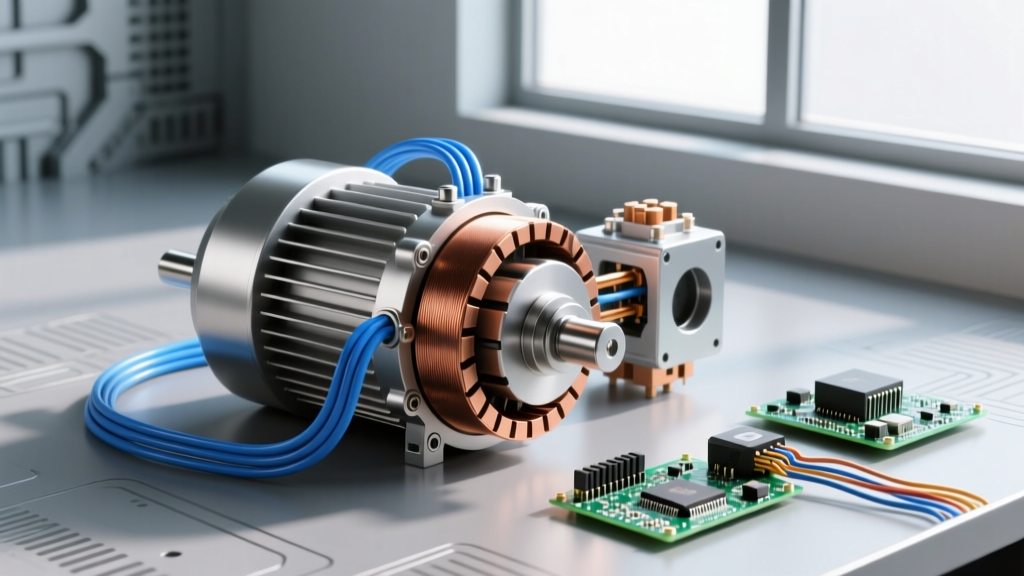

A three-phase motor works by passing three alternating currents—offset by exactly 120 electrical degrees—through stator windings to generate a rotating magnetic field (RMF). This RMF induces current in the rotor, creating a secondary magnetic field that chases the stator field, producing continuous rotational torque without the need for start capacitors or centrifugal switches. Unlike single-phase motors that require a mechanical or electrical "kick" to start, the inherent phase shift in a three-phase supply creates a naturally rotating field from the moment power is applied.
But understanding the physics is only half the battle on the shop floor. Knowing how does a three phase motor work theoretically must translate into selecting the right NEMA frame, wiring the terminal block correctly, and pairing it with the appropriate drive. Below is a decision-forward guide to sizing, wiring, and troubleshooting three-phase motors for real-world loads.
The Core Physics: Rotating Magnetic Fields and Slip
Inside the stator of a standard AC induction motor, three sets of windings are physically spaced 120 mechanical degrees apart. When fed by a 3-phase supply (e.g., 480V AC at 60Hz), the current in each winding peaks sequentially. This sequential peaking creates a magnetic field that rotates at a strict mathematical speed, known as synchronous speed.
You can calculate synchronous speed ($N_s$) using the formula:
$N_s = (120 \times f) / P$
Where f is frequency (Hz) and P is the number of poles. For a 4-pole motor on a 60Hz grid, $N_s = (120 \times 60) / 4 = 1800$ RPM.
However, a standard induction motor rotor will never quite reach 1800 RPM. If it did, it would be moving at the exact same speed as the magnetic field, meaning no magnetic lines would be "cut," no current would be induced, and torque would drop to zero. The rotor must lag slightly behind the RMF. This lag is called slip, typically 2% to 5% at full load. Therefore, your 1800 RPM synchronous motor will actually spin at roughly 1750 RPM under load, as defined by the NEMA MG 1 standard.
Motor Type Comparison: Induction vs. Synchronous vs. BLDC
While the squirrel-cage induction motor is the workhorse of industry, modern drives have made other three-phase topologies viable. Here is how they compare when selecting a motor for a specific load profile.
| Motor Type | Torque Curve & Slip | Control / Drive Needs | Relative Cost | Best Load Profile |
|---|---|---|---|---|
| AC Induction (TEFC) | High starting torque, 2-5% slip at full load. | DOL, Soft Start, or standard V/f VFD. | Low ($) | Pumps, fans, conveyors, compressors. |
| PMSM (Synchronous) | Zero slip, constant torque across speed range. | Requires VFD with sensorless vector or encoder feedback. | High ($$$) | Precision CNC, extruders, high-dynamic positioning. |
| BLDC (Brushless DC) | Trapezoidal back-EMF, high torque-to-inertia ratio. | Dedicated 3-phase ESC (Electronic Speed Controller). | Medium ($$) | Drones, RC models, small automated guided vehicles. |
Terminal Wiring & Identification: Wye vs. Delta
Most industrial three-phase induction motors (10HP and below) are dual-voltage, featuring 9 leads in the peckerhead (terminal box). Wiring these incorrectly will either result in a dead short, a motor running at half-speed with massive current draw, or a burned-out winding.
| Configuration | Target Voltage | Lead Grouping (9-Lead Motor) | Power Connections |
|---|---|---|---|
| Wye (Star) | High (e.g., 460V) | Tie 4-5-6 together; Tie 7-8-9 together | L1 to T1, L2 to T2, L3 to T3 |
| Delta | Low (e.g., 230V) | Tie 1-6-7; Tie 2-4-8; Tie 3-5-9 | L1 to 1-6-7, L2 to 2-4-8, L3 to 3-5-9 |
For a deeper dive into reading the specific data points on the motor tag, reference this guide on motor nameplate basics from Fluke.
Sizing Rule of Thumb & Worked Load Example
Never size a motor based solely on running horsepower. You must account for the load's starting torque and inertia. The rule of thumb for general machinery is to calculate the steady-state running load, then apply a 1.15 Service Factor (SF) margin, while verifying the motor's NEMA Design Letter can handle the breakaway torque.
Worked Example: Sizing a Motor for a 5HP Reciprocating Air Compressor
- Load Context: A reciprocating compressor requires roughly 150% of its running torque just to break away and start pumping against head pressure.
- Running Load: Measured at 4.2 HP (3.13 kW) at 1750 RPM.
- Starting Torque Demand: 4.2 HP × 1.5 = 6.3 HP equivalent breakaway torque.
- Motor Selection: A standard 5HP NEMA Design B motor produces roughly 130% starting torque. It will likely stall or trip the breaker on startup. We must select a 5HP NEMA Design C motor, which is specifically wound to deliver 200%+ starting torque while maintaining standard full-load slip.
- Current Draw: At 460V, a 5HP motor draws approximately 7.6 Full Load Amps (FLA). With a 1.15 SF, the thermal overload relay must be set to protect at 8.7A.
Drive Selection: DOL, Soft Start, or VFD?
The controller you pair with the motor dictates its lifespan and your utility bill. Your choice depends entirely on the load's inertia and whether speed variation is required.
Direct-On-Line (DOL) / Across-the-Line: The contactor slams full line voltage into the motor. Inrush current hits 600% of FLA. Use this only for small motors (under 5HP) or loads with low starting inertia where mechanical shock won't snap belts or strip gears.
Soft Starter: Uses back-to-back SCRs to ramp voltage up over 2 to 10 seconds. Limits inrush to 200-300% of FLA and eliminates mechanical water-hammer in pumps. It does not save energy at steady state and cannot control speed.
Variable Frequency Drive (VFD): Rectifies AC to DC, then uses IGBTs to synthesize a new 3-phase AC waveform at any frequency and voltage. This gives you full speed control and limits starting current to 110-150% of FLA. According to the Department of Energy's motor selection guidelines, applying a VFD to variable-torque loads (like centrifugal fans and pumps) can yield energy savings of 20% to 50%.
Failure Signatures & Troubleshooting
When a three-phase motor fails, it rarely does so silently. Listen and measure for these specific signatures:
- The "Hum" and Failure to Start: This is the classic signature of single-phasing. One of the three supply legs is dead (blown fuse, broken contactor pole). The motor acts like a single-phase motor with no start winding. Fix: Measure phase-to-phase voltage at the contactor load side. All three readings must be within 1% of each other.
- Overheating at Full Speed: If the motor casing is too hot to touch (>90°C) but it's running at rated RPM, check for voltage unbalance or overload. A mere 2% voltage unbalance across the three phases can cause a 20% increase in winding temperature due to negative-sequence currents. Fix: Verify supply voltage and check the driven load for binding bearings.
- Stalling Under Load: The motor runs fine unloaded but bogs down and stalls when the machine engages. You have exceeded the motor's breakdown torque. Fix: You either undersized the motor, selected the wrong NEMA Design letter (e.g., used a Design A instead of a Design C for a high-inertia load), or the VFD's V/f curve is set too low.
The Decision Path: Picking Your Exact Motor and Drive
Stop guessing. Use this decision matrix to terminate your selection process with a concrete bill of materials.
| If Your Load Is... | And You Need... | Then Select This Motor Type | And This Drive Type |
|---|---|---|---|
| Centrifugal Pump / Fan | Energy savings, soft starting | TEFC Induction (NEMA Design B) | VFD (Variable Torque V/f mode) |
| Reciprocating Compressor / Crusher | High breakaway torque, constant speed | TEFC Induction (NEMA Design C) | Soft Starter or VFD (Sensorless Vector) |
| CNC Spindle / Precision Conveyor | Zero slip, dynamic braking, high precision | PMSM (Permanent Magnet Synchronous) | VFD (Closed-Loop Flux Vector with Encoder) |
| Simple Auger / Exhaust Blower | Lowest upfront cost, on/off operation | TEFC Induction (NEMA Design B) | DOL (Contactor + Thermal Overload) |
Buy this: A WEG W22 Super Premium (IE4) TEFC Induction Motor (NEMA Design B, 1.15 SF, 460V).
Drive it with: A Yaskawa GA800 VFD (or an Allen-Bradley PowerFlex 525 if you are in a Rockwell ecosystem).
This combination gives you IE4 efficiency, robust thermal protection, sensorless vector control for high starting torque without an encoder, and a proven global supply chain for replacements. Wire it in Wye for 460V, set the VFD to auto-tune the motor parameters, and it will outlast the machine it is bolted to.


