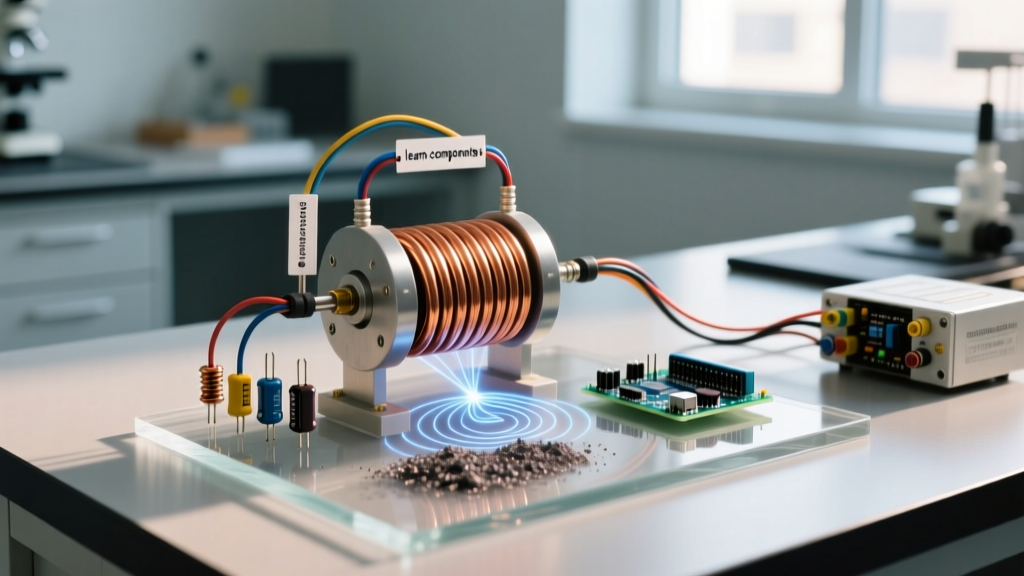
A run capacitor continuously shifts the phase of the current in a single-phase AC motor’s auxiliary winding to create a rotating magnetic field, improving torque and efficiency while the motor operates. Unlike start capacitors, which disconnect after the motor reaches roughly 75% of its rated RPM, run capacitors remain in the circuit 100% of the time. They are essential for keeping single-phase compressors, blower motors, and condenser fans running smoothly without overheating the auxiliary winding.
The Physics: Phase Shifting and the Auxiliary Winding
Single-phase AC power does not naturally produce a rotating magnetic field; it produces a pulsating one. If you apply single-phase power to a motor with only one winding, the rotor will just hum and vibrate. To make it spin, we introduce a second winding (the auxiliary or start winding) physically offset from the main winding. However, we also need the current in this second winding to be out of phase with the main winding.
This is exactly what a run capacitor does. By placing a capacitor in series with the auxiliary winding, the current in that circuit leads the voltage. This phase shift creates the illusion of a two-phase system, generating the rotating magnetic field required to turn the rotor.
Bench Example: Let’s calculate the capacitive reactance ($X_c$) for a typical 5µF run capacitor on a 120V, 60Hz system. Using the formula $X_c = 1 / (2 \pi f C)$:
- $X_c = 1 / (2 \times 3.14159 \times 60 \times 0.000005)$
- $X_c \approx 530.5 \, \Omega$
Using Ohm’s Law ($I = V / X_c$), the current through the auxiliary winding will be roughly 0.226A. If you swap that 5µF capacitor for a 10µF unit, the reactance drops to 265Ω, doubling the auxiliary current. This will rapidly overheat and burn out the auxiliary winding, which is why exact sizing matters.
Decoding Capacitor Markings and Specifications
When you pull a capacitor from an HVAC unit or a bench grinder, the label tells you everything you need to know about its dielectric construction and limits. Here is how to read the physical markings:
| Marking | Meaning & Application |
|---|---|
| CBB60 / CBB61 / CBB65 | Indicates metallized polypropylene film construction. CBB60 is typically cylindrical (general motors), CBB61 is rectangular (ceiling fans), and CBB65 is oval (HVAC compressors). |
| µF or MFD | Capacitance value (microfarads). A 45/5 MFD marking on a dual capacitor means 45µF for the compressor circuit and 5µF for the fan circuit. |
| VAC Rating | Maximum continuous AC voltage. Common ratings are 370VAC and 440VAC. Never use a VDC (DC voltage) rated capacitor for AC motor applications; the dielectric will fail catastrophically. |
| 50/60 Hz | Frequency rating. Because $X_c$ is inversely proportional to frequency, a capacitor rated only for 60Hz will have a higher reactance (and lower current) if used on a 50Hz European grid, slightly reducing motor torque. |
For a deeper look into how capacitive reactance interacts with inductive motor windings, the phase shift theory covered by All About Circuits provides excellent foundational math.
Run vs. Start vs. Dual Capacitors: Which Type for Which Job?
Confusing these three types is the most common cause of motor failure in DIY repairs. The dielectric material and physical construction dictate whether a capacitor can handle continuous duty or just a brief surge.
| Feature | Run Capacitor | Start Capacitor | Dual Run Capacitor |
|---|---|---|---|
| Construction | Metallized Polypropylene Film | Non-Polarized Electrolytic | Metallized Polypropylene Film (Two internal sections) |
| Tolerance | ± 3% to ± 6% | -20% to +80% (Very loose) | ± 5% per section |
| Tempco / Duty | Continuous (100% duty cycle) | Intermittent (Max 3 seconds on, 20 cycles/min) | Continuous (100% duty cycle) |
| Typical Use | Blower motors, pool pumps, compressor run windings | High-torque startup for compressors, well pumps | Central HVAC systems (one can runs both compressor and fan) |
Selection Rule: If the circuit includes a centrifugal switch or a potential relay that removes the capacitor from the circuit once the motor is up to speed, use a start capacitor. If the capacitor stays wired directly across the auxiliary winding while the motor runs, you must use a run capacitor.
Diagnosing Failure Modes: Visual and Electrical Symptoms
SAFETY WARNING: Capacitors store lethal electrical energy even when power is disconnected. Before touching any terminals, de-energize the circuit, lock out the breaker, and discharge the capacitor using a 20,000-ohm, 5-watt resistor across the terminals. Never short the terminals with a screwdriver; this damages the internal metallization and creates an arc flash hazard.
Run capacitors degrade over time due to heat, voltage spikes, and dielectric breakdown. Here is how to identify a failing unit:
Visual Symptoms
- Dome Bulging: The top of the capacitor swells upward. This indicates internal gas generation from dielectric breakdown. The capacitor is dead and must be replaced immediately.
- Ruptured Pressure Interrupter: Many CBB65 oval capacitors have a scored groove under the top lip. If internal pressure builds, the top pops up and physically breaks the internal wiring to prevent an explosion. If the top is popped, it is done.
- Oil Weeping: Older capacitors or heavy-duty industrial models are filled with dielectric oil (historically PCBs, now mineral oil or soybean oil). Any wetness around the base or terminals means the seal has failed and moisture has compromised the film.
Electrical Testing
Visual inspection misses "weak" capacitors that have lost 10-15% of their capacitance without bulging. To test properly, use a multimeter with a dedicated capacitance setting (like the Fluke 117 or 87V). A 40µF run capacitor reading 35µF is out of the ±5% tolerance band and will cause the compressor to draw high amps and trip the thermal overload.
The Substitution Matrix: Safely Replacing a Missing Part
When you are on a job site or troubleshooting at midnight and the exact OEM part isn't in your truck, you need to know the rules for safe substitution. Follow this matrix to avoid burning up a $1,500 compressor motor.
- The Voltage Rule (Upgrade Only): You can always substitute a higher voltage capacitor for a lower one. If the original is 370VAC, a 440VAC replacement is perfectly safe and will actually last longer in environments with dirty power or voltage spikes. Never substitute a lower voltage rating.
- The Capacitance Rule (Strict Tolerance): For run capacitors, the replacement must be within ±5% of the original microfarad rating. If the motor calls for 45µF, you can use a 40µF and a 5µF wired in parallel to yield 45µF, or use a 45µF exact match. Do not use a 50µF cap; the excess phase current will overheat the auxiliary winding.
- The Frequency Rule: A 50/60Hz capacitor can replace a 60Hz-only capacitor. A 60Hz-only capacitor should not be used on a 50Hz system, as the capacitive reactance will increase by 20%, starving the auxiliary winding of current and dropping starting torque.
- Never Cross the Streams: You can never use a start capacitor in place of a run capacitor. The electrolytic dielectric in a start cap will overheat and explode if subjected to continuous AC current.
Frequently Asked Questions
What happens if you use a higher uF run capacitor?
Using a higher microfarad (µF) run capacitor decreases the capacitive reactance, which allows more current to flow through the auxiliary winding. While this might slightly increase starting torque, it will cause the auxiliary winding to overheat during continuous operation. Over time, the excess heat degrades the winding insulation, leading to a short circuit and a burned-out motor. Always stick to the manufacturer's specified µF rating within a ±5% tolerance.
Can I use a start capacitor as a run capacitor?
No, absolutely not. Start capacitors are built with non-polarized electrolytic construction designed for high capacitance in a small package, but they can only handle current for a few seconds at a time. If left in a continuous run circuit, the internal electrolyte will rapidly boil, generating gas until the capacitor vents or explodes. Run capacitors use metallized polypropylene film, which is designed to dissipate heat continuously.
How do I know if my run capacitor is weak but not dead?
A weak run capacitor won't show visual signs like bulging or leaking, but the motor will exhibit specific symptoms: it will run hotter than normal, draw higher amperage on the main winding, and may hum loudly or struggle to maintain speed under load. The only definitive way to identify a weak capacitor is to isolate it from the circuit, discharge it, and measure it with a digital multimeter capable of reading microfarads. If the reading falls outside the ±5% tolerance printed on the label (e.g., a 40µF cap reading 37µF), it is weak and must be replaced.