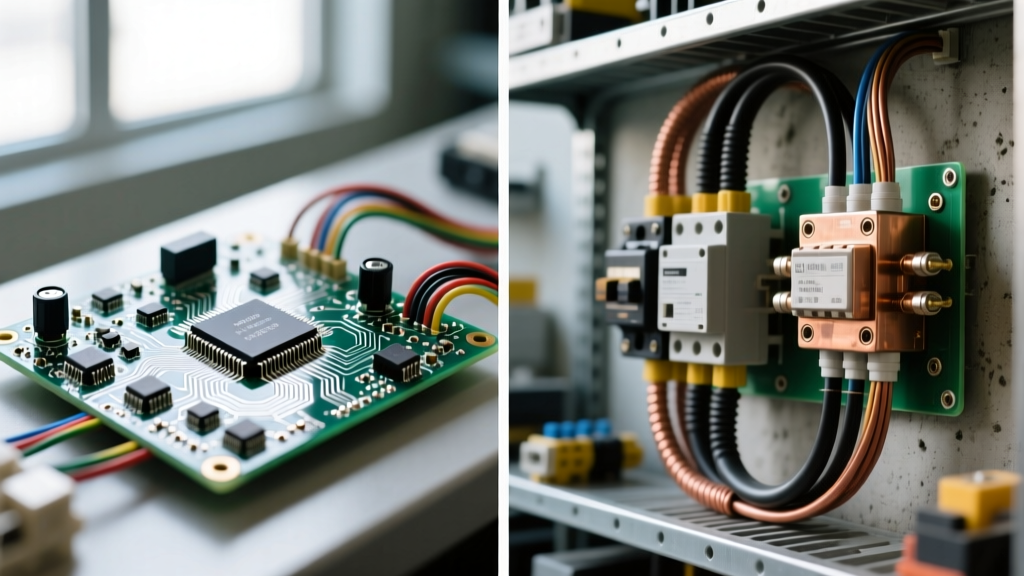
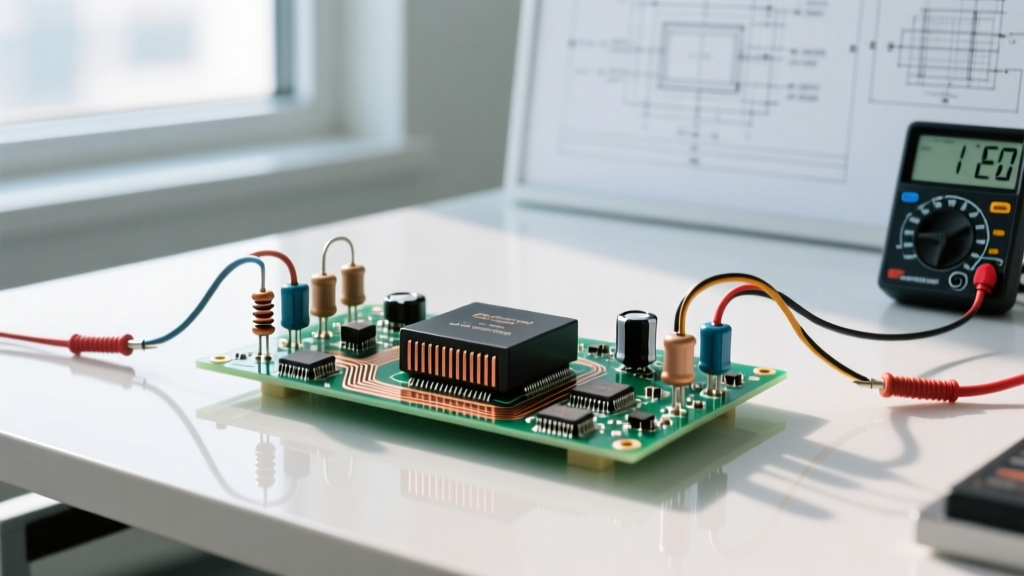
The working definition of electricity in a practical sense is the directed flow of electron charge through a conductive medium, driven by a potential difference (voltage) to deliver measurable power to a load. While textbooks focus on atomic theory, on the workbench, electricity is defined by what it does: it generates heat, creates magnetic fields, and forces us to manage thermal limits in every wire, breaker, and semiconductor we install.
Understanding this definition changes how you approach real circuits. It dictates why a 14 AWG wire melts under a sustained 18A load, why an ESP32 brownouts when a servo motor kicks on, and why we derate conductors in a hot attic. What people most commonly confuse is the difference between the pressure of the system (voltage) and the actual volume of work being done (current and power), leading to dangerous undersizing of protective devices.
The Core Physics: Charge, Drift, and the Single Analogy
We will use the standard water analogy exactly once to establish the baseline: Voltage (Volts) is the water pressure in the pipe, Current (Amps) is the flow rate (gallons per minute), and Resistance (Ohms) is the pipe's diameter and internal friction.
However, the physical reality of electrons in a copper wire is stranger than the water model. According to Georgia State University HyperPhysics, the actual physical movement of electrons—known as drift velocity—is incredibly slow, often less than 1 millimeter per second in a standard DC circuit. The reason your light turns on instantly is that the electromagnetic wave propagating through the space around the wire travels at a significant fraction of the speed of light. You aren't waiting for an electron to travel from the breaker panel to the outlet; you are waiting for the wave to push the electrons already sitting inside the outlet's copper.
Worked Numeric Example: The 1500W Space Heater Problem
Let's apply the practical definition of electricity to a scenario that trips breakers and causes fires every winter: plugging a 1500W space heater into a standard US residential 120V bedroom circuit.
Step 1: Calculate Base Current
Using Ohm's and Watt's laws: I = P / V
1500W / 120V = 12.5 Amps
Step 2: Apply the Continuous Load Rule
The National Electrical Code (NEC) defines a continuous load as one expected to run for 3 hours or more. A space heater in a cold room easily meets this. NEC Article 210.20(A) requires branch circuit overcurrent devices to be rated at 125% of the continuous load.
12.5A × 1.25 = 15.625 Amps
Step 3: The Failure Point
A standard bedroom is wired with 14 AWG NM-B cable (rated 15A) on a 15A breaker. Because 15.625A exceeds 15A, the breaker's thermal element will eventually heat up and trip, usually after 45 to 90 minutes of runtime. If the breaker fails to trip, the 14 AWG wire will operate above its ampacity, degrading the insulation over time.
The Fix: You must upgrade to a 20A breaker and 12 AWG copper wire (rated 20A at 60°C column for NM-B), which safely handles the 15.625A continuous requirement.
Where You Meet This in Practice
The abstract definition of electricity becomes physical reality in three specific areas of DIY and professional installations:
- Voltage Drop in Long Feeder Runs: Electricity encounters resistance. If you run 50 feet of 12 AWG wire to a shed drawing 16A, you will lose roughly 3.1 volts. Your 120V nominal drops to 116.9V. While acceptable (under the 3% NEC recommendation), if you used 14 AWG, the drop doubles, causing motors to overheat and draw more current to compensate for the lower voltage.
- Inrush Current and Capacitive Loads: When you switch on a Mean Well LED driver or a large toroidal transformer, the initial charging of the internal capacitors looks like a dead short. A 100W LED driver might draw 40A for 5 milliseconds. Understanding that electricity behaves dynamically—not just as a steady-state number—is why we use slow-blow fuses or thermistors for inrush limiting.
- AC RMS vs. Peak Voltage: A US wall outlet is '120V', but that is the Root Mean Square (RMS) value. As All About Circuits details, the actual peak voltage of a 120V RMS sine wave is
120 × √2 = 169.7V. If you are building a DIY rectifier circuit, your filter capacitors must be rated for at least 200V or 250V, not 150V, or they will violently vent electrolyte.
Decision Tree: Sizing Wire and Breakers for Branch Circuits
Use this decision matrix to terminate your circuit design with a concrete, safe parts list. This assumes standard US 120V residential AC, copper conductors, and 60°C/75°C termination ratings.
| Load Wattage | Base Amps (P/V) | Continuous? (>3 hrs) | Required Ampacity | Min. Wire AWG (NM-B) | Breaker Size | Concrete Part Pick |
|---|---|---|---|---|---|---|
| 600W (Lights) | 5.0A | No | 5.0A | 14 AWG | 15A | Eaton BR115 + Southwire 14/2 |
| 1440W (Outlets) | 12.0A | No | 12.0A | 14 AWG | 15A | Eaton BR115 + Southwire 14/2 |
| 1500W (Heater) | 12.5A | Yes | 15.6A | 12 AWG | 20A | Eaton BR120 + Southwire 12/2 |
| 1920W (Window AC) | 16.0A | No | 16.0A | 12 AWG | 20A | Eaton BR120 + Southwire 12/2 |
| 2400W (Baseboard) | 20.0A | Yes | 25.0A | 10 AWG | 30A | Eaton BR130 + Southwire 10/2 |
Common Confusions: What Electricity Is Not
Confusing Voltage with Danger: People assume high voltage is inherently lethal. In reality, it is the current (specifically, 50mA to 100mA crossing the heart) that causes fibrillation. A static shock from a doorknob is 10,000V but delivers microamps for a nanosecond. Conversely, a 12V car battery can deliver 600A, which will instantly weld a steel wrench to the terminals and cause severe arc-flash burns, even though the voltage cannot push current through dry human skin.
Confusing Power (Watts) with Energy (Watt-hours): A 100W incandescent bulb and a 100W LED grow light consume the exact same amount of electrical power at any given second. However, if you run the bulb for 10 hours, you have consumed 1,000 Watt-hours (1 kWh) of energy, which is what your utility meter actually tracks and bills you for. When sizing a LiFePO4 solar battery bank, you must calculate Watt-hours, not just peak Watts.
FAQ: Real-World Electricity Questions
Q: Does electricity take the path of least resistance?
A: No. This is a dangerous myth. Electricity takes all available paths, inversely proportional to their resistance (per Kirchhoff's Current Law). If you touch a live 120V wire while grounded, the current will flow through the copper ground wire (low resistance) and through your body (higher resistance). The ground wire doesn't 'absorb' all the current; it just takes the majority share.
Q: Why do we use AC for mains power instead of DC?
A: Because AC voltage can be easily stepped up and down using passive transformers. To transmit power 50 miles without massive voltage drop, utilities step AC up to 115,000V (lowering the current, which minimizes I²R heating losses in the wires), then step it back down to 120V/240V at your house. Doing this with DC requires expensive, high-frequency solid-state switching converters, though modern HVDC (High Voltage DC) is now used for very specific ultra-long-distance transmission lines.
Q: What is the actual speed of electricity?
A: The signal (electromagnetic wave) travels at 50% to 99% the speed of light, depending on the dielectric constant of the wire's insulation. The physical electrons move at less than a millimeter per second. If you push an electron into one end of a 10-foot wire, a different electron pops out the other end almost instantly, but the original electron will take hours to traverse the wire.