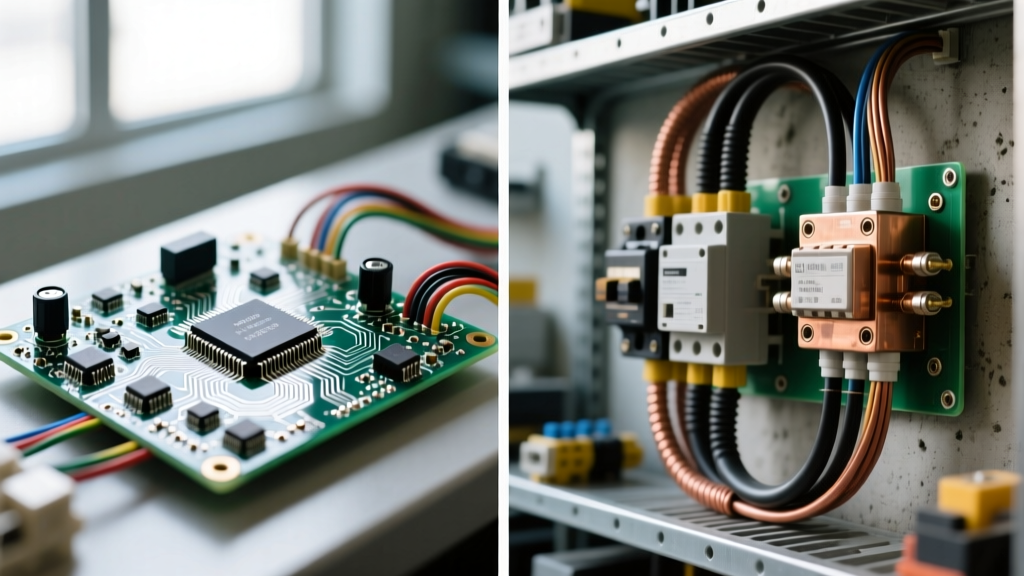

The Verdict: When to Use Electrical vs. Electronic Systems
If you need to move raw power from point A to point B, drive a high-torque motor, or distribute mains voltage safely, electrical systems win. If you need to process data, amplify a millivolt sensor signal, or execute precision timing and logic control, electronic systems win. Electrical engineering focuses on the macro-scale generation and distribution of power, while electronics focuses on the micro-scale manipulation of charge carriers to process information. You cannot compute a PID control loop with a copper busbar, and you cannot safely switch a 240V AC compressor using a bare silicon logic gate.
- You are routing power over long distances (e.g., THHN wire in conduit, NM-B Romex).
- You are switching loads above 50A or dealing with 120V/240V/480V AC mains.
- You need passive, highly reliable components that do not require software or logic to function (e.g., thermal breakers, fuses, transformers).
- You are reading analog sensors, conditioning signals, or communicating via I2C/SPI/UART.
- You need to step down a 12V signal to a 3.3V logic level for a microcontroller GPIO pin.
- You are building variable frequency drives (VFDs) or PWM motor controllers where rapid switching of silicon (MOSFETs/IGBTs) dictates the output.
The Single Physical Difference That Drives Everything
The fundamental physical difference that dictates all other variations between these two fields is passive conduction versus active manipulation of charge carriers.
In electrical systems, electrons flow through a conductive medium (like copper or aluminum) driven by an electromotive force (voltage). The material's atomic structure has a 'sea of free electrons' in its valence band that move predictably according to Ohm's Law and Kirchhoff's Laws. The goal is simply to deliver energy with minimal resistive loss (I²R heating). Components like resistors, inductors, and capacitors passively react to this flow.
In electronic systems, the flow of electrons is actively manipulated using semiconductor materials (silicon, germanium, gallium arsenide) or vacuum tubes. By introducing specific impurities (doping) into a silicon crystal lattice, engineers create P-N junctions that can act as one-way valves (diodes) or voltage-controlled switches (transistors). As detailed in the All About Circuits semiconductor primer, this allows a tiny 3.3V, 10mA signal to control a much larger current, enabling amplification and binary logic. Electronics is not just about moving power; it is about using power to represent and process information.
Head-to-Head Comparison: Electrical vs. Electronic Components
The table below breaks down the concrete engineering and economic differences between standard electrical and electronic components.
| Criteria | Electrical Systems (e.g., Contactors, Wire, Breakers) | Electronic Systems (e.g., Microcontrollers, MOSFETs, Op-Amps) |
|---|---|---|
| Primary Function | Bulk power transmission, isolation, and high-current actuation. | Signal processing, logic computation, and precision control. |
| Typical V/I Ranges | 120V–600V AC; 15A–400A continuous. | 1.2V–24V DC; microamps to 5A (per pin/channel). |
| Core Materials | Copper, aluminum, steel laminations, thermoset plastics. | Silicon wafers, gold bonding wires, gallium arsenide, FR4 fiberglass. |
| Primary Cost Driver | Raw material commodity weight (e.g., LME copper prices per pound). | Silicon lithography node complexity and packaging (e.g., TSMC wafer pricing). |
| Common Failure Mode | Thermal meltdown, contact pitting, arc flash, insulation breakdown. | ESD gate puncture, latch-up, thermal runaway, firmware brownout. |
Cost and Availability Note: Electrical components are heavily commoditized and priced by the pound. A 500-foot spool of 12 AWG THHN wire tracks directly with global copper markets. Electronic components, however, are priced by integration density. A $2.50 ESP32-WROOM-32 module contains millions of transistors, but its availability is highly susceptible to global semiconductor supply chain shocks and fabrication plant capacity, unlike a standard 20A duplex receptacle which you can buy at any local hardware store.
Where They Are Absolutely Not Interchangeable
The most common mistake hobbyists and junior engineers make is attempting to bridge the gap between electronic logic and electrical loads without proper isolation and amplification.
Consider a smart home project where you want an ESP32 microcontroller to turn on a 240V, 30A electric water heater. The ESP32 is an electronic device. Its GPIO pins operate at 3.3V and can safely source a maximum of 40mA (with a recommended continuous limit of 20mA). The water heater is an electrical load requiring 7,200 watts of continuous power.
You cannot wire the ESP32 directly to the heater, nor can you use a standard electronic logic gate to switch the mains voltage. If you attempt to force an electronic component to do an electrical job, you will instantly vaporize the silicon die and potentially start a fire. Conversely, you cannot use an electrical 40A double-pole contactor to perform the 10-bit analog-to-digital conversion required to read a thermistor's temperature.
The Bridge: To make them work together, you must use an intermediary. The ESP32 (electronic) sends a 3.3V logic signal to a solid-state relay or an optocoupler. This triggers a 12V DC coil on a heavy-duty 40A mechanical contactor (electrical), which physically closes the high-current contacts to power the heater. The NFPA 70 National Electrical Code (NEC) strictly governs the wiring of the 240V electrical side, requiring proper AWG sizing, conduit fill limits, and breaker protection, while the 3.3V electronic side operates entirely outside the NEC's jurisdiction.
Pros of Electrical Components
- Extremely robust against voltage spikes and ESD.
- Centuries of standardized safety codes (NEC, IEC).
- Easy to troubleshoot with a basic $20 multimeter.
- No software bugs or firmware bricking risks.
Cons of Electrical Components
- Bulky and heavy (e.g., iron-core transformers).
- Mechanical contacts wear out and arc over time.
- Incapable of complex logic or data processing.
- Slow switching speeds (milliseconds vs nanoseconds).
Frequently Asked Questions
Is a transistor considered electrical or electronic?
A transistor is strictly an electronic component. While it conducts electricity, its defining characteristic is the active manipulation of current flow using semiconductor P-N junctions (in BJTs) or electric fields across an insulating oxide layer (in MOSFETs). It acts as an amplifier or a solid-state switch, which is the foundational building block of modern electronics. If a component relies on silicon bandgap physics to function, it belongs to electronics.
Why do electronic devices need electrical power supplies?
Electronic 'brains' (like an Arduino or a Raspberry Pi) require highly stable, ripple-free, low-voltage DC power (e.g., exactly 5.0V or 3.3V) to maintain logic states and prevent brownouts. However, the power grid delivers 'messy' high-voltage AC (120V/240V nominal, swinging between 114V and 126V, with frequent harmonic distortion). An electrical power supply (like a transformer or a switching AC-DC converter) bridges this gap, stepping down the macro-scale electrical energy into the micro-scale, highly regulated DC voltage that sensitive electronic silicon requires to operate without thermal damage.
Can an electrical engineer design electronic circuits?
Yes, but with a learning curve. As outlined in MIT's OpenCourseWare Electronic Devices curriculum, the physics of semiconductors is a core requirement for both disciplines. However, a traditional electrical engineer specializing in power systems or high-voltage transmission may lack practical experience with high-speed PCB layout, I2C pull-up resistor calculations, or embedded C programming. They understand the underlying physics of a MOSFET perfectly, but might need to brush up on the specific datasheet timing diagrams required to implement it in a digital logic circuit.
What is the difference between electrical and electronic engineering degrees?
An Electrical Engineering (EE) degree typically focuses on macro-scale systems: power generation, electric motors, high-voltage transmission, control systems, and electromagnetics. An Electronic Engineering (or Computer Engineering) degree focuses on micro-scale systems: VLSI (Very Large Scale Integration) chip design, embedded systems, RF communications, signal processing, and semiconductor physics. In the US, many universities combine these into a single 'EE' degree with specialized electives, whereas in the UK and Europe, they are often distinct, separate degree programs from the first year.


