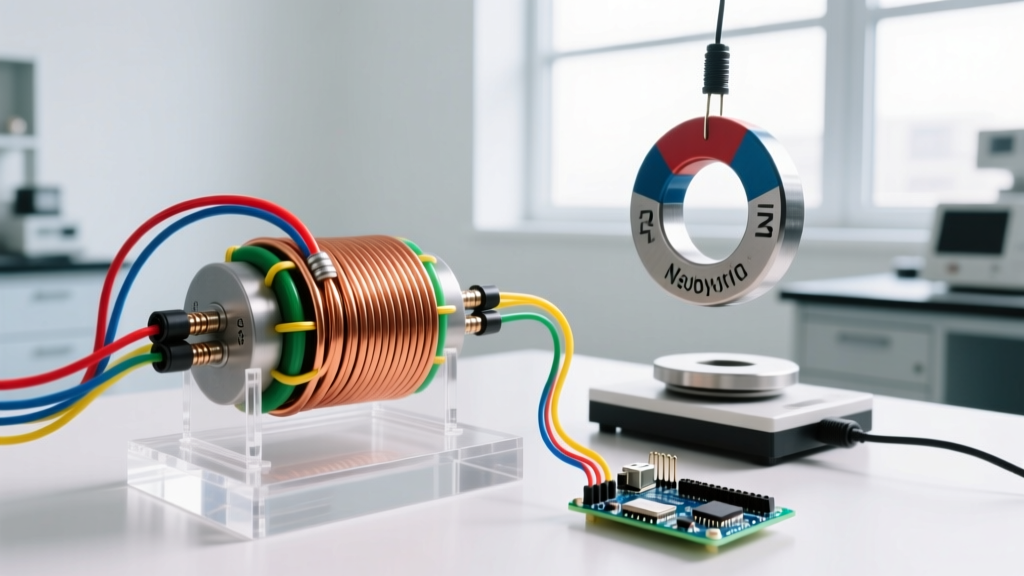
Electricity is the controlled flow of electrons through a conductive path, driven by a difference in electrical potential, to transfer energy from a source to a load. When you flip a switch or trigger a microcontroller GPIO pin, you are not creating energy out of nothing; you are completing a circuit that allows stored or generated potential energy to convert into work, heat, light, or logical states. Understanding this fundamental transfer of energy is not just an academic exercise—it dictates every wire gauge, breaker rating, and semiconductor selection on your workbench.
The Core Mechanics: What Electricity Changes in a Circuit
To understand electricity in practice, we break it down into three interacting properties: voltage (potential difference), current (electron flow), and resistance (opposition to flow). According to All About Circuits, these three variables are bound by Ohm's Law ($V = I \times R$), which governs how electrical energy behaves in any physical system.
The most reliable way to visualize this is the water analogy: imagine a pressurized water tank (voltage) feeding a pipe (wire) with a nozzle (resistance). The pressure pushes the water (current) through the nozzle. If you pinch the nozzle (increase resistance), the flow drops unless you increase the tank pressure (voltage) to compensate.
But what does electricity actually change in a real installation? When current flows through a physical medium, it alters the physical state of that medium in three primary ways:
- Thermal State: Electrons colliding with the atomic lattice of a conductor generate heat ($I^2R$ losses). This is why a 15A load on a 14 AWG copper wire is safe, but that same load on an 18 AWG wire will melt the PVC insulation and start a fire.
- Magnetic State: Moving electrons generate a magnetic field perpendicular to their flow. This is the operating principle behind inductors, transformers, and the stator windings in your AC induction motors.
- Chemical/Logical State: In a lithium-ion cell, electrical current forces ions across a separator (charging). In an ESP32 microcontroller, a tiny current (often < 20mA) flips the state of a MOSFET gate to register a binary 1 or 0.
| Property | Unit | Symbol | Physical Meaning |
|---|---|---|---|
| Voltage | Volt | V | Joules of energy per Coulomb of charge |
| Current | Ampere | A | Coulombs of charge passing a point per second |
| Resistance | Ohm | Ω | Volts required to push one Ampere through a material |
| Power | Watt | W | Joules of energy transferred per second |
Worked Numeric Example: Calculating Voltage Drop in a 12V DC Array
The meaning of electricity shifts from abstract theory to hard constraints when you have to size conductors. Let's look at a real-world scenario: wiring a 12V DC solar water pump located 30 feet away from your battery bank.
The Parameters:
- Load: 10A continuous (a 120W 12V DC diaphragm pump)
- Wire: 10 AWG stranded copper (THHN)
- Distance: 30 feet one-way (60 feet total circuit loop)
The Calculation:
According to NEC Chapter 9, Table 8, 10 AWG stranded copper has a resistance of approximately 1.24 ohms per 1,000 feet at 75°C.
- Total Loop Resistance: $(60 \text{ ft} / 1000 \text{ ft}) \times 1.24 \,\Omega = 0.0744 \,\Omega$
- Voltage Drop ($V = I \times R$): $10\text{A} \times 0.0744\,\Omega = 0.744\text{V}$
- Percentage Drop: $(0.744\text{V} / 12\text{V}) \times 100 = 6.2\%$
Where You Meet This in Practice
Depending on your project, electricity takes on a different functional role. Recognizing which 'flavor' of electricity you are dealing with prevents catastrophic design flaws.
1. Home Wiring (AC Mains Delivery)
In residential wiring, you meet electricity as a high-potential, low-current delivery system. The utility steps voltage up to hundreds of thousands of volts for transmission to minimize $I^2R$ losses, then steps it down to 120V/240V nominal at your panel. Here, electricity's primary job is bulk energy transfer. You manage it using 14 AWG or 12 AWG NM-B cable, thermal-magnetic breakers, and AFCI/GFCI protection to prevent the thermal and shock hazards inherent to high-voltage AC.
2. Embedded Systems (DC Logic and Signal)
On a breadboard with an Arduino Nano or ESP32-WROOM-32, electricity is an information carrier. A 3.3V logic HIGH sourcing 12mA isn't doing mechanical work; it's charging the parasitic capacitance of a trace to flip a transistor gate. Here, the 'meaning' of electricity is tied to timing, impedance matching, and signal integrity. A 0.5V drop in a 12V motor circuit is negligible; a 0.5V drop on an I2C SDA line will corrupt your data packets and crash your sensor network.
3. Power Electronics (Energy Storage and Conversion)
In a 48V LiFePO4 battery bank or a DC-DC buck converter, electricity is raw chemical-to-electrical energy conversion. You are managing internal impedance, Coulomb counting (state of charge), and C-rates. The physical limits of the lithium chemistry dictate how fast electrons can be forced into the anode without causing lithium plating and thermal runaway.
Common Confusions: What People Get Wrong About Electricity
Even experienced hobbyists mix up foundational concepts. Clarifying these prevents bad design choices.
Confusion 1: Power (Watts) vs. Energy (Watt-hours)
Power is the instantaneous rate of work. Energy is power integrated over time. A 100W incandescent bulb draws 100W whether it is on for one second or one year. Your utility company bills you for kilowatt-hours (kWh)—the total energy consumed—not the peak kilowatts (kW) you pulled at any given second.
Confusion 2: Electrons Move at the Speed of Light
The electromagnetic wave (the signal or energy transfer) propagates through the dielectric around the wire at a significant fraction of the speed of light (typically 50% to 99% of $c$). However, the actual physical electrons drift through the copper at a fraction of a millimeter per second. When you flip a switch, the energy hits the load almost instantly, even though the specific electrons at the switch won't reach the load for hours.
Confusion 3: Ground vs. Neutral
In AC mains wiring, neutral is the normal, intended return path for current back to the source. Ground (the equipment grounding conductor) is a safety path that carries zero current during normal operation. Ground only carries current during a fault (like a loose hot wire touching a metal chassis) to provide a low-resistance path that trips the breaker instantly.
Frequently Asked Questions About the Meaning of Electricity
What is the basic meaning of electricity in physics?
In physics, electricity refers to the set of physical phenomena associated with the presence and motion of charged particles, specifically electrons and protons. It encompasses electrostatics (stationary charges), electrodynamics (moving charges/current), and electromagnetism (the interaction between electric currents and magnetic fields). In practical circuit theory, we focus almost entirely on electrodynamics—harnessing the continuous drift of free electrons in a conductive lattice to transfer energy.
How does the meaning of electricity differ between AC and DC circuits?
In Direct Current (DC) circuits, electricity flows continuously in a single direction from the higher potential (positive) to the lower potential (negative). The voltage and current values are generally constant over time. In Alternating Current (AC) circuits, the direction of electron flow reverses periodically (e.g., 60 times per second in US 60Hz mains). Because AC voltage is constantly changing, we use Root Mean Square (RMS) values to express an 'equivalent' DC heating effect. For example, 120V RMS AC delivers the exact same average power to a resistive heater as 120V DC, even though the AC peak voltage actually reaches roughly 170V.
Why does the meaning of electricity matter when sizing a breaker?
Breakers are not designed to protect your equipment; they are designed to protect the wire inside your walls from melting. Because electricity generates heat proportional to the square of the current ($I^2R$), pushing 20 amps through a 14 AWG wire rated for 15 amps will cause the copper to overheat, degrading the insulation and causing a fire. A breaker uses a bimetallic strip (for thermal overload) and an electromagnet (for short-circuit magnetic tripping) to physically interrupt the electron flow before the wire's thermal limits are exceeded.
What is the difference between static and current electricity?
Static electricity is an accumulation of excess electrical charge on the surface of an insulating material, resulting in a high voltage but zero continuous current (like the shock you get from a doorknob after walking on carpet). Current electricity is the continuous, controlled flow of electrons through a conductor, driven by a sustained potential difference (like a battery powering a flashlight). Makers and engineers deal almost exclusively with current electricity, though static discharge (ESD) remains a critical hazard when handling sensitive CMOS components like microcontrollers and MOSFETs.