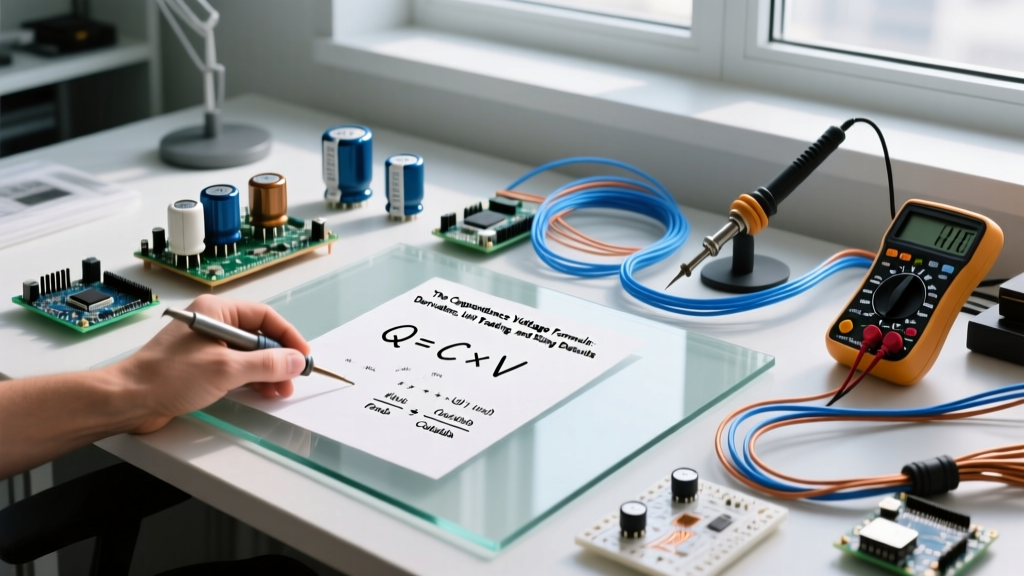
When makers and students search for the meaning of electrical engineering, they often find abstract textbook definitions about electromagnetism and field theory. In practical terms, electrical engineering is the applied science of manipulating electrons to safely generate, transmit, and utilize power and information. In a real circuit or installation, this discipline changes a theoretical schematic into a physical system that manages thermal limits, prevents voltage sags, and ensures protective devices trip before wires melt.
The Core Disciplines of the Field
To understand the scope of the profession, it helps to break it down by the voltage and current scales involved. According to the ABET Engineering Program Criteria, the field encompasses everything from nanoscale semiconductor physics to continental power grids. For a DIY builder or hobbyist, you will typically intersect with the first two disciplines below.
| Sub-Discipline | Typical Voltage/Current | Key Components | Primary Failure Mode |
|---|---|---|---|
| Power Engineering | 120V – 765kV AC / 10A – 3000A | Transformers, Contactors, THHN Wire, Breakers | Arc faults, thermal runaway, insulation breakdown |
| Electronics | 1.2V – 48V DC / mA – 15A | MOSFETs, Op-Amps, ESP32, LiFePO4 Cells | Overvoltage, ESD damage, brownouts |
| Control Systems | 4-20mA loops / 0-10V DC | PLCs, PID Controllers, Optoisolators | Ground loops, signal noise, feedback oscillation |
| Signal Processing | mV to 5V AC/DC | DSPs, RC Filters, Antennas | Aliasing, impedance mismatch, attenuation |
What People Commonly Confuse It With
A common mistake is treating "electrical engineering" as a monolith, or confusing it with adjacent fields. While an electrical engineer might design the power distribution for a data center, an electronics engineer designs the server motherboards inside it, and a computer engineer writes the firmware for the baseboard management controller. Here is how the boundaries actually break down in practice.
| Discipline | Primary Focus | Typical Tools | Choose This When... |
|---|---|---|---|
| Electrical Engineering | Generation, transmission, and utilization of electrical power. | Clamp meters, Megohmmeters, AutoCAD Electrical | You are sizing feeders, calculating voltage drop, or designing motor drives. |
| Electronics Engineering | Design of active/passive circuits, semiconductors, and PCBs. | Oscilloscopes, Soldering stations, Altium/KiCad | You are routing high-speed I2C traces or designing a switching power supply. |
| Computer Engineering | Integration of hardware and software, microarchitecture. | Logic analyzers, JTAG debuggers, C/C++ IDEs | You are writing bare-metal RTOS drivers or designing FPGA logic. |
| Physics | Fundamental laws of nature, quantum mechanics, materials. | Electron microscopes, Cryostats, MATLAB | You are researching new dielectric materials or Hall effect sensors. |
A Worked Numeric Example: Translating Theory to the Workbench
Theory assumes ideal wires with zero resistance. The practical meaning of electrical engineering is calculating what happens when those wires are not ideal. Let us look at a common DIY scenario: powering a 12V DC bilge pump from a battery bank on a boat or an off-grid solar setup.
The Scenario: You need to run a 12V DC pump that draws 8 Amps under load. The battery is 15 feet away from the pump. You decide to use 16 AWG stranded copper wire.
The Math:
- Total Wire Length: Current must travel to the pump and back. 15 feet × 2 = 30 feet total circuit length.
- Wire Resistance: According to standard copper wire tables, 16 AWG has a resistance of approximately 4.016 ohms per 1,000 feet at 20°C. For 30 feet, the resistance is (30 / 1000) × 4.016 = 0.1205 ohms.
- Voltage Drop: Using Ohm’s Law (V = I × R), the voltage dropped across the wire is 8A × 0.1205Ω = 0.964 Volts.
- Load Voltage: The pump will actually see 12.0V - 0.964V = 11.036 Volts.
- Power Dissipation (Heat): Using P = I² × R, the wire will dissipate (8²) × 0.1205 = 7.71 Watts of heat.
Where You Meet This in Practice
If you are building projects at home, the meaning of electrical engineering manifests in three specific areas where ignoring physical realities leads to failure.
1. Microcontroller Brownouts and Power Integrity
When an ESP32-WROOM-32 transmits a WiFi packet, its current draw can spike from 80mA to over 240mA in microseconds. If your 3.3V power rail has high impedance (due to long, thin jumper wires or inadequate decoupling capacitors), that current spike causes a momentary voltage drop. If the voltage at the chip's VDD pin falls below the brownout detector threshold of roughly 2.43V, the ESP32 will reset. The engineering fix is not in the code; it is placing a 10µF ceramic capacitor physically within 2mm of the module's power pins to supply instantaneous transient current.
2. Battery Management and Cell Balancing
In a 4S LiFePO4 battery pack (nominal 12.8V), the cells are never perfectly matched in internal resistance or capacity. If you charge them in series without a Battery Management System (BMS), the weakest cell will hit its maximum voltage of 3.65V while the others are still at 3.40V. The charger will keep pushing current, driving the weak cell into overvoltage, which degrades the electrolyte and risks thermal runaway. Electrical engineering solves this via active or passive balancing circuits on the BMS, bleeding off excess current from the full cells so the pack charges safely as a unit.
3. NEC Ampacity Derating in Home Wiring
Beginners often look at an ampacity chart and see that 12 AWG THHN copper wire is rated for 30 Amps (in the 90°C column). They assume they can put it on a 30A breaker. However, the meaning of the National Electrical Code (NEC) 110.14(C) is that termination limits govern the circuit. Most standard residential breakers and receptacles are only rated for 60°C or 75°C terminations. Therefore, you must use the 60°C column for 12 AWG, which limits the wire to 20 Amps. Engineering is knowing which column of the table the law actually requires you to use.
Frequently Asked Questions
Is electrical engineering just about wiring houses?
No. While power distribution and home wiring fall under the electrical engineering umbrella (specifically power engineering), the field heavily encompasses microelectronics, RF communications, digital signal processing, and control theory. A residential electrician executes the physical installation; an electrical engineer designs the systems, calculates the loads, and specifies the protective devices.
Do I need to know calculus to build Arduino projects?
For basic hobbyist projects, algebra and Ohm's law are sufficient. However, the deeper meaning of electrical engineering reveals itself when you design custom PCBs, tune PID control loops for motors, or design analog filters. At that stage, differential equations and Laplace transforms become necessary to predict circuit behavior over time and frequency.
What is the most common mistake DIYers make that electrical engineering prevents?
Ignoring parasitic inductance and resistance. A wire is not just a conductor; at high frequencies or high current-switching speeds (like PWM motor control), it acts as an inductor and a resistor. Failing to account for this results in voltage spikes that destroy MOSFETs, which is why engineers add flyback diodes and snubber circuits to real-world designs.