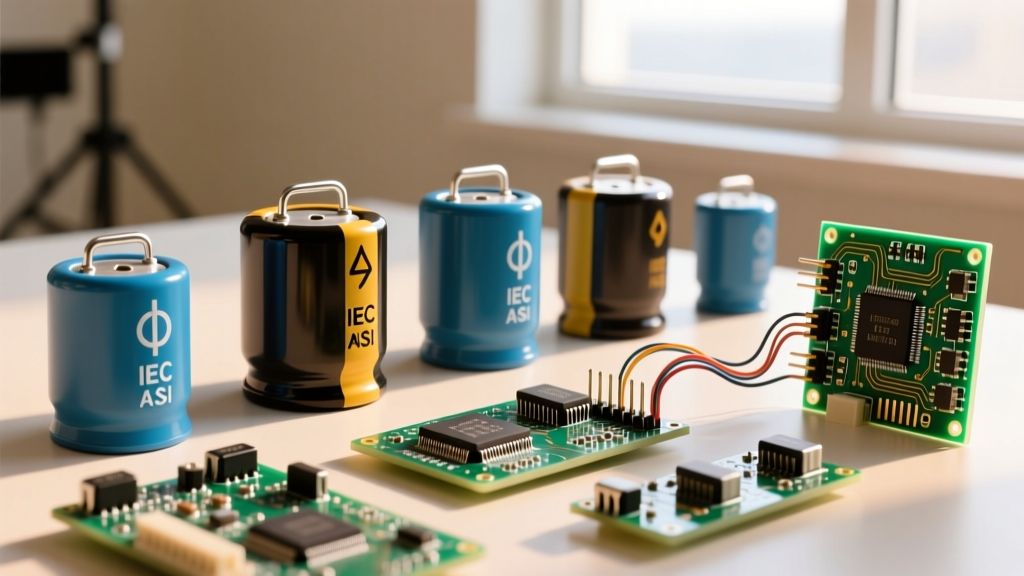
Capacitance is the ability of a component or circuit to collect and store energy in the form of an electrical charge. When you apply a voltage across a capacitor's conductive plates, it draws current until the electric field within its dielectric material is fully saturated, effectively acting as a temporary, fast-acting voltage reservoir. Unlike a battery, which relies on chemical reactions to release energy over hours, a capacitor stores energy electrostatically and can dump it in milliseconds.
The Core Mechanics: What Capacitance Actually Changes
To understand how capacitance works at a physical level, visualize a flexible rubber membrane stretched tightly across the inside of a water pipe. When you turn on the pump (apply voltage), water (current) flows into the pipe and pushes against the membrane. The membrane stretches, building back-pressure, but no water actually passes through it. Once the membrane's back-pressure matches the pump's pressure, the flow stops entirely. In a DC circuit, this is why a fully charged capacitor blocks steady-state current.
However, if the pump constantly reverses direction (AC current), the membrane flexes back and forth continuously. The water never crosses the membrane, but the alternating movement transfers energy through the pipe. This is why capacitors pass AC signals while blocking DC.
- Voltage Ripple: It acts as a shock absorber in power supplies, filling in the 'valleys' of rectified AC to maintain a steady DC voltage.
- Signal Coupling: It blocks DC bias voltages between amplifier stages while allowing the AC audio signal to pass.
- Phase Angle: In AC motor windings, it shifts the current phase to create the rotating magnetic field required to spin the rotor.
- Timing Delays: Paired with a resistor, its predictable charging curve sets precise time intervals in oscillators like the NE555 timer.
Dielectric Selection: How Materials Dictate Behavior
The dielectric—the insulating material between the conductive plates—determines a capacitor's physical size, voltage limit, and stability. According to Electronics Tutorials, the relative permittivity (κ) of the dielectric directly scales the capacitance value. However, chasing high permittivity often introduces severe trade-offs in voltage stability and temperature tolerance.
| Dielectric Material | Relative Permittivity (κ) | Typical Voltage Rating | Primary Application | ESR & Stability Characteristic |
|---|---|---|---|---|
| Ceramic (Class 1 / C0G) | 10 - 100 | 50V - 1000V | RF filtering, precision timing, audio signal path | Ultra-low ESR; near-zero temperature/voltage drift |
| Ceramic (Class 2 / X7R) | 2,000 - 4,000 | 16V - 100V | General decoupling, bypass, bulk MLCC | Low ESR; severe DC bias derating (loses up to 80% capacitance at rated voltage) |
| Aluminum Electrolytic | 8 - 10 (oxide layer) | 6.3V - 450V | Bulk power supply filtering, motor start | High ESR; polarized; degrades over time if not exercised |
| Tantalum (Solid MnO2) | 20 - 30 | 4V - 50V | Compact low-profile decoupling on dense PCBs | Medium ESR; highly polarized; catastrophic short-circuit failure mode if reverse-biased |
| Polypropylene Film | 2.2 | 250V - 2000V | AC motor run, audio crossovers, snubber circuits | Very low ESR; non-polarized; excellent high-voltage AC handling |
Bench Warning on X7R Ceramics: Makers frequently buy a 10µF 0805 X7R ceramic capacitor rated for 16V, assuming it will provide 10µF in a 12V circuit. Due to the DC bias effect, that capacitor will likely drop to ~2.5µF at 12V DC. Always check the manufacturer's DC bias derating curves (from vendors like Murata or TDK) when using Class 2 ceramics near their rated voltage.
Worked Numeric Example: Sizing a Power Supply Filter
Let's look at a real-world sizing problem. You are building a linear power supply for a sensitive audio preamp using a full-wave bridge rectifier. Your load draws 500 mA (0.5 A) at 12V DC. To prevent audible 120 Hz hum in the audio output, you need to keep the peak-to-peak ripple voltage below 50 mV (0.05 V). The mains frequency is 60 Hz, meaning the ripple frequency (f) after full-wave rectification is 120 Hz.
The foundational formula for bulk filter capacitance is:
C = I / (f × V_ripple)
Plugging in our real values:
- C = 0.5 A / (120 Hz × 0.05 V)
- C = 0.5 / 6
- C = 0.0833 Farads
Converting to microfarads, we need 83,333 µF. As All About Circuits notes in their DC theory section, theoretical math rarely matches the parts bin. You will not find an 83,333 µF capacitor on a distributor's shelf. The practical solution is to parallel two 47,000 µF aluminum electrolytic capacitors (such as the Cornell Dubilier 380LX series) to yield 94,000 µF. This provides a 12% safety margin and, crucially, cuts the Equivalent Series Resistance (ESR) in half, which reduces internal heating from ripple current.
Where You Meet Capacitance in Practice
Capacitance isn't just a textbook concept; it dictates the physical layout and component selection of almost every electrical system you interact with.
Motor Start and Run Circuits
HVAC compressors and pool pumps rely on high-capacitance run capacitors to operate. These are typically 5 µF to 80 µF, 370V/440V AC oil-filled polypropylene film capacitors. They create a phase shift in the motor's start winding, generating the rotating magnetic field necessary to keep the rotor spinning. If a pool pump hums but won't spin, the run capacitor's internal film has likely degraded, dropping its capacitance below the threshold needed to maintain torque.
High-Frequency Decoupling
Microcontrollers like the ESP32 or ATmega328P draw current in sharp, nanosecond spikes when their internal logic gates switch states. This creates high-frequency noise on the VCC rail. To prevent brownouts, every VCC pin requires a 100 nF (0.1 µF) ceramic capacitor placed physically within 2mm of the pin. This localized capacitance acts as a high-speed energy reservoir, supplying the instantaneous current spike before the main power trace's parasitic inductance can choke the flow.
Common Confusions and Bench FAQs
What do people commonly confuse capacitance with?
Capacitance vs. Battery Capacity: A 3000 mAh LiPo battery stores chemical energy for long-term, steady discharge. A 1 Farad supercapacitor stores electrostatic energy, capable of dumping massive current but only sustaining a load for seconds. Capacitance is measured in Farads (F); battery capacity is measured in Amp-hours (Ah).
Capacitance vs. Inductance: Capacitors resist changes in voltage (storing energy in an electric field), while inductors resist changes in current (storing energy in a magnetic field). They are mathematical duals of one another.
Can I replace a 25V capacitor with a 50V capacitor?
Yes. The voltage rating on a capacitor is a maximum breakdown limit, not an operating target. A 50V capacitor will work perfectly in a 12V circuit. The only penalties are a larger physical footprint and potentially higher cost. Just ensure the ESR and ripple current ratings are appropriate for the application.
Why did my electrolytic capacitor explode on the bench?
Reverse polarity. Aluminum electrolytic capacitors are polarized. Applying reverse voltage breaks down the internal aluminum oxide dielectric layer, causing an exothermic chemical reaction that generates hydrogen gas. The internal pressure builds until the scored vent on the top of the can ruptures violently. Always verify that the stripe (indicating the negative lead) on the capacitor can matches the shaded band on the PCB silkscreen before applying power.