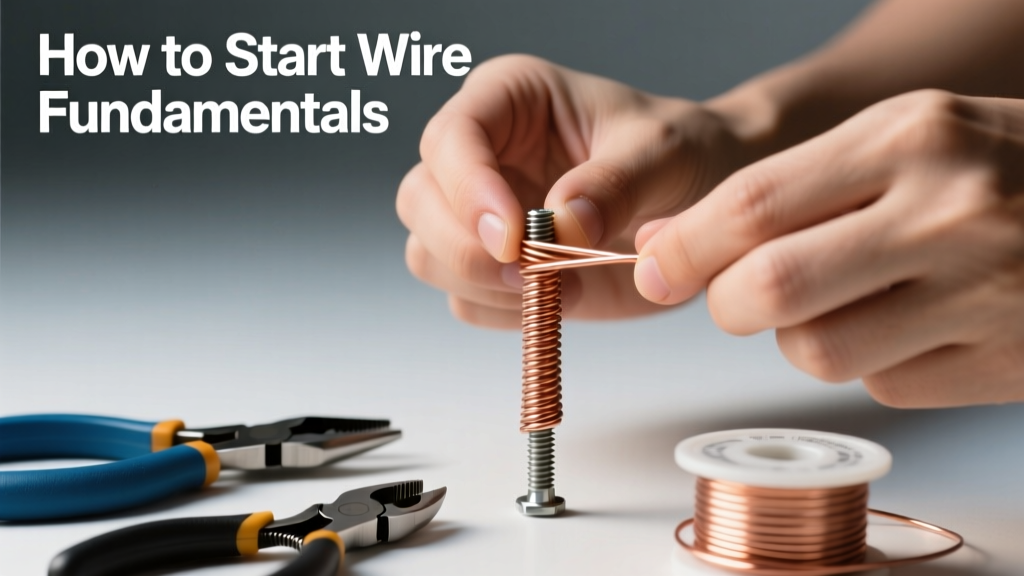
Starting with wire fundamentals means building competence in selecting, handling, measuring, terminating, and inspecting electrical conductors—before touching a circuit breaker or installing a receptacle. This foundation directly impacts safety, code compliance, energy efficiency, and system longevity. Misapplied wire causes 42% of non-weather-related residential electrical fires (NFPA 921, 2023). Key starting points include understanding American Wire Gauge (AWG) sizing—where 14 AWG copper supports up to 15 amps at 75°C, while 12 AWG handles 20 amps—and recognizing that THHN insulation is rated for 90°C dry locations but only 75°C when bundled. Real brands matter: Southwire’s SIMpull® NM-B cable reduces pulling force by 33% versus standard NM-B, and Ideal’s Wing-Nut® wire connectors are UL-listed for 600V and tested to withstand 25 lb pull force per connection. This article walks through core concepts with precise data, actionable steps, and field-proven techniques—not theory alone.
Why Wire Fundamentals Matter More Than You Think
Wire is not a passive component—it’s the circulatory system of every electrical installation. Its physical properties dictate voltage drop, thermal performance, fault current capacity, and electromagnetic compatibility. Using 16 AWG wire on a 20-amp circuit violates NEC Article 240.4(D) and creates an immediate fire hazard; the National Fire Protection Association reports that improper conductor sizing contributes to 18,200 home structure fires annually in the U.S. (NFPA Fire Analysis & Research, 2022). Beyond safety, wire choice affects operational costs: a 100-foot 12 AWG run powering a 1,200W load at 120V incurs 2.1V drop (1.75%), while the same distance in 14 AWG yields 3.4V drop (2.83%)—reducing light output and motor torque. Industry professionals consistently cite misidentified insulation types as the #2 cause of failed inspections (2023 NECA Field Survey, n=1,247 contractors).
Understanding Conductor Types and Material Properties
Copper remains the dominant conductor material due to its 58.0 MS/m conductivity (International Annealed Copper Standard), low thermal expansion coefficient (16.5 × 10⁻⁶/°C), and reliable oxide behavior. Aluminum, though lighter and less expensive, has only 61% of copper’s conductivity and requires larger cross-sections—for example, a 12 AWG copper wire carries 20A, but aluminum needs 10 AWG to match that capacity per NEC Table 310.16. Stranded vs. solid construction also matters: solid wire is rigid and ideal for permanent residential branch circuits (e.g., 14 AWG Romex® NM-B from Southwire); stranded offers flexibility for appliance cords (e.g., SJOOW portable cord rated 300V, -40°C to 60°C) and panel feeders.
Common Insulation Types and Their Ratings
Insulation defines where and how a wire can be used. THHN (Thermoplastic High Heat-resistant Nylon-coated) is ubiquitous in conduit: rated 90°C dry / 75°C wet, 600V, UL Type THHN. It features a nylon jacket over PVC, providing abrasion resistance during pulls. In contrast, XHHW-2 uses cross-linked polyethylene (XLPE), offering 90°C wet/dry rating and superior dielectric strength (45 kV/mm vs. THHN’s 28 kV/mm). For outdoor direct burial, USE-2 (Underground Service Entrance) cable—such as Belden 1583A—is sunlight-resistant, moisture-proof, and rated 90°C, but cannot be used inside structures per NEC 338.10(B)(2).
Copper vs. Aluminum: When Each Is Appropriate
Aluminum service entrance cables (e.g., Southwire 750 kcmil XHHW-2) are standard for 200A+ residential mains because they reduce weight and cost without sacrificing ampacity—750 kcmil Al carries 320A at 75°C (NEC Table 310.16), versus 800 kcmil Cu needed for equivalent capacity. However, aluminum requires antioxidant paste (e.g., Burndy Kopr-Shield®) and torque-specific lugs (UL 486A-B listed) to prevent cold flow and oxidation. NEC 110.14(A) mandates that terminals be marked for aluminum use—most standard residential breakers are not, making Cu mandatory for branch circuits under 125A.
Decoding AWG: Size, Ampacity, and Voltage Drop Calculations
American Wire Gauge (AWG) is logarithmic: each 3-gauge decrease doubles cross-sectional area. A 10 AWG wire has 10,380 circular mils (CM); 12 AWG has 6,530 CM; 14 AWG has 4,110 CM. NEC Table 310.16 provides ampacity ratings based on conductor material, insulation type, and ambient temperature. At 30°C ambient, 14 AWG THHN copper is rated 25A in free air—but drops to 15A when installed in NM-B cable with three current-carrying conductors (NEC 310.15(B)(2)(a) derating). Voltage drop must stay ≤3% for branch circuits per NEC 210.19(A)(1) Informational Note No. 4. Calculate it precisely: VD = (K × 2 × L × I) ÷ CM, where K = 12.9 for copper, L = one-way length in feet, I = load amperes, CM = circular mils. For a 120V, 15A load at 85 feet using 14 AWG: VD = (12.9 × 2 × 85 × 15) ÷ 4110 ≈ 8.0V (6.7%)—violating code and requiring 12 AWG (VD = 5.0V, 4.2%).
Real-World Sizing Examples
Consider a 240V, 40A EV charger installed 60 feet from the panel. NEC requires minimum 6 AWG copper THHN (55A ampacity at 75°C) or 4 AWG aluminum (65A). But voltage drop matters more here: 6 AWG Cu yields VD = (12.9 × 2 × 60 × 40) ÷ 26240 ≈ 2.4V (1.0%)—acceptable. Now imagine a security camera PoE++ (IEEE 802.3bt) running 100W at 52V over 275 feet. Cat6 cable (23 AWG, 205 CM) gives VD = (12.9 × 2 × 275 × 1.92) ÷ 205 ≈ 6.6V—leaving only 45.4V at the device, below the 44–57V operational range. Solution: use shielded Cat6a with 22 AWG (255 CM) or install a local 52V power supply.
Termination Methods and Connector Selection
Over 68% of field failures originate at terminations—not the wire itself (2022 IEEE PES Distribution Reliability Report). Proper termination requires matching connector type to conductor class, size, and environment. Wire nuts (e.g., Ideal 30-110 red, rated for 2–4 #14 AWG) rely on spring tension and twisting; they’re prohibited for aluminum-to-copper splices (NEC 110.14(A)). Instead, use irreversible crimps: the Panduit CP14-6B copper lug accepts 14–6 AWG, requires a Panduit H500 hydraulic tool (3.5-ton pressure), and achieves <0.1mΩ contact resistance when properly applied. For panel neutral bars, torque matters critically—Square D QO breakers demand 50 in-lb for 14–10 AWG Cu (QO Catalog 0600DB0201, p. 24); under-torquing increases resistance and heat; over-torquing deforms lugs and voids UL listing.
Stripping and Preparation Best Practices
Strip length must match connector depth exactly: too short exposes uninsulated copper beyond the connector; too long leaves bare wire vulnerable to shorting. For a 12 AWG THHN wire entering an Ideal 30-110, strip 0.50 inches (12.7 mm)—the exact insertion depth stamped on the connector body. Use a precision stripper like the Klein Tools 11055, which auto-adjusts for AWG and prevents nicking (copper nicks reduce tensile strength by up to 40%). Never use utility knives or pliers—these deform strands and create stress risers. After stripping, twist stranded wires clockwise with lineman’s pliers (e.g., Channellock 9.5") until uniform and compact—no splaying.
Grounding and Bonding Wire Requirements
Equipment grounding conductors (EGCs) follow distinct rules. NEC 250.122 specifies EGC size based on overcurrent protection—not load current. A 60A breaker feeding a subpanel requires an 10 AWG Cu EGC (not 6 AWG like the hot conductors). For a 400A service, the grounding electrode conductor (GEC) to a ground rod must be at least 2 AWG Cu (NEC 250.66(A)). Burying bare copper GEC? Use 6 AWG minimum for rods (NEC 250.66(C)), but note that 4 AWG is required if connected to a concrete-encased electrode (Ufer ground). All grounding connections must be exothermically welded or listed irreversible compression connectors—no split-bolts or solder-only joints.
Safety Standards, Code Compliance, and Inspection Readiness
Three standards govern wire fundamentals in North America: NEC (NFPA 70), UL 83 (thermoplastic wires), and UL 44 (thermoset wires). UL listing is mandatory for all conductors sold in the U.S.; look for the UL Mark followed by “AWM” (Appliance Wiring Material) or “RHH/RHW” (building wire). NEC updates triennially—the 2023 edition introduced new requirements for AFCI protection in dwelling unit outlets (210.12(B)) and clarified that NM-B cable cannot be used in damp locations like basements unless marked “NM-B with moisture-resistant jacket” (e.g., Southwire 56627202). Violating these triggers automatic inspection failure. In California, Title 24 mandates solar-ready wiring: 12 AWG Cu THWN-2 must be pre-pulled from roof to panel with labeled conduit stubs—verified by county inspectors using a calibrated tape measure and UL certification lookup.
Hands-On Practice: Your First 5-Wire Project
Begin with a controlled, low-risk project: installing a dedicated 20A circuit for a workshop outlet using 12/2 NM-B cable. Follow this verified sequence:
- Verify panel space: confirm 20A double-pole breaker fits your Square D Homeline panel (HOM220CP)
- Select cable: Southwire 12/2 NM-B SIMpull® (Cat. # 56627202), 250 ft box
- Measure and cut: Use a Stanley FatMax tape (Class II, ±1.5 mm accuracy) to mark 42 ft 6 in—add 3 ft for panel and outlet box loops
- Drill holes: 3/4" holes centered 1.25" from stud edges (NEC 300.4(A)(1))
- Secure cable: Use Arlington CD2S staples, spaced ≤4.5 ft apart and within 12" of boxes
- Strip and terminate: Klein 11055 stripper set to 12 AWG; 0.5" strip length; Ideal 30-110 orange wire nut (2–3 #12)
- Label everything: Use Brother P-touch PT-D600 labeler with laminated 0.5" tape; mark circuit “WORKSHOP OUTLET – 20A”
This project reinforces AWG identification, NEC spacing rules, proper stripping, and torque-free termination—all before energizing. Document each step with photos and notes; most jurisdictions require a rough-in inspection before drywall. Bring your printed NEC 2023, UL White Book, and cable spec sheet to the inspection—inspectors routinely verify markings against UL’s online database (ul.com/database).
Troubleshooting Common Wire Issues
Even experienced electricians encounter recurring problems. Here’s how to diagnose and resolve them:
- Hot neutral bar in panel: Indicates shared neutrals or bootleg grounds. Use a Fluke 323 clamp meter to measure neutral current—if >5% of phase current, isolate circuits and check for MWBC miswiring.
- Frequent GFCI tripping: Often caused by undersized or damaged NM-B sheathing allowing moisture ingress into junction boxes. Replace with UF-B for outdoor runs or add weatherproof conduit bodies (e.g., Hubbell HBL220P).
- Voltage drop complaints on HVAC: Verify conductor size against nameplate FLA (Full Load Amps). A 5-ton AC unit drawing 28.5A FLA requires minimum 10 AWG Cu per NEC 440.33—but 8 AWG is recommended for 150-ft runs to hold VD <2%.
- Discolored wire insulation near outlets: Signifies sustained overheating. Check torque with a Wiha 20700 torque screwdriver (set to 50 in-lb for Leviton Decora); retorque and retest with infrared thermometer (Fluke 62 Max+).
| Wire Type | Typical Use | Ampacity (75°C) | Max Temp Rating | Key Brand Example | UL Standard |
|---|---|---|---|---|---|
| THHN | Conduit runs, commercial panels | 30A (#10 Cu) | 90°C dry / 75°C wet | Belden 8761 | UL 83 |
| XHHW-2 | Service entrances, industrial feeders | 55A (#10 Cu) | 90°C wet/dry | Southwire 56627202 | UL 44 |
| NM-B | Residential dry-location branch circuits | 20A (#12 Cu) | 90°C (conductor), 60°C (sheath) | Southwire SIMpull® | UL 719 |
| USE-2 | Direct burial, underground service | 40A (#8 Al) | 90°C, sunlight resistant | Belden 1583A | UL 854 |
| TECK90 | Hazardous locations, exposed industrial | 35A (#10 Cu) | 90°C, oil-resistant, flame-retardant | General Cable TECK90 | UL 13 |
Mastering wire fundamentals isn’t about memorizing tables—it’s about developing pattern recognition across materials, environments, and loads. When you see a yellow-jacketed 10 AWG wire labeled “THWN-2”, you immediately know it’s suitable for wet conduit but not for direct burial. When a customer says their LED lights dim when the AC kicks on, you calculate voltage drop before opening the panel. These reflexes come from deliberate practice with real products, verified calculations, and strict adherence to documented standards—not guesswork. Start small: buy one reel of 12/2 NM-B, one pack of Ideal wire nuts, and a Klein voltage tester. Measure, cut, strip, connect, and verify—then repeat. Every correctly terminated wire builds confidence, competence, and credibility. The physics doesn’t change: 12.9 × 2 × L × I ÷ CM is always the voltage drop. Your job is to make that math visible, repeatable, and safe—every time.
Remember that wire fundamentals anchor all higher-level electrical work—from designing renewable energy systems to commissioning data centers. Data center cabling standards (TIA-942) require 10 AWG grounding conductors for rack PDUs, while NEC 690.31(E) mandates PV wire (e.g., SunBandit PV Wire 10 AWG) rated 150°C and sunlight-resistant. These aren’t arbitrary choices—they reflect decades of failure analysis and thermal modeling. By grounding your practice in precise measurements, brand-specific specifications, and enforceable code language, you transform wire from a commodity into a calculated engineering element. That shift—from installer to informed specifier—is where professional authority begins.
Finally, treat wire as a living component. Its resistance changes with temperature (copper α = 0.00393/°C), its insulation degrades with UV exposure (XHHW-2 loses 30% tensile strength after 10,000 hours at 60°C per ASTM D1307), and its ampacity falls with ambient heat (derate 15% at 40°C per NEC Table 310.15(B)(1)). Respect those variables, document your assumptions, and verify outcomes—not just once, but continuously. That discipline separates competent practitioners from exceptional ones.
There’s no substitute for hands-on verification. Before calling an inspector, test continuity with a Fluke 1587 FC (0.01Ω resolution), check ground-fault impedance with a Megger MIT420 (100V DC, 200 MΩ range), and validate torque with a calibrated tool. Record all values in a simple spreadsheet: date, circuit, conductor size, measured resistance, ambient temp, and inspector initials. Over time, this log becomes your personal benchmark—revealing patterns no textbook captures. Wire fundamentals aren’t static knowledge; they’re a dynamic skill set refined by measurement, reflection, and repetition. Start today—with one wire, one calculation, one correct termination.
When selecting tools, prioritize metrological traceability. A $12 Harbor Freight tape measure may drift ±3 mm over 10 meters; a Starrett 730B-6 (NIST-traceable, Class I) holds ±0.15 mm. That difference determines whether your 12 AWG run meets NEC 300.18’s 30-inch maximum unsupported length—or violates it. Precision compounds: correct strip length enables proper connector engagement, which ensures low-resistance joints, which prevents heating, which avoids insulation breakdown. It’s a chain where every link depends on the one before. Build yours deliberately.
Industry certifications reinforce this rigor. The ETA Certified Electronics Technician (CET) requires passing a 100-question exam covering AWG conversion, derating factors, and NEC Article 310 applications. The NCCER Electrical Level 1 curriculum dedicates 24 hours exclusively to conductor selection and termination. These aren’t hoops to jump through—they’re validation that your wire fundamentals meet nationally recognized benchmarks. Enroll in one. Take the test. Then apply what you’ve learned—not on paper, but on the next 12/2 cable you pull.
Every wire you handle carries legacy: decades of fire investigations, laboratory testing, and field experience encoded in its gauge, insulation, and markings. Treat it with that respect. Measure twice. Strip once. Terminate to spec. Verify with instruments—not assumptions. That’s how wire fundamentals become second nature—and how you build installations that last, protect, and perform.


