High voltage fencing is a pulsed-DC electrical circuit that uses brief, high-voltage (typically 2,000V–10,000V) and low-current shocks to deter animals or intruders without causing lethal harm. Unlike standard continuous AC or DC circuits that rely on a dedicated physical wire for the return path, high voltage fencing changes the circuit topology by using the earth itself as the return conductor (a ground-return circuit). People commonly confuse this system with continuous high-voltage power transmission lines or illegal mains-voltage 'hot wires,' assuming the danger lies in the voltage rather than understanding that the extremely short pulse duration and low average current are what make it non-lethal.
The Circuit Theory Behind the Shock
At the heart of any high voltage fencing system is the energizer (often called a charger). Modern solid-state energizers do not output a continuous stream of electricity. Instead, they utilize a capacitor-discharge circuit. The internal circuitry draws power from a 120V AC mains source, a 12V DC battery, or a solar panel, and uses it to slowly charge a high-capacity capacitor.
Once per second, a timing circuit triggers a switch (usually a thyristor or IGBT) that dumps the stored energy into the primary winding of a step-up transformer. The secondary winding then releases a massive voltage spike onto the fence wire. This pulse typically lasts for only 150 microseconds (0.00015 seconds) and repeats at a rate of 1 Hz (one pulse per second).
The microsecond pulse duration is a critical safety feature. According to OSHA electrical safety guidelines, the 'let-go' threshold—the point at which muscle tetanus prevents a person or animal from releasing a live conductor—requires sustained current flow. A 150 µs pulse is far too brief to induce ventricular fibrillation or sustained muscle contraction, allowing the subject to reflexively pull away.
Worked Numeric Example: Sizing an Energizer and Grounding
To understand how high voltage fencing operates in a real installation, let's calculate the electrical requirements and physical sizing for a 5-mile perimeter fence designed for cattle containment.
1. Sizing the Energizer Output (Joules)
The industry rule of thumb for agricultural fencing is 1 stored Joule of output energy per mile of fence line, assuming moderate weed load. For a 5-mile fence, we need an energizer rated for at least 5 Joules of stored energy per pulse.
2. Peak vs. Average Current Calculation
This is where the circuit theory proves why the fence is non-lethal. Assume our 5-Joule energizer outputs a peak voltage of 5,000V across a 150 µs pulse.
- Peak Power: Power = Energy / Time = 5 J / 0.00015 s = 33,333 Watts (peak).
- Peak Current: Current = Power / Voltage = 33,333 W / 5,000 V = 6.67 Amps (peak). This is what the animal feels as a sharp, painful snap.
- Average Power: Since it pulses once per second, Average Power = 5 J / 1 s = 5 Watts.
- Average Current: Average Current = 5 W / 5,000 V = 0.001 Amps (1 mA).
While the peak current is high enough to trigger pain receptors, the average current over time is a mere 1 milliamp—well below the 5 mA threshold for perception in humans and entirely non-lethal.
3. Sizing the Ground Return System
The ground return is the most critical part of the circuit. If the earth resistance is too high, the circuit cannot close, and the shock is weak. The standard sizing formula requires 3 feet of ground rod per Joule of energizer output.
- 5 Joules × 3 feet/Joule = 15 feet of total ground rod.
- Installation: Drive three 5-foot galvanized ground rods into the earth, spacing them at least 10 feet apart, and bond them together with continuous 12 AWG bare copper wire or high-tensile fence wire.
Where You Meet This in Practice
High voltage fencing is deployed across several distinct fields, each with specific circuit requirements:
- Agricultural Livestock Containment: Used for cattle, sheep, and horses. These systems rely on high-tensile smooth wire and polytape, requiring energizers in the 2 to 10 Joule range. The animal's hooves provide the ground connection.
- Wildlife Exclusion: Used to deter bears, deer, and wild boars from crops or apiaries. Bear fences often require tighter wire spacing (e.g., alternating hot and ground wires) because a bear's thick fur and dry paws increase contact resistance.
- Perimeter Security: Commercial and military installations use high voltage fencing as a non-lethal deterrent. These systems often incorporate continuous current monitoring and alarm circuits that trigger if the wire is cut or shorted to ground.
Troubleshooting the Ground Return Circuit
In practice, 90% of high voltage fencing failures are not caused by the energizer, but by a degraded ground return circuit. The earth is a highly variable resistor. During dry summer months or in sandy soils, earth resistance can spike above 1,000 ohms, preventing the circuit from closing effectively.
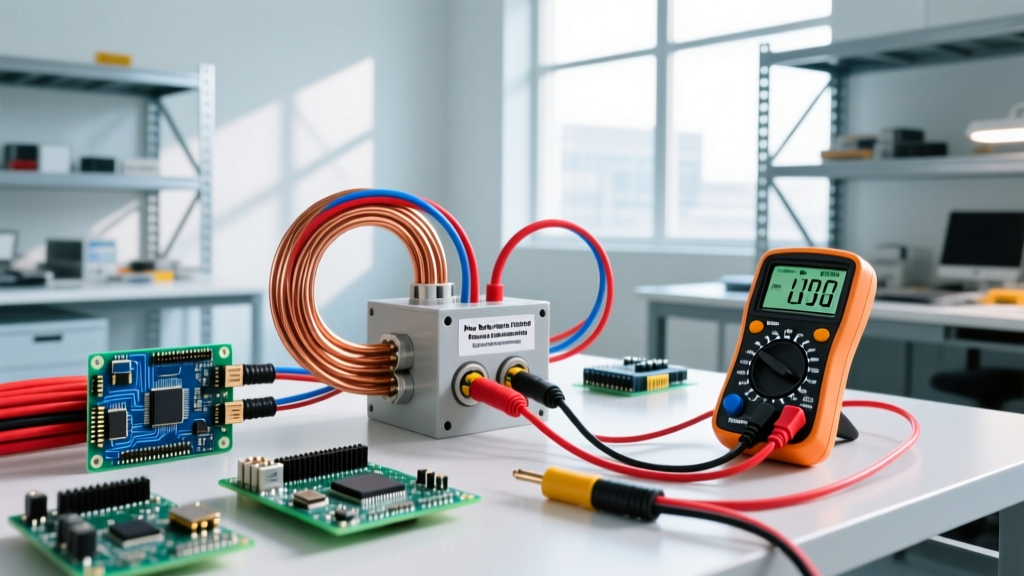
To diagnose this, use a standard digital multimeter. Set it to measure AC/DC voltage. Have a second person intentionally short the fence wire to a ground rod using a piece of metal (this simulates an animal touching the wire). While the wire is shorted, measure the voltage between the energizer's ground terminal and a separate, isolated metal stake driven into the soil 50 feet away. If you read more than 400 volts on your meter, your ground system is inadequate and carrying too much voltage drop. You must add more ground rods or install an earth-return wire (a grounded wire run parallel to the hot wire) to bypass the high-resistance soil.
For deeper technical specifications on agricultural installations, the Food and Agriculture Organization (FAO) solar electric fencing guidelines provide excellent regional soil-resistance data and wiring schematics.
Frequently Asked Questions
Is high voltage fencing lethal to humans or pets?
No. As demonstrated in the pulse math above, the lethality of an electrical shock is determined by the average current flow and duration, not just the peak voltage. Because high voltage fencing limits the pulse to roughly 150 microseconds and restricts the average current to a few milliamps, it causes a painful reflex reaction but cannot induce cardiac arrest or sustained muscle tetanus in humans, dogs, or livestock.
Can I hook a high voltage fence directly to a 120V wall outlet?
You can plug a mains-powered energizer into a 120V wall outlet, but you must never wire the 120V line voltage directly to the fence wire. Mains power provides continuous AC current at 60Hz. Direct contact with a continuous 120V/240V AC circuit is highly lethal and violates all electrical codes. The energizer contains internal transformers and rectifiers specifically designed to convert that 120V AC into the safe, high-voltage pulsed DC required for the fence.
Why does my high voltage fence click but not shock?
The clicking sound is the internal spark gap or transformer discharging, proving the energizer is generating voltage. If there is no shock when touching the wire, the circuit is open. The most common culprits are a dry or inadequate ground rod system (preventing the earth return), heavy vegetation touching the wire and bleeding the voltage to ground before it reaches the animal, or a cracked insulator allowing the current to leak into the wooden or metal fence posts. Manufacturers like Parmak recommend using a dedicated fence voltmeter to trace where the voltage drop occurs along the line.
What is the difference between high voltage fencing and continuous electric wire?
Continuous electric wire (sometimes used in old, illegal, or highly specific industrial applications) outputs a steady stream of current. If an animal or person grabs continuous wire, the sustained current causes muscles to lock, trapping the victim on the wire and leading to electrocution. High voltage fencing uses pulsed DC with a 1-second off-time between microsecond pulses, allowing the subject's muscles to relax and reflexively pull away from the wire immediately after the initial shock.