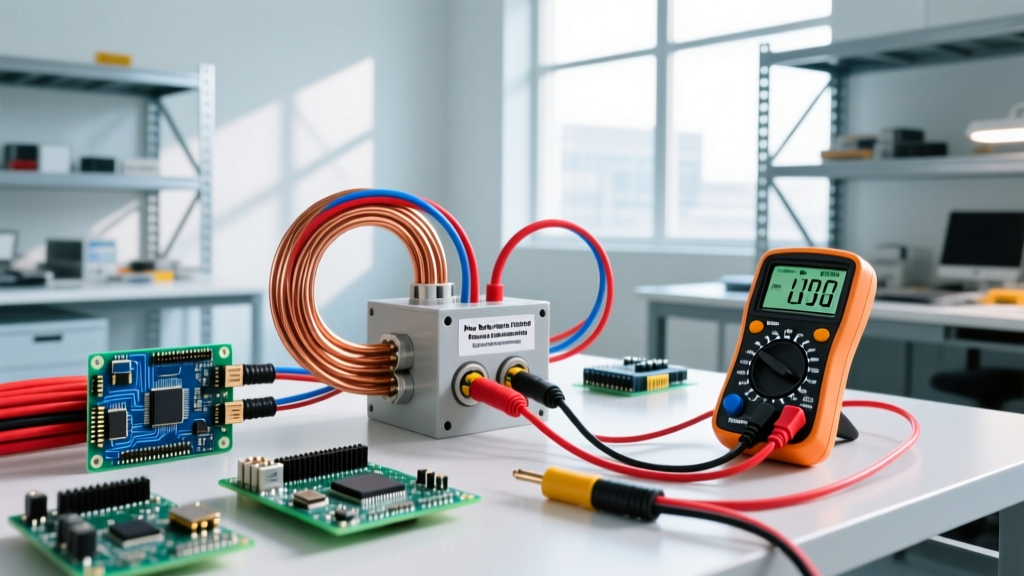

At a standard 240V single-phase residential supply, 10,000 watts equals 41.67 amps. If you are running this load on a 120V branch circuit, it draws 83.33 amps. The exact amperage depends entirely on your system voltage, the number of phases, and the power factor of the equipment. For a purely resistive DC or single-phase AC load, the formula is I = P / V. Substituting our values for a 240V circuit: 10,000W / 240V = 41.67A. For three-phase power, the formula shifts to I = P / (√3 × V × PF), which drastically lowers the current draw per leg.
10,000 Watt Amperage Across Standard Voltages
Because watts measure real power and amps measure current flow, you cannot convert between them without knowing the system voltage. Below is the primary reference chart for a 10kW (10,000W) load across common North American and international voltages. This table assumes a Power Factor (PF) of 1.0, which is standard for resistive loads like electric heat strips, tankless water heaters, or large EV chargers.
| System Voltage | Phase Type | Formula Used | Calculated Amps | Min. Breaker (125% Continuous) |
|---|---|---|---|---|
| 12V DC | DC | I = P / V | 833.33 A | 1000 A (or Busbar) |
| 120V AC | Single-Phase | I = P / V | 83.33 A | 100 A or 125 A |
| 208V AC | Three-Phase | I = P / (√3 × V) | 27.76 A | 35 A or 40 A |
| 230V AC | Single-Phase | I = P / V | 43.48 A | 50 A or 60 A |
| 240V AC | Single-Phase | I = P / V | 41.67 A | 50 A or 60 A |
| 480V AC | Three-Phase | I = P / (√3 × V) | 12.03 A | 15 A or 20 A |
Note: Breaker sizing assumes the 10kW load is continuous (running for 3 hours or more), requiring the 125% multiplier per NEC Article 210.20(A). If the load is non-continuous, standard breaker sizing applies.
Neighboring Load Values (8,000W to 12,000W at 240V)
In real-world applications, a "10kW" load is rarely exactly 10,000 watts. Heating elements fluctuate with voltage drops, and inverter efficiencies vary. Here is how the amperage shifts across a ±20% range (8kW to 12kW) on a standard 240V single-phase split-phase system.
| Real Power (Watts) | Amps at 240V (1-Phase) | Amps at 208V (3-Phase) | Amps at 480V (3-Phase) |
|---|---|---|---|
| 8,000 W | 33.33 A | 22.21 A | 9.62 A |
| 9,000 W | 37.50 A | 24.98 A | 10.83 A |
| 10,000 W | 41.67 A | 27.76 A | 12.03 A |
| 11,000 W | 45.83 A | 30.53 A | 13.23 A |
| 12,000 W | 50.00 A | 33.31 A | 14.43 A |
Notice how shifting from a 240V single-phase residential supply to a 208V three-phase commercial supply drops the current per leg from 41.67A to 27.76A. This is why large commercial HVAC units and industrial machinery use three-phase power: it delivers the same wattage using significantly less current per conductor, allowing for smaller wire gauges and reduced I²R (heat) losses in the conductors.
The Assumptions That Fix Your Answer
The conversions above rely on a critical assumption: a Power Factor (PF) of 1.0. This is true for resistive loads like incandescent lighting, space heaters, and resistive dummy loads. However, if you are sizing a circuit for a 10kW inductive load—such as a large air compressor motor, a commercial transformer, or a bank of fluorescent ballasts—the conversion becomes meaningless without knowing the PF.
Inductive loads require reactive power to establish magnetic fields. This means the apparent power (measured in Volt-Amps, VA) is higher than the real power (measured in Watts). The true formula for AC amperage is I = P / (V × PF) for single-phase, and I = P / (√3 × V × PF) for three-phase.
- Resistive Load (PF = 1.0): 10,000W / 240V = 41.67A.
- Inductive Motor (PF = 0.80): 10,000W / (240V × 0.80) = 52.08A.
If you size a breaker and wire for 41.67A on a 10kW motor with a 0.80 power factor, you will draw 52A and trip a 50A breaker immediately, or worse, overheat the conductors if the breaker fails to trip. As noted in standard AC circuit theory references, always check the equipment nameplate for the rated FLA (Full Load Amps) or the specific power factor before finalizing your wire size. Never rely solely on a watts-to-amps conversion for motor circuits.
Frequently Asked Questions: Wiring and Protection
What size breaker do I need for a 10,000 watt load at 240V?
If the load is continuous (on for 3+ hours), NEC-style guidance requires you to multiply the calculated amps by 1.25. 41.67A × 1.25 = 52.08A. Since 52A is not a standard breaker size, you must step up to the next standard size, which is a 60-amp double-pole breaker. If the load is strictly non-continuous, a 50-amp breaker is permissible, but 60A is the safer, more common choice for future-proofing.
What wire gauge handles 10,000 watts at 240V?
For a 60-amp breaker, you need wire rated for at least 60 amps. According to the 75°C column of standard ampacity tables, 6 AWG copper THHN/THWN wire is rated for 65 amps and is the correct choice. If you are using NM-B (Romex) cable, you are restricted to the 60°C column, where 6 AWG is only rated for 55 amps. In that specific case, you must step up to 4 AWG copper NM-B to safely handle the 60A breaker.
Can I plug a 10kW load into a standard 120V outlet?
Absolutely not. At 120V, 10,000 watts draws 83.33 amps. A standard NEMA 5-15R household outlet is rated for only 15 amps (or 20 amps on a dedicated 20A circuit). Attempting to pull 83A through a 120V branch circuit will instantly melt the receptacle, trip the main breaker, and create a severe fire hazard. A 10kW load requires a dedicated 240V hardwired connection or a high-amperage receptacle like a NEMA 14-50 (rated for 50A, which would still be insufficient for 10kW continuous without derating).