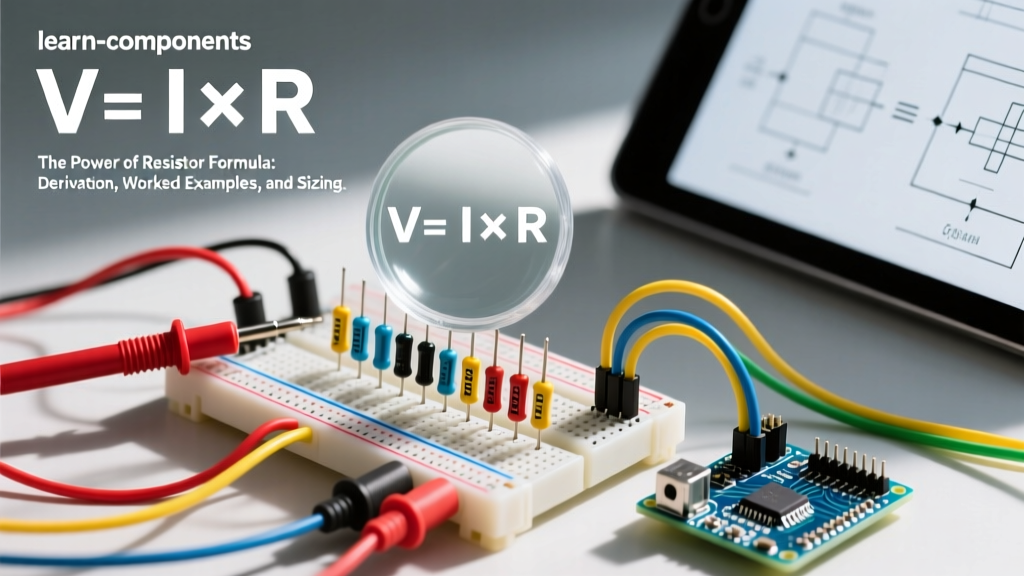
The fundamental formula for Ohms Law is V = I × R. This equation defines the linear relationship between voltage (V), current (I), and resistance (R) in an electrical circuit. Whether you are sizing a current-limiting resistor for an LED on a breadboard or calculating the voltage drop on a 50-foot THHN wire feeder to a subpanel, this single algebraic relationship is the baseline for all DC circuit analysis.
The Core Equation and Symbol Definitions
Before plugging numbers into a calculator, you must map your physical measurements to the correct mathematical symbols and base SI units. Mixing up milliamps and base amps is the most common reason bench calculations fail.
| Symbol | Quantity | SI Unit | Unit Abbreviation | Typical Bench Magnitude |
|---|---|---|---|---|
| V | Voltage (Potential Difference) | Volt | V | 3.3V (logic), 12V (auto), 120V (mains) |
| I | Current (Electron Flow) | Ampere | A | 20mA (LED), 2A (strip), 15A (branch circuit) |
| R | Resistance (Opposition to Flow) | Ohm | Ω | 220Ω (resistor), 0.5Ω (wire), 10kΩ (pull-up) |
Rearranged Forms for Circuit Analysis
Because you rarely know all three variables on a workbench, you need the formula for Ohms law rearranged to solve for the missing value. Here is the complete algebraic set:
- To find Voltage (V): Multiply current by resistance.
V = I × R - To find Current (I): Divide voltage by resistance.
I = V / R - To find Resistance (R): Divide voltage by current.
R = V / I
These three forms cover 99% of basic DC troubleshooting. If you know the supply voltage and the resistance of the load, you use the current form to figure out what size fuse or breaker you need to protect the circuit.
Worked Examples with Strict Unit Tracking
Theoretical formulas are useless if you drop a decimal point. Below are two real-world scenarios demonstrating how to apply the formula for Ohms law with explicit intermediate steps and dimensional unit tracking.
Problem 1: Sizing an LED Current-Limiting Resistor
Scenario: You are powering a standard 5mm red LED from a 5V Arduino Nano GPIO pin. The LED datasheet specifies a forward voltage ($V_f$) of 2.0V and a maximum continuous forward current of 20mA. What resistance do you need?
- Convert to base SI units: The formula requires Amperes, not milliamperes.
20mA = 0.020 A. - Determine the voltage across the resistor ($V_R$): The resistor only sees the voltage left over after the LED drops its share.
$V_R = V_{source} - V_f = 5V - 2.0V = 3.0V$. - Select the correct rearranged formula: We need to solve for R.
$R = V / I$. - Substitute values and track units:
$R = 3.0V / 0.020A = 150 (V/A)$.
Since 1 Volt per Ampere is defined as 1 Ohm, $R = 150Ω$. - Real-world component selection: 150Ω is not a standard E12 series value. To ensure the LED doesn't burn out if the 5V rail runs slightly hot, round up to the next standard value: 180Ω or 220Ω.
Problem 2: Calculating Voltage Drop on a Wire Feeder
Scenario: You are running 50 feet of 14 AWG THHN copper wire to a 12V DC water pump that draws 8A under load. Will the pump receive enough voltage to start? (The resistance of 14 AWG copper is approximately 2.525 Ω per 1,000 ft at 20°C).
- Calculate total wire length: Current must travel out to the pump and back to the source.
50 ft × 2 = 100 ft total conductor length. - Calculate total wire resistance (R):
$R = (100 ft / 1000 ft) × 2.525Ω = 0.2525Ω$. - Apply the formula for voltage drop:
$V_{drop} = I × R$. - Substitute and track units:
$V_{drop} = 8A × 0.2525Ω = 2.02 (A·Ω)$.
Since 1 Ampere times 1 Ohm equals 1 Volt, $V_{drop} = 2.02V$. - Sanity check the magnitude: A 2.02V drop on a 12V system is a 16.8% loss. DC motors typically require voltage to stay within 5% of nominal to start reliably under load. Conclusion: 14 AWG is too small. You must upsize to 10 AWG or 8 AWG to reduce the resistance and keep the voltage drop under 0.6V.
Assumptions, Limitations, and Fatal Unit Mistakes
The formula for Ohms law is elegantly simple, but it relies on strict physical assumptions. If you violate these, your math will perfectly predict a reality that doesn't exist.
When the Formula Applies (and When It Doesn't)
Ohm's Law strictly applies only to ohmic materials—components where resistance remains constant regardless of the applied voltage or current. Standard carbon film resistors, thick-film SMD resistors, and copper/aluminum wire at a stable temperature are ohmic.
The formula fails on non-ohmic devices. Diodes, LEDs, transistors, and incandescent light bulbs do not have a fixed resistance. As an incandescent bulb's tungsten filament heats up, its resistance increases dramatically. As detailed in the All About Circuits DC textbook, attempting to use V=IR to find the 'resistance' of a diode will yield a different number for every single voltage point you measure. For non-ohmic devices, you must rely on the manufacturer's I-V curve datasheet, not Ohm's Law.
The Temperature Assumption
Resistance is temperature-dependent. Copper wire has a temperature coefficient of roughly 0.00393 per °C. If you calculate the voltage drop of a 14 AWG wire at 20°C (68°F), but that wire is routed through a 50°C (122°F) attic in the summer, the actual resistance will be about 12% higher than your calculation. Always assume worst-case ambient temperatures when sizing conductors for continuous loads.
Fatal Unit Mistakes
The most common way to break the formula for Ohms law is mixing metric prefixes. If you multiply 5 milliamps (5mA) by 100 Ohms (100Ω), the answer is not 500 Volts. It is 0.5 Volts.
Always convert your measurements to the base SI units defined by NIST (Volts, Amperes, Ohms) before executing the math.
• milli (m) = $10^{-3}$ (divide by 1,000)
• kilo (k) = $10^3$ (multiply by 1,000)
• mega (M) = $10^6$ (multiply by 1,000,000)
Realistic Answer Magnitudes
Developing an intuition for realistic magnitudes will save you from wiring disasters.
• Microamps (µA): Normal for ESP32 deep-sleep modes or high-value pull-up resistors (e.g., 100kΩ).
• Milliamps (mA): Normal for logic circuits, LEDs, and small relays (e.g., 5mA to 50mA).
• Amps (A): Normal for motors, heaters, and branch circuits (e.g., 2A to 20A).
• Hundreds of Amps: If your formula spits out 400A on a 120V residential circuit, you haven't discovered a free energy source; you have calculated a dead short ($120V / 0.3Ω = 400A$). The breaker will trip instantly.
Frequently Asked Questions
What is the formula for Ohms law in AC circuits?
In Alternating Current (AC) circuits, resistance is replaced by Impedance (Z), which accounts for both resistance (R) and reactance (X) from capacitors and inductors. The formula becomes V = I × Z. Because AC voltage and current can be out of phase, these values are often calculated using complex numbers ($Z = R + jX$) and RMS (Root Mean Square) voltage measurements rather than peak voltages.
Why does the formula for Ohms law fail on diodes and LEDs?
Diodes and LEDs are semiconductor devices with an exponential current-voltage (I-V) relationship. Below their forward voltage threshold (e.g., ~0.7V for silicon, ~2.0V for red LEDs), they act like an open circuit (near infinite resistance). Once the threshold is crossed, current spikes exponentially while voltage remains relatively clamped. Because their resistance is constantly shifting based on the applied voltage, they are non-ohmic, and V=IR cannot be used to model their behavior linearly.
How do I calculate power using the formula for Ohms law?
Ohm's Law calculates electrical pressure, flow, and friction, but not heat or work. To find Power (P in Watts), you combine Ohm's Law with Joule's Law ($P = V × I$). By substituting the rearranged forms of Ohm's Law, you get two highly useful derivatives for bench work:
• P = I² × R (Used to calculate heat dissipation in a wire or resistor).
• P = V² / R (Used to calculate the power draw of a fixed-resistance heating element).
Bench tip: If your $I^2R$ calculation shows a 220Ω resistor dissipating 0.5W, a standard 1/4W (0.25W) through-hole resistor will overheat and fail. You must step up to a 1W physical package.
What is a realistic magnitude for current in a 12V DC system?
Current magnitude depends entirely on the load's resistance. A 5-meter strip of 5050 SMD LEDs typically draws about 1.2A to 2A per meter at 12V. A 12V compressor fridge might draw 5A to 8A during startup surges. Conversely, a 12V automotive starter motor can pull 150A to 250A due to its extremely low internal winding resistance. Always size your 12V fuses and wire gauges based on the maximum continuous draw plus a 25% safety margin, not the nominal operating current.