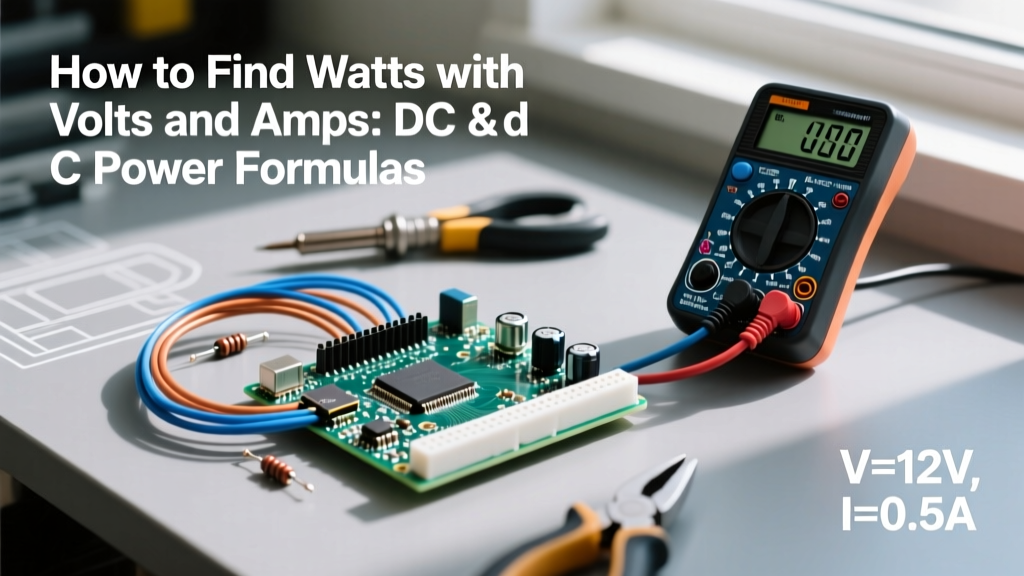

The Direct Answer: Watts measure the rate of electrical energy transfer, calculated by multiplying the electrical pressure (volts) by the flow rate (amps). To find watts with volts and amps in a basic DC circuit, simply multiply the two values together (W = V × A). For single-phase AC circuits with inductive loads, you must also multiply by the Power Factor (W = V × A × PF).
Understanding how to calculate real power is the dividing line between guessing and engineering. When you know exactly how many watts a load consumes, you stop blowing fuses, stop undersizing inverter cables, and stop tripping branch circuit breakers. Here is exactly how to calculate it across different environments, what it changes in your physical installation, and where the standard formula falls short.
The Core Formula: How to Find Watts with Volts and Amps in DC Circuits
In direct current (DC) systems—like solar arrays, automotive wiring, and battery banks—voltage and current are in perfect sync. The formula is straightforward:
Power (Watts) = Voltage (Volts) × Current (Amps)
However, the most common mistake DIYers make is using the nominal voltage of a system rather than the measured voltage. A '12V' lithium iron phosphate (LiFePO4) battery rarely sits at exactly 12.0V; it rests around 13.4V to 13.6V when fully charged and drops to 12.0V under heavy load.
Worked Numeric Example: You are testing a 200W nominal solar panel connected to a charge controller. Your multimeter reads 18.4V at the panel terminals, and your DC clamp meter reads 10.6A of current.
Calculation: 18.4V × 10.6A = 195.04 Watts.
If you had used the nominal '12V' or '18V' labels printed on the sticker, your calculation would be off by up to 15%, leading you to undersize your downstream wiring.
What Changes in AC: Power Factor and Real vs. Apparent Power
When you move to Alternating Current (AC), the simple V × A formula only works for purely resistive loads like incandescent heaters or toasters. For inductive loads (motors, compressors, transformers) or capacitive loads (switching power supplies), the voltage and current waveforms fall out of phase.
This phase shift creates a discrepancy between Apparent Power (Volt-Amps, or VA) and Real Power (Watts). To find actual watts in an AC circuit, you must introduce the Power Factor (PF), a ratio between 0 and 1.
AC Power Formula: Watts = Volts × Amps × Power Factor
Let us look at a real-world scenario. You have a 120V AC well pump motor drawing 12A on your clamp meter. The motor's nameplate specifies a Power Factor of 0.75.
- Apparent Power (VA): 120V × 12A = 1,440 VA
- Real Power (Watts): 120V × 12A × 0.75 = 1,080 Watts
According to Georgia State University's HyperPhysics reference on AC power, the utility company must supply the full 1,440 VA to push the current through the wires, but the motor only converts 1,080W into actual mechanical work. The rest is reactive power sloshing back and forth in the magnetic fields.
Where You Meet This in Practice: Sizing Breakers, Wires, and Inverters
Calculating watts changes physical hardware choices. It dictates thermal limits, wire gauge, and overcurrent protection. The most critical place you meet this is when sizing a DC-to-AC inverter and its battery feed cables.
Bench Tip: Always calculate the DC side of an inverter using the lowest expected battery voltage and account for inverter inefficiency. This yields the highest possible current, ensuring your wire and fuse sizing covers worst-case thermal stress.
The Scenario: You want to run a 1,200W microwave off a 12V LiFePO4 battery bank using a pure sine wave inverter.
- Base DC Current: 1,200W / 12.0V (low cutoff voltage) = 100A.
- Inverter Inefficiency: Inverters are typically 85% to 90% efficient. Divide by 0.85 to find the actual draw from the battery: 100A / 0.85 = 117.6A.
- Hardware Selection: Because the continuous draw exceeds 115A, you cannot use 4 AWG wire. You must step up to 2 AWG THHN or fine-strand welding cable (rated for 115A-130A depending on the temperature column) and install a 150A Class T or ANL fuse within 18 inches of the battery positive terminal.
If you had simply divided 1,200W by a nominal 14V and ignored inverter losses, you would have calculated 85A, mistakenly bought 4 AWG wire, and created a fire hazard under continuous load.
Decision Tree: Which Power Formula Do You Actually Need?
Use this decision path to select the correct formula and tooling for your specific measurement scenario.
| Circuit Type | Load Characteristic | Formula to Use | Required Tooling |
|---|---|---|---|
| DC (Solar, Auto, Battery) | Any (Resistive, LED, Motor) | W = V × A | Standard Multimeter + DC Clamp Meter |
| Single-Phase AC (120V/240V) | Purely Resistive (Heaters, Toasters) | W = V × A | Standard Multimeter + AC Clamp Meter |
| Single-Phase AC (120V/240V) | Inductive/Capacitive (Motors, SMPS) | W = V × A × PF | True RMS Meter + Power Quality Analyzer |
| Three-Phase AC (208V/480V) | Any (Industrial Motors, HVAC) | W = √3 × V(LL) × A × PF | 3-Phase Power Logger |
The Concrete Pick: If you are frequently troubleshooting unknown AC loads (like HVAC compressors or server racks) and cannot easily find the Power Factor on a nameplate, stop trying to calculate it manually. Default to a Fluke 376 FC True RMS Clamp Meter or a dedicated plug-in wattmeter like the Kill A Watt P3 P4400. These devices sample the voltage and current waveforms simultaneously, calculate the phase angle internally, and display real Watts directly on the screen.
Common Confusions: Watts vs. Volt-Amps vs. Amp-Hours
Misunderstanding these three units leads to the most common sizing errors in off-grid and backup power systems.
- Watts (W) vs. Volt-Amps (VA): Watts measure real power (work done, heat generated). VA measures apparent power (the total electrical burden on the wires and transformers). UPS (Uninterruptible Power Supply) systems are often rated in VA, not Watts. A '1000VA' UPS with a 0.6 PF can only support 600W of actual real power. Always check the W rating, not just the VA rating.
- Watts (W) vs. Watt-Hours (Wh): Watts are a rate (like miles per hour). Watt-hours are a total volume (like miles traveled). A 100W lightbulb running for 10 hours consumes 1,000Wh (1 kWh) of energy.
- Amp-Hours (Ah) vs. Watts: Battery capacity is often sold in Ah, but Ah is meaningless without voltage. A 100Ah 12V battery holds 1,200Wh (12V × 100Ah). A 50Ah 24V battery also holds 1,200Wh (24V × 50Ah). Always convert battery Ah to Wh to accurately compare energy storage across different voltage platforms.
Quick-Reference FAQ for Power Calculations
Can I use a cheap $15 multimeter to find AC watts?
No. Standard averaging multimeters assume a perfect sine wave and cannot measure True RMS voltage or current, let alone the phase angle required for Power Factor. For AC loads with switching power supplies (like LED drivers or PC power supplies), a cheap meter will give you dangerously inaccurate readings. You need a True RMS meter at minimum, and a wattmeter for actual wattage.
Why does my 15A, 120V breaker trip when my load only calculates to 1,400W?
A 15A breaker at 120V can theoretically handle 1,800W (120 × 15). However, the National Electrical Code (NEC) requires continuous loads (those running for 3 hours or more) to be derated to 80% of the breaker's capacity. 1,800W × 0.80 = 1,440W. If your load is 1,400W and runs continuously, you are right on the edge of the thermal trip curve. Move the load to a 20A circuit.
Do I need to calculate watts to size a solar charge controller?
Yes, but you must look at both the Watt limit and the Amp limit. A 40A MPPT charge controller on a 12V battery bank can handle roughly 520W (40A × 13V charging voltage). If you upgrade that same 40A controller to a 24V battery bank, it can now handle 1,040W (40A × 26V). The amp limit stays the same, but the watt capacity doubles because the voltage doubled.


