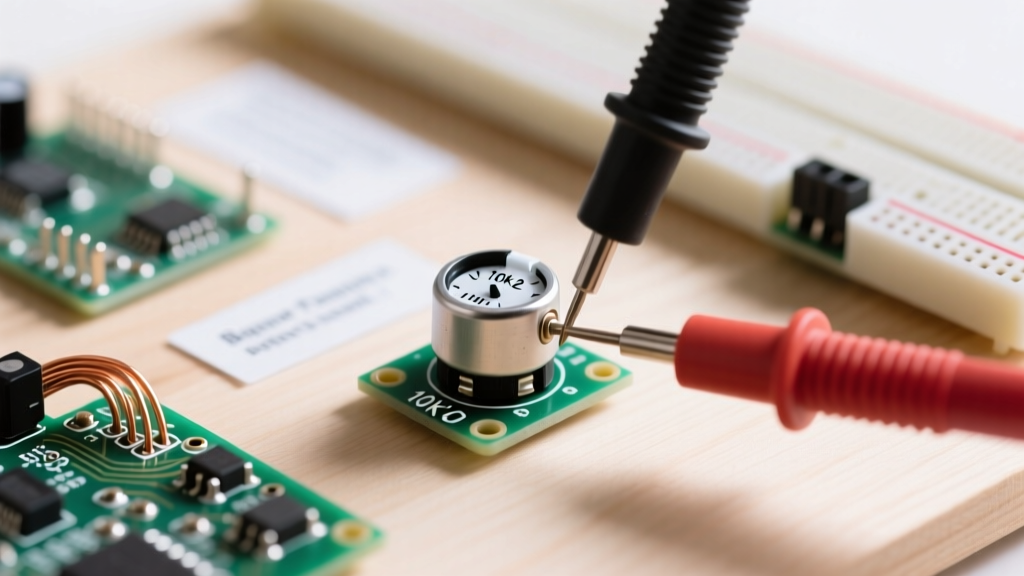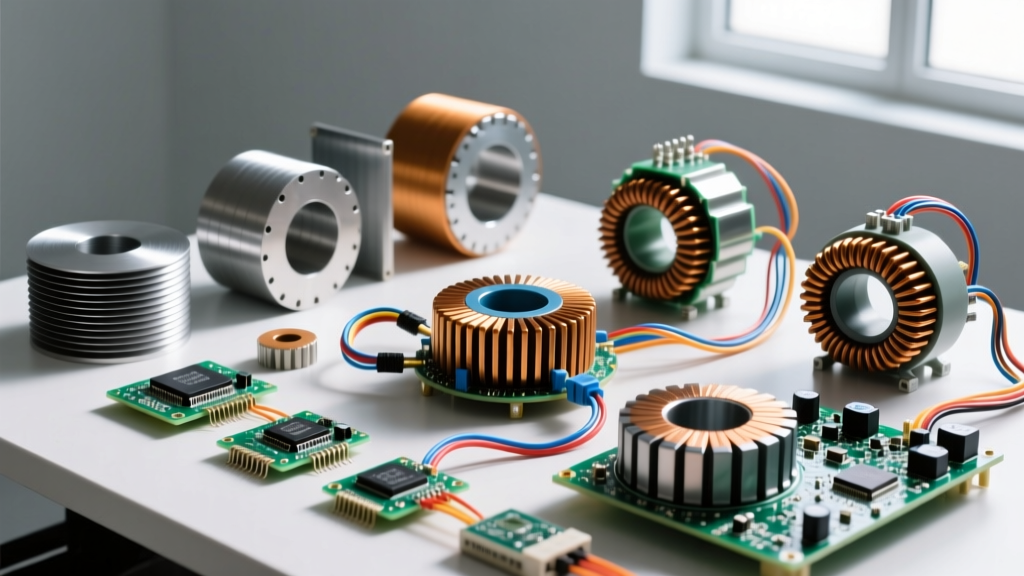

An electrical transformer is a static device that transfers electrical energy between two or more circuits through electromagnetic induction, changing voltage and current levels while maintaining the same frequency. In a real circuit or installation, a transformer changes the voltage-to-current ratio to match load requirements and provides galvanic isolation, breaking the direct electrical path between primary and secondary to prevent shock hazards and eliminate ground loops. People commonly confuse transformers with inductors (which only have a single winding and store energy in a magnetic field rather than transferring it) or switch-mode DC-DC converters (which rely on high-frequency semiconductor switching rather than pure magnetic induction at line frequency).
The Core Materials: Silicon Steel vs. Ferrite vs. Toroidal
The physical construction and core material of a transformer dictate its operating frequency, efficiency, and stray magnetic field. According to Electronics Tutorials, the core's primary job is to provide a low-reluctance path for magnetic flux while minimizing eddy current losses.
Laminated Silicon Steel (EI Core)
The standard 50/60Hz line-frequency transformer uses an 'EI' shaped core made of thin silicon steel laminations (typically 0.35mm to 0.5mm thick). The laminations are insulated from each other to break up eddy currents. These are heavy, cheap to manufacture, and robust, but they leak a moderate amount of stray magnetic flux and can hum audibly if the laminations vibrate.
Toroidal (Continuous Grain-Oriented Steel)
Toroidal transformers use a donut-shaped core wound from a continuous strip of grain-oriented silicon steel. Because there are no air gaps (unlike the butt joints in an EI core), the magnetic path is highly efficient. This results in a smaller physical footprint, lower weight, and a drastically reduced stray magnetic field. The tradeoff is higher manufacturing cost and a high inrush current when first energized, as the core can easily saturate if switched on at the zero-crossing of the AC waveform.
Ferrite (High-Frequency Switchmode)
For frequencies above 20kHz, silicon steel losses become unacceptable. Ferrite cores—a ceramic compound of iron oxide mixed with nickel, zinc, or manganese—are used instead. Ferrite has high electrical resistivity, practically eliminating eddy currents at high frequencies. As noted by TDK Electronics, these cores are the backbone of modern switch-mode power supplies (SMPS), allowing for massive reductions in size and weight compared to line-frequency magnetics.
Worked Example: Sizing a 500VA Control Transformer
Let's look at the math for a common industrial application: stepping down 240V AC mains to 24V AC to power an HVAC control board and a bank of contactor coils. We need to select a transformer rated for the total Volt-Ampere (VA) load.
Formula: VA = Voltage × Current (I = VA / V)
Primary Side (240V):
I_primary = 500VA / 240V = 2.08 Amps.
For wire sizing, a 14 AWG THHN copper wire (rated 15A at 60°C) is more than sufficient. You would protect this side with a 3A or 4A slow-blow fuse.
Secondary Side (24V):
I_secondary = 500VA / 24V = 20.83 Amps.
This requires heavier wire. A 10 AWG copper wire (rated 30A) or 12 AWG (rated 20A, if terminations are rated 75°C and load is strictly continuous) is needed. You would protect this side with a 20A or 25A breaker or fuse.
Where You Meet These Transformers in Practice
You will encounter specific electrical transformer types across different domains of electrical and electronics work:
- HVAC and Industrial Control (Class 2): Usually 40VA to 100VA EI-core transformers stepping 120V/240V down to 24V AC. These are often potted in epoxy for moisture resistance and have built-in thermal fuses.
- Audio Isolation and Impedance Matching: 1:1 or step-up/step-down audio transformers use specialized high-permeability cores (like mu-metal or permalloy) and interleaved windings to maintain flat frequency response from 20Hz to 20kHz while breaking ground loops.
- Tube Amplifiers (Output Transformers): These match the high-impedance, high-voltage output of vacuum tubes (e.g., 5,000 ohms) to the low-impedance of a speaker voice coil (4 or 8 ohms). They require precise air-gapped cores to handle DC bias current without saturating.
- Linear Bench Power Supplies: Heavy, low-frequency step-down transformers followed by a bridge rectifier and linear regulator. They are prized in RF and audio labs for producing exceptionally clean DC with zero high-frequency switching noise.
Decision Tree: Picking the Right Transformer Type for Your Build
Choosing the correct magnetics component comes down to your operating frequency, isolation requirements, and physical constraints. Use this decision matrix to lock in your component selection.
| Application Scenario | Core / Type Required | Key Constraint to Watch | Concrete Default Pick (Part/Series) |
|---|---|---|---|
| 50/60Hz Mains isolation, ultra-low hum for audio/sensitive analog | Toroidal (Grain-oriented silicon steel) | High inrush current; requires slow-blow fusing and mechanical mounting hardware. | Hammond 1182M Series (e.g., 1182M30 for 30VA) |
| 50/60Hz Mains step-down, tight budget, industrial panel mount | EI Core (Laminated silicon steel), open frame | Stray magnetic field can interfere with nearby Hall-effect sensors or unshielded inductors. | Hammond 166 Series or equivalent DIN-rail control transformer |
| High-frequency (>50kHz) SMPS forward or flyback converter | Ferrite E-core or ETD core | Skin effect and proximity effect at high freq require Litz wire or copper foil windings. | TDK EPCOS EFD25 ferrite core (B66317G) |
| Low power (<20W) direct PCB mounting for IoT or microcontroller supplies | Encapsulated PCB-mount module (internally uses high-frequency switching) | Derating at high ambient temperatures; check the manufacturer's thermal curve. | Mean Well LPM-20-12 (20W, 12V output) |
For general-purpose hobbyist and prototyping linear power supplies operating at line frequency, the Hammond 166 series or their chassis-mount toroidals remain the industry baseline for reliability and predictable thermal performance.
Common Mistakes and Misconceptions
Can I use a 60Hz transformer on a 50Hz mains supply?
No. The induced voltage in a transformer core is proportional to frequency (V = 4.44 × f × N × B_max × A). If you drop the frequency from 60Hz to 50Hz while maintaining the same primary voltage, the magnetic flux density (B) must increase by 20%. This usually pushes the silicon steel core past its saturation point, causing a massive spike in magnetizing current, severe overheating, and eventual winding failure. Always use a transformer rated for 50/60Hz if operating on 50Hz mains.
Does a transformer regulate voltage?
No. A transformer only scales voltage based on its turns ratio. If your utility grid voltage sags by 10% (e.g., from 120V to 108V), your transformer's secondary voltage will also drop by exactly 10%. If you need a stable output voltage regardless of input fluctuations, you must follow the transformer with a voltage regulator (like an LM317 linear regulator or a buck/boost switching regulator).
Why does my transformer get hot even with no load connected?
All transformers experience 'no-load losses' (core losses). The alternating magnetic field causes hysteresis losses (energy spent realigning magnetic domains in the steel) and eddy current losses (circulating currents within the core material). While a high-quality toroidal might only waste 1W or 2W at no load, a cheap, poorly laminated EI core can dissipate 10W to 15W as heat just sitting on your bench plugged into the wall.