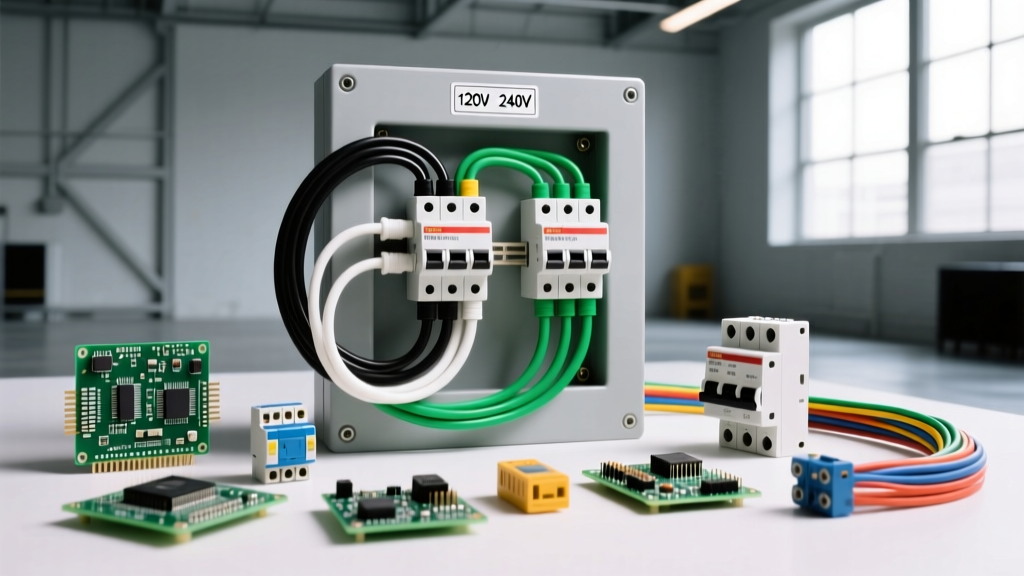
An electrical fault is any abnormal deviation in current, voltage, or impedance that forces electricity outside its intended path or stops it from flowing entirely. When a fault occurs, it instantly alters the circuit's impedance, causing massive current spikes (in short circuits) or total voltage drops (in open circuits). Hobbyists and apprentices frequently confuse a fault with an overload; an overload is simply too much current flowing down the correct path (like plugging three 1500W space heaters into one 15A outlet), whereas a fault means the current has found a completely unintended path or the path has physically broken.
The Four Core Types of Electrical Faults
Every electrical anomaly you will troubleshoot on the bench or in a panel falls into one of four categories. Understanding the physical mechanism of each dictates how you protect the circuit.
| Fault Type | Physical Mechanism | Primary Hazard | Typical Trigger |
|---|---|---|---|
| Short Circuit | Line conductor touches neutral or another line, bypassing the load. | Extreme heat, vaporized copper, explosive arcing. | Stripped wire insulation, crushed cable, failed component. |
| Ground Fault | Line conductor touches a grounded surface (metal box, chassis, earth). | Electrocution, chassis energization, fire. | Moisture ingress, frayed appliance cord, nicked wire in a metal box. |
| Arc Fault | Current jumps across a gap in a broken conductor or loose connection. | Sustained high-temperature plasma (up to 10,000°F) igniting nearby combustibles. | Loose terminal screw, nail through a wall cable, damaged cord. |
| Open Circuit | The conductive path is physically broken, stopping current flow. | Loss of function, floating voltages, unexpected logic states in embedded systems. | Blown fuse, broken trace, cold solder joint, tripped breaker. |
The Math: Calculating Fault Current in a Real Circuit
To understand why faults destroy equipment, you need to calculate the available fault current. Think of a short circuit like a municipal water main bursting: the water takes the path of least resistance, bypassing the faucets entirely and flooding the street. In electrical terms, removing the load resistance drops the circuit impedance to near zero.
Let us run a real-world calculation for a standard US residential 120V branch circuit:
- Source Voltage (V): 120V nominal (measured at 122V under no-load).
- Conductor: 14 AWG THHN copper.
- Loop Length: 50 feet total (25 feet out to the outlet, 25 feet back to the panel).
- Wire Resistance: 14 AWG copper at 75°C is approximately 3.07 ohms per 1,000 feet. For 50 feet, the wire resistance is 0.153 ohms.
- Transformer & Service Impedance: Let us assume a robust utility transformer and short service drop adding roughly 0.047 ohms of impedance.
- Total Fault Loop Impedance (R): 0.153 + 0.047 = 0.200 ohms.
Using Ohm's Law (I = V / R):
Fault Current = 122V / 0.200Ω = 610 Amps.
A standard 15A breaker will not wait for the thermal bimetallic strip to heat up and bend at 610A. Instead, its magnetic trip solenoid detects the massive spike and physically forces the contacts open in under 16 milliseconds (one 60Hz cycle). However, if this same fault occurred on a massive industrial 480V feeder with 0.01 ohms of impedance, the fault current could exceed 48,000 Amps. This is why breakers are rated for AIC (Ampere Interrupting Capacity). A standard residential breaker has a 10kA (10,000 Amp) AIC rating. If your calculated fault current exceeds the breaker's AIC, the breaker will literally explode when it tries to clear the fault. For nearly all residential and light commercial DIY work, 10kA AIC is the required baseline.
Where You Meet This in Practice
You will encounter these faults across three distinct environments, each requiring a different diagnostic approach:
1. Home Wiring and Panel Upgrades
In residential wiring, NEC guidelines mandate specific fault protection based on the room. Kitchens and bathrooms require Ground Fault protection because water lowers human skin resistance, making 120V lethal. Bedrooms require Arc Fault protection because loose connections behind drywall can smolder for hours before igniting studs. If a breaker trips instantly upon resetting with nothing plugged in, you have a dead short or ground fault in the walls—do not force it back on.
2. DIY Solar and DC Battery Banks
DC faults do not have a natural zero-crossing to extinguish an arc like AC power does. A short circuit on a 48V LiFePO4 battery bank will sustain a continuous, violent DC arc. This is why you must use DC-rated breakers (like the MidNite Solar MNE-DC) or High Rupturing Capacity (HRC) fuses (like Class T or ANL fuses) placed as close to the battery positive terminal as physically possible. A standard AC breaker used on a DC battery bank will fail to clear a fault and melt.
3. Embedded Electronics (ESP32 / Arduino Bench Work)
On the workbench, an open circuit or short circuit usually manifests as a brownout or a bricked microcontroller. If you accidentally wire a 5V sensor output directly into a 3.3V GPIO pin on an ESP32-WROOM-32, you create a localized fault. The internal protection diodes shunt the excess voltage to the 3.3V rail, causing a current spike that exceeds the silicon's thermal limits, permanently shorting the pin to VCC. Always measure continuity with a multimeter before applying power to a newly wired breadboard.
Fault Protection Decision Tree
Use this decision path to select the exact protective device for your specific fault scenario. Never use a standard breaker where code or physics demands specialized fault clearing.
| Observed Symptom / Scenario | Identified Fault | Required Protection Type | Concrete Part Pick (120V AC) |
|---|---|---|---|
| Breaker trips instantly with a loud pop; no load connected; wires smell like ozone. | Dead Short Circuit | Standard Thermal-Magnetic Breaker (10kA AIC minimum) | Eaton BR115 (15A, 1-Pole, 120/240V) |
| Breaker trips only when using outdoor power tools, or near sinks/tubs; GFCI test button works. | Ground Fault (Current leaking to earth > 5mA) | GFCI Breaker or Receptacle | Siemens QF120 (20A, 1-Pole GFCI Breaker) or Leviton GFNT2 (Receptacle) |
| Breaker trips randomly; wires look fine; happens when a vacuum motor starts or a cord is bent. | Series or Parallel Arc Fault | AFCI Breaker (Combination Type) | Square D HOM115AFIC (15A, 1-Pole AFCI Breaker) |
| 48V DC solar array wiring; high available short-circuit current from lithium bank. | DC Short Circuit / Sustained DC Arc | Class T Fuse or DC-Rated Breaker | Blue Sea 5191 (Class T Fuse Block with 200A Fuse) |
Frequently Asked Questions
Can a multimeter detect an electrical fault?
Yes, but only when the circuit is de-energized. Set your multimeter to the continuity or resistance (Ω) setting. With the breaker off and the load disconnected, measure between Line and Neutral. A reading of 'OL' (Open Loop) or infinite resistance means no short circuit. If you read < 2 ohms, you have a dead short. To check for a ground fault, measure between Line and the bare copper ground wire; it should also read 'OL'. Never attempt to measure resistance on a live circuit, or you will blow the multimeter's internal fuse or destroy the meter.
Why does my breaker trip but my GFCI outlet does not reset?
This usually indicates a downstream ground fault or a miswired load/line configuration. According to Fluke's troubleshooting guidelines, if a GFCI refuses to reset, the internal solenoid has detected an imbalance between the hot and neutral conductors. Disconnect all downstream loads. If it still will not reset, the GFCI's internal sensing coil has failed (common after 10 years or a nearby lightning surge) and the device must be replaced.
Is an open circuit considered a dangerous fault?
In power wiring, an open circuit (like a broken neutral) is highly dangerous. A broken neutral on a multi-wire branch circuit (MWBC) or a 240V split-phase system can cause the voltage on one leg to float up to 200V+ while the other drops to 40V, instantly destroying 120V appliances. In low-voltage DC logic (like an I2C bus on a Raspberry Pi), an open circuit simply causes a timeout error or a floating pin state, which is a functional failure rather than a fire hazard.
When designing or troubleshooting any system, default to 10kA AIC breakers for AC mains, use Class T fuses for high-current DC battery banks, and never rely on a standard thermal breaker to clear an arc or ground fault. Match the protective device to the specific physics of the fault, and the system will clear the anomaly safely every time.