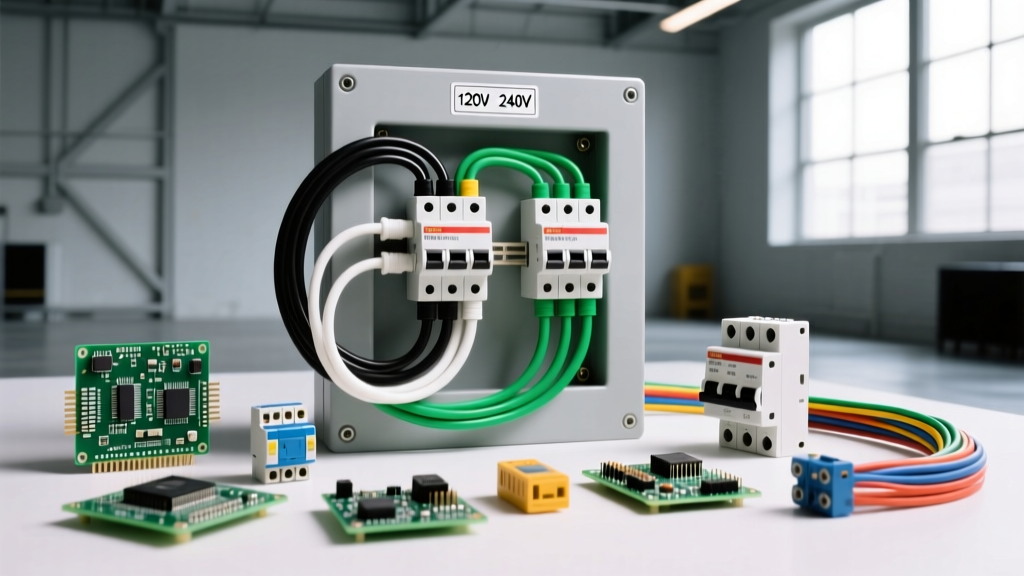

120/240V split-phase power is a single-phase electrical distribution system that uses a center-tapped utility transformer to provide 240 volts across two hot legs for heavy loads, and 120 volts from either hot leg to a grounded neutral wire for standard outlets. This dual-voltage architecture is the backbone of North American residential wiring, dictating everything from your breaker panel layout to the specific cable types you pull through your walls. In a real circuit, stepping up to 240V cuts the current draw in half for the same wattage, which fundamentally changes the required wire gauge, breaker pole count, and voltage drop characteristics of the installation.
The Physics of Split-Phase: How 120 and 240 Coexist
To understand the 120 240 volt meaning, you have to look at the utility transformer on the pole outside your house. The secondary winding of this transformer outputs a single 240V alternating current (AC) sine wave. However, the utility connects a grounded wire (the neutral) to the exact physical center of this winding. This is known as a center-tapped transformer.
Think of it like a balanced mechanical seesaw. The fulcrum in the middle is the neutral wire (0V relative to ground). One end of the seesaw represents Leg A (Hot 1), and the other end represents Leg B (Hot 2). When Leg A is pushed up to its positive peak, Leg B is pushed down to its negative peak. Because the two legs are exactly 180 degrees out of phase, measuring from either hot leg to the neutral fulcrum gives you 120V RMS. But if you measure across the entire seesaw—from Leg A directly to Leg B—the potential differences add together vectorially (120V - (-120V)), giving you 240V RMS.
What 240V Actually Changes in Your Circuit
The primary reason we use 240V for heavy appliances is to reduce current (Amps). Lower current means less heat generated in the wires, allowing us to use smaller, cheaper copper and standard residential breakers. Let us look at a concrete numeric example to see how this changes a real installation.
Numeric Example: Sizing a 9.6 kW Level 2 EV Charger
Imagine you are installing a hardwired 9,600-watt (9.6 kW) Level 2 Electric Vehicle charger. According to Department of Energy guidelines, EV charging is considered a continuous load (operating for 3 hours or more), meaning the National Electrical Code (NEC Article 100) requires you to multiply the base current by 125% to size the breaker and wire.
- The 240V Path (Standard): 9,600W ÷ 240V = 40 Amps. Applying the 125% continuous load rule (40A × 1.25), you need a 50-Amp double-pole breaker. According to NEC Table 310.16 (75°C column), this requires 6 AWG copper wire.
- The 120V Path (Hypothetical): If you tried to run this same 9,600W charger on a 120V circuit, the math changes drastically. 9,600W ÷ 120V = 80 Amps. Applying the 125% rule (80A × 1.25), you would need a 100-Amp single-pole breaker. To carry 100A safely, you would need massive 3 AWG copper wire, which is incredibly stiff, expensive, and difficult to terminate in standard residential enclosures.
By utilizing the 240V split-phase supply, you cut the required ampacity in half, dropping the wire size from a bulky 3 AWG down to a manageable 6 AWG, and keeping the breaker size within standard residential panel limits.
Where You Meet This in Practice
You will encounter 120/240V split-phase configurations in three primary areas of a residential or light-commercial jobsite:
- Major Appliances (Ranges and Dryers): Modern electric ranges and dryers use 4-wire receptacles (like the NEMA 14-50 or 14-30). These utilize both 240V (across the two hot legs) to power the high-wattage heating elements, and 120V (from one hot leg to the neutral) to power the control boards, timers, and drum motors. The separate ground wire provides a safe fault path.
- HVAC Condensers and Heat Pumps: The outdoor compressor units for central air systems almost exclusively run on 240V single-phase power to handle the high starting torque of the compressor motor. These typically use a 2-pole breaker and only require two hot wires and a ground (no neutral needed, as there are no 120V components in the outdoor unit).
- Subpanel Feeders: When running a feeder to a detached garage or a subpanel, you must pull two hot legs, a neutral, and a ground. Pulling both 120V hot legs ensures that the 120V branch circuits in the subpanel can be distributed evenly across the two phases, balancing the load on the main utility transformer and preventing neutral overload.
Common Confusions: Split-Phase vs. Two-Phase vs. 208V
The terminology surrounding residential power is a frequent source of errors on the bench and in the field. Here is what people commonly confuse with 120/240V split-phase:
- "Two-Phase" Power: True two-phase power (where the waveforms are 90 degrees apart) is an obsolete system from the early 1900s, mostly found only in parts of Philadelphia and Buffalo. North American homes do not have two-phase power. Calling split-phase "two-phase" is technically incorrect and will confuse commercial electricians.
- 120/208V Three-Phase Wye: In commercial buildings, you will often see 120/208V. This is derived from a three-phase wye-connected transformer. You get 120V from any hot leg to neutral, but the phase-to-phase voltage is 208V, not 240V. The Danger: If you take a 240V resistive appliance (like a commercial heater) and plug it into a 208V supply, it will not just run "a little slower." Because power equals voltage squared divided by resistance (P = V²/R), running a 240V heater on 208V results in only 75% of its rated heat output, which can cause contactors to chatter and motors to overheat.
Decision Tree: Sizing Your Next 120V or 240V Circuit
Use this decision matrix to select the correct voltage, breaker, and wire for your next project. This assumes standard copper conductors, an ambient temperature of 30°C (86°F), and standard residential NM-B (Romex) or THHN in conduit.
| Load Scenario | Target Voltage | Breaker Type & Size | Wire Size & Type (Copper) |
|---|---|---|---|
| Standard wall outlets / lighting (General Purpose) | 120V | Single-Pole, 15A or 20A | 14/2 NM-B (15A) or 12/2 NM-B (20A) |
| Kitchen/Bathroom small appliance circuits | 120V | Single-Pole, 20A (GFCI/AFCI) | 12/2 NM-B |
| Window AC unit or small compressor (< 2000W) | 120V | Single-Pole, 15A or 20A | 14/2 or 12/2 NM-B (Check nameplate FLA) |
| Level 2 EV Charger (32A continuous / 40A breaker) | 240V | Double-Pole, 40A | 8 AWG NM-B or 8 AWG THHN |
| Level 2 EV Charger (40A continuous / 50A breaker) | 240V | Double-Pole, 50A | 6 AWG NM-B or 6 AWG THHN |
| Electric Range / Oven (up to 12kW) | 120/240V | Double-Pole, 40A or 50A | 8/3 NM-B (40A) or 6/3 NM-B (50A) |
| Detached Garage Subpanel (60A feeder) | 120/240V | Double-Pole, 60A | 4 AWG THHN in conduit (4 hots/neut/ground) |
When planning any new dedicated circuit, default to 240V for any load exceeding 3000 watts. The material savings on copper wire and the reduction in voltage drop over long runs make 240V the undisputed, code-compliant choice for heavy residential loads. Always verify the specific nameplate amperage of your appliance before pulling wire, and ensure your panel has the physical space and calculated load capacity to support the new double-pole breaker.


