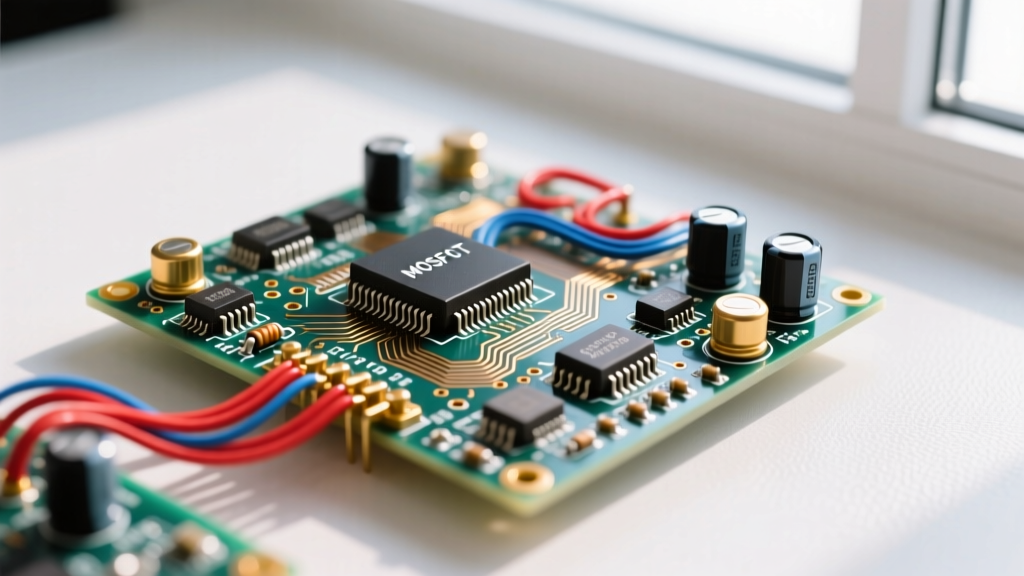
If you want to design the mathematical models for a novel silicon carbide (SiC) MOSFET or calculate the transient stability of a 500kV power grid, choose Electrical Engineering (EE). If you want to build the test jig, wire the gate drivers, program the PLC, and validate that SiC MOSFET's thermal performance on a physical PCB, choose Electrical Engineering Technology (EET). The verdict is straightforward: EE wins for theoretical R&D, abstract system architecture, and Professional Engineer (PE) licensing, while EET wins for hands-on manufacturing, field testing, hardware prototyping, and faster entry into practical technologist roles.
The Core Divide: Abstract Theory vs. Applied Implementation
The single physical difference that drives all others between these two disciplines is the domain of operation: EE operates primarily in the abstract domain of mathematical modeling and theoretical physics, while EET operates in the physical domain of hardware implementation, instrumentation, and empirical testing. An EE might use partial differential equations to model the electromagnetic interference (EMI) radiating from a switching power supply. An EET will take that design, lay out the copper traces to minimize loop inductance, and use a near-field probe and spectrum analyzer to measure the actual EMI on the bench.
This divergence starts on day one of university. EE programs treat advanced mathematics as the primary language of design. EET programs treat mathematics as a practical tool to verify physical implementations. Below is a data-dense breakdown of what you will actually study in an ABET-accredited program for each track.
| Criteria | Electrical Engineering (EE) | Electrical Engineering Tech (EET) |
|---|---|---|
| Math Sequence | Calculus I-IV, Differential Equations, Linear Algebra, Discrete Math | College Algebra, Trigonometry, Applied Calculus I-II, Statistics |
| Physics Depth | Calculus-based Physics I-III (Mechanics, E&M, Optics/Modern) | Algebra/Trig-based Physics I-II, Applied Electromagnetics |
| Core Circuit Classes | Circuit Analysis, Signals & Systems, Electromagnetic Field Theory | DC/AC Circuits, Industrial Motor Controls, PCB Layout, PLC Programming |
| Lab/Hands-on Hours | ~15-20% of curriculum (mostly verification of theory) | ~40-50% of curriculum (build, test, troubleshoot, calibrate) |
| Capstone Project | Theoretical design, simulation, and mathematical proof-of-concept | Physical prototype build, empirical testing, and manufacturing documentation |
| ABET Accreditation | Engineering Accreditation Commission (EAC) | Engineering Technology Accreditation Commission (ETAC) |
Head-to-Head Comparison Matrix
When deciding which path to take, you need to look past the course catalog and examine the career trajectory, compensation, and daily reality of the work. The following matrix compares the two paths across four concrete criteria based on current industry standards and Bureau of Labor Statistics data.
| Criterion | Electrical Engineering (EE) | Electrical Engineering Technology (EET) |
|---|---|---|
| Primary Daily Focus | Simulation (SPICE, MATLAB), mathematical modeling, system architecture, component specification. | Bench testing, oscilloscope diagnostics, soldering, PLC/HMI programming, CAD layout, field commissioning. |
| Entry-Level Salary (Median) | $85,000 - $95,000 | $65,000 - $75,000 |
| Mid-Career Salary (Median) | $125,000 - $160,000+ | $90,000 - $115,000 |
| Primary Tools Used | MATLAB, Simulink, Ansys HFSS, Cadence Virtuoso, Python. | Altium/KiCad, Multimeters, Scopes, Soldering Stations, Rockwell/Siemens PLC IDEs. |
The salary gap is real, but it reflects the differing scalability of the roles. An EE designing a novel power management IC can impact millions of units, driving higher compensation ceilings. An EET ensures the factory producing that IC doesn't burn down and that the test fixtures yield 99.9% reliability. Both are critical, but the market prices theoretical abstraction higher than physical execution.
The Dealbreaker: Where They Are NOT Interchangeable
The most dangerous trap for prospective students is assuming that an EET degree is just an "easier EE degree" that leads to the same job titles. In the eyes of the law and major corporate HR departments, they are fundamentally distinct credentials. According to ABET accreditation standards, the two tracks serve different professional purposes, and this creates hard boundaries in the workforce.
The Professional Engineer (PE) License Trap
If your goal is to stamp and seal electrical blueprints for commercial buildings, power substations, or public infrastructure, you must get a Professional Engineer (PE) license. The National Council of Examiners for Engineering and Surveying (NCEES) and most state boards require your degree to be from an ABET-EAC (Engineering) program. An ABET-ETAC (Technology) degree will disqualify you from sitting for the PE exam in most US states, regardless of how many years of experience you have. If you want to be a consulting engineer who signs off on municipal grid upgrades, EET is a dead end.
Furthermore, they are not interchangeable in deep R&D. If you apply for a role at a national lab or a semiconductor fab (like TSMC or Intel) to research the quantum tunneling effects in sub-2nm gate oxides, an EET degree will not qualify you. That work requires the heavy quantum mechanics and solid-state physics inherent in an EE (or Physics) curriculum. Conversely, an EE grad thrust onto a manufacturing floor to troubleshoot a failing 480V 3-phase VFD or rewire a ControlLogix PLC network will often lack the practical, hands-on muscle memory that an EET grad has drilled for four years.
Choose EE When / Choose EET When
Your decision should be driven by how you prefer to solve problems, not just by the starting salary. Use this decision framework to pick your path.
Choose Electrical Engineering (EE) When:
- You love the math: You genuinely enjoy calculus, differential equations, and proving why a circuit behaves the way it does on paper before it ever touches a breadboard.
- You want the PE License: Your career goal involves consulting, public works, power generation, or signing/sealing legal engineering documents.
- You are targeting deep R&D: You want to design the internal silicon architecture of microcontrollers, develop new antenna geometries, or write the control algorithms for grid-tied inverters.
- You are aiming for grad school: You plan to pursue a Master's or PhD in electrical engineering, where heavy theoretical math is mandatory.
Choose Electrical Engineering Technology (EET) When:
- You learn by doing: You prefer holding a soldering iron, wiring a relay panel, or writing ladder logic over solving triple integrals.
- You want to build and test: Your ideal day involves taking a schematic, laying out the PCB, assembling the prototype, and debugging it with an oscilloscope and thermal camera.
- You want faster workforce entry: EET programs often have fewer abstract prerequisites, allowing you to focus on industry-standard tools (like AutoCAD Electrical or Rockwell Studio 5000) and enter the workforce with highly marketable, practical skills.
- You are targeting manufacturing or field service: You want to work in automated manufacturing, aerospace testing, field commissioning, or hardware validation.
Cost & Availability Considerations
EE programs are widely available at almost every state university and private college, but they are expensive and time-intensive (often 128+ credit hours). EET programs are frequently offered at polytechnic institutes, state technical colleges, and specialized universities (like Purdue Polytechnic or DeVry). These programs often cost 20-30% less in total tuition due to fewer credit requirements and lower overhead, offering a strong return on investment if your goal is a hands-on technologist role rather than a theoretical engineering position.