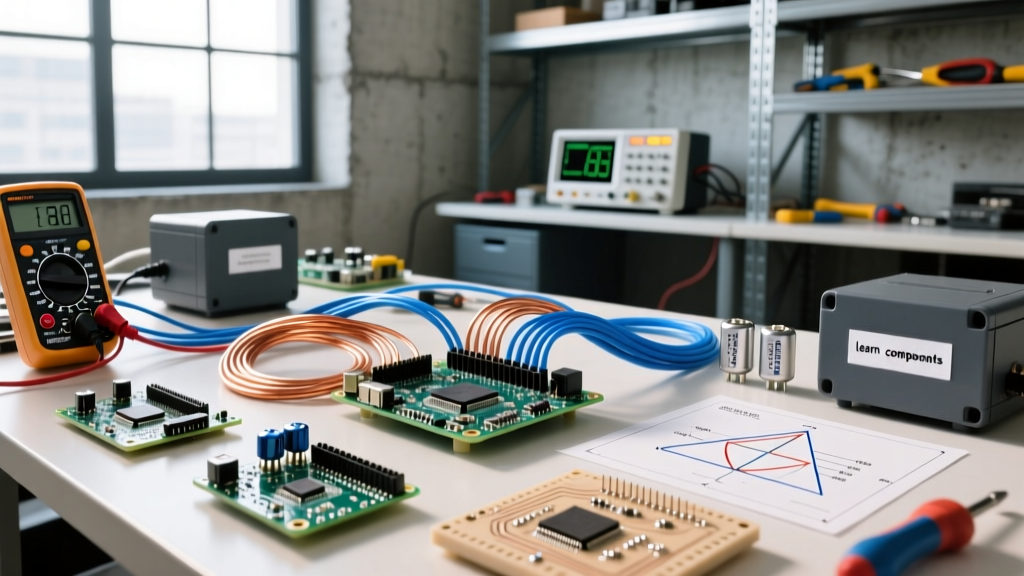
When evaluating alternatives to critical electronic components when supply is limited, hardware engineers generally face a fork in the road: rebuild the missing function using discrete analog components (BJTs, op-amps, passives) or pivot to low-cost programmable digital silicon (microcontrollers like the CH32V003 or CPLDs). The verdict is strictly use-case dependent: For high-speed, ultra-low noise, or high-voltage linear applications, discrete analog networks win because they avoid clock-switching noise and execution latency. However, for complex timing, state machines, or multi-rail sequencing where board space is at a premium, programmable digital alternatives win due to their ability to consolidate dozens of missing logic gates or timers into a single $0.12 chip without requiring precision-matched passive components.
The Single Physical Difference Driving Component Substitution
The fundamental physical difference that dictates every other performance metric between these two substitution strategies is continuous electron flow versus discrete-time sampled logic.
When you build a discrete analog alternative—such as using an LM358 op-amp and a 2N3904 BJT to replace an out-of-stock LM317 linear regulator or a 555 timer—the circuit processes signals in real-time. The physical voltage and current manipulate the semiconductor junctions continuously. There is no clock cycle; the transistor enters saturation or the linear region precisely when the physical threshold is crossed. This results in near-zero propagation delay and inherently smooth output waveforms, but it requires careful thermal management and precision resistor matching to maintain accuracy.
Conversely, programmable digital alternatives rely on discrete-time sampling. A microcontroller like the WCH CH32V003 or an ATtiny85 executes instructions at fixed clock intervals (e.g., every 20 nanoseconds at 48 MHz). It reads an ADC pin, processes the logic, and toggles a GPIO. This physical reality introduces quantization error, switching noise, and software execution latency. While a digital alternative offers immense flexibility—you can change a timing constant in firmware rather than desoldering a capacitor—it fundamentally cannot replicate the continuous, infinitely granular physical response of an analog junction.
Discrete Analog vs. Programmable Digital: By the Numbers
When searching for Octopart or checking distributor stock, you will often weigh a discrete network against a cheap programmable part. Below is a concrete comparison assuming we are replacing a missing specialized timing/sequencing IC.
| Criterion | Discrete Analog (LM358 + 2N3904 Network) | Programmable Digital (CH32V003 RISC-V MCU) |
|---|---|---|
| Quiescent Current | 0.7 mA (typical for LM358 dual op-amp) | 3.5 mA (active @ 48 MHz) / 10 µA (sleep) |
| Propagation Delay | < 50 ns (BJT saturation physics limit) | 20 ns clock + software overhead (~150 ns total) |
| BOM Line Count | 10-14 lines (ICs, resistors, caps, diodes) | 3 lines (MCU, 100nF decoupling cap, pull-up) |
| Unit Cost (1k qty) | $0.24 (aggregate network cost) | $0.12 (single CH32V003J4M6 chip) |
| PCB Footprint | ~120 mm² (SOIC-8 + 0603 passives) | ~9 mm² (SOIC-8 MCU only) |
Decision Framework: When to Choose Which
- Choose Discrete Analog when: Your circuit handles continuous linear regulation, ultra-low noise sensor amplification, or high-frequency RF oscillation where digital clock harmonics would ruin the signal-to-noise ratio.
- Choose Programmable Digital when: You are replacing missing logic gates, complex state machines, or multi-channel PWM sequencers, and you need to minimize BOM line counts and PCB real estate.
- Choose Discrete Analog when: The operating environment exceeds 105°C or involves high-voltage transients that would instantly destroy the thin gate oxides of a low-cost microcontroller.
- Choose Programmable Digital when: The original component's function requires frequent tuning, temperature compensation, or I2C/SPI communication that would be impossibly complex to build with discrete op-amps.
Where These Alternatives Are Strictly NOT Interchangeable
A common mistake when scrambling for DigiKey Reference Designs or substitutions is assuming that any function can be digitized. There are hard physical boundaries where these two approaches are absolutely not interchangeable.
High-Frequency RF and Switching: You cannot replace a discrete 100 MHz Colpitts oscillator or a high-speed gate driver with a standard low-cost MCU. The MCU's GPIO toggle speed and internal clock latency make it physically incapable of generating or responding to sub-nanosecond edge transitions. If a specialized RF mixer or high-speed comparator is on backorder, you must substitute with another discrete analog topology (like a common-base BJT amplifier), not a programmable part.
Ultra-Low Noise Linear Regulation: If an LM317 or specialized low-dropout (LDO) regulator is unavailable, attempting to replace it with an MCU-driven PWM buck converter will introduce high-frequency switching ripple. In mixed-signal boards powering 16-bit or 24-bit ADCs, this digital switching noise will couple into the analog ground plane, destroying measurement resolution. In these cases, you must build a discrete linear pass-element regulator using a BJT, a Zener diode, and an op-amp error amplifier.
Galvanic Isolation and High Voltage: Programmable silicon operates strictly within its VCC limits (usually 3.3V or 5V). If you need to replace an isolated gate driver or a high-side switch operating at 400V DC, discrete components (like optocouplers, pulse transformers, or high-voltage IGBTs) are mandatory. An MCU cannot physically bridge a 2kV isolation barrier without external discrete translation.
FAQ: Navigating Component Shortages in 2026
How do I find alternatives to critical electronic components when supply is limited for high-voltage designs?
For high-voltage designs (mains AC, 400V+ DC bus), you must look at discrete power semiconductors rather than integrated controllers. If a specific integrated gate driver is out of stock, substitute it with a discrete totem-pole BJT/MOSFET driver stage paired with a pulse transformer for isolation. Use parametric search engines to filter by breakdown voltage (Vceo or Vds) and gate charge (Qg) rather than just package type. Always verify the Safe Operating Area (SOA) curve on the datasheet of the discrete substitute to ensure it can handle the inductive kickback energy without avalanching.
What software tools help identify alternatives to critical electronic components when supply is limited?
Beyond basic distributor search, professional hardware teams rely on silicon lifecycle and supply chain platforms. Tools like SiliconExpert and IHS Markit (now part of S&P Global) provide deep data on end-of-life (EOL) status, multi-source equivalents, and cross-reference mappings. For schematic-level integration, modern ECAD tools like Altium Designer and KiCad (via plugins) integrate directly with APIs like Octopart or Supplyframe. These plugins flag out-of-stock parts in real-time during the schematic capture phase and automatically suggest pin-compatible drop-in replacements based on current global inventory levels, preventing you from designing in a chip with a 52-week lead time.
Are there alternatives to critical electronic components when supply is limited that do not require a PCB respin?
Yes, but they require clever mechanical and electrical adaptation. If a specific SOIC-8 logic IC or timer is completely unavailable and you cannot wait for a PCB respin, you can use a 'dead-bug' or interposer adapter board. For example, if a specific analog switch is missing, you can program a tiny QFN microcontroller (like an ATtiny202) to emulate the logic, solder it to a generic SOIC-8 breakout PCB, and mount it on the original pads. Alternatively, for passives and discrete semiconductors, you can often stack surface-mount components (e.g., stacking two 0603 10k resistors in parallel to achieve 5k) or use enameled magnet wire to route off-board discrete transistors to the existing pads, allowing you to validate the hardware before committing to a new board layout.