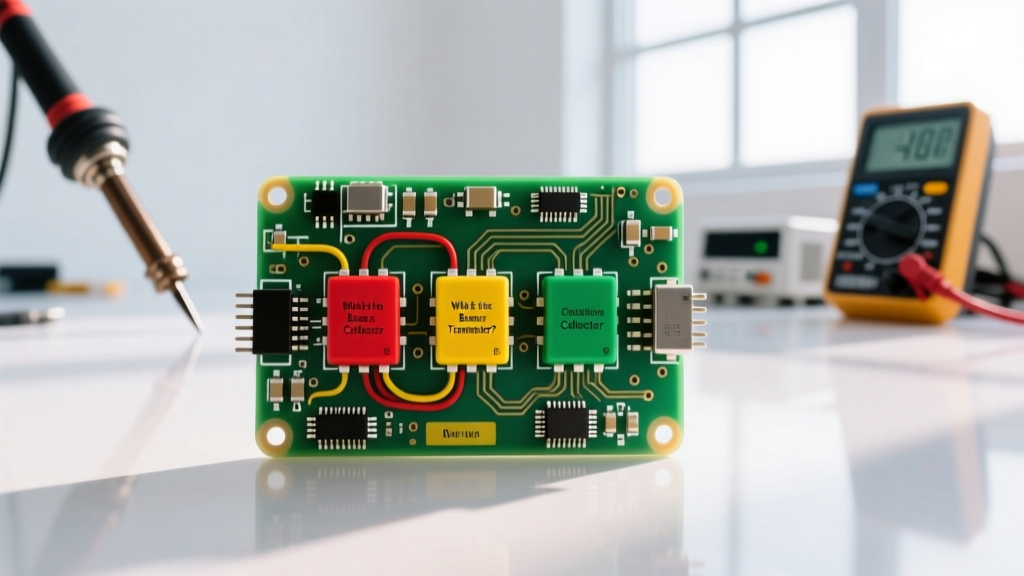
The Core Definition: Conductors allow electrons to flow freely, semiconductors allow controlled flow under specific conditions, and insulators block electron flow almost entirely.
What this fundamental triad changes in a real circuit is the difference between delivering power efficiently (conductor), actively controlling logic or high-current loads via a small signal (semiconductor), and preventing lethal shocks or short circuits (insulator). The most common confusion among hobbyists is treating semiconductors as mere 'high resistors'; unlike a fixed carbon resistor that passively burns energy as heat to limit current, a semiconductor actively modulates current flow via an external control signal (like a gate voltage) without acting as a simple ohmic bottleneck.
The Physics You Actually Need: Band Gaps and Breakdown
To make practical decisions, you only need to understand the valence band gap—the energy required to free an electron. In conductors like copper or aluminum, the valence and conduction bands overlap. Electrons move with minimal energy input, which is why a 1.5V AA battery can push current through a copper wire. According to All About Circuits, copper has roughly 8.5 x 10^28 free electrons per cubic meter.
In insulators like PVC, Teflon, or ceramic, the band gap is massive (often >5 eV). It takes extreme voltage to rip electrons across this gap, a threshold known as dielectric breakdown.
Semiconductors like silicon or germanium sit in the middle (band gap ~1.1 eV for silicon). By introducing impurities (doping), we create N-type (extra electrons) and P-type (electron holes) regions. Think of a semiconductor as a mechanical valve in a pressurized water pipe: the pipe (conductor) just carries the water, but the valve (semiconductor) uses a small mechanical lever (gate voltage) to throttle or completely stop a massive flow of water (drain-source current) without the lever itself getting wet.
The Numbers: A 12V, 10A Motor Switching Example
Theory is useless without bench math. Let us design a circuit to switch a 12V DC motor drawing 10A using an ESP32 GPIO pin (3.3V logic). We need a conductor to carry the power, a semiconductor to switch it, and an insulator to protect the chassis.
1. The Conductor: 14 AWG Copper Wire
We will use 2 feet of 14 AWG stranded copper for the positive lead and 2 feet for the ground (4 feet total round-trip). The resistance of 14 AWG copper is approximately 2.525 ohms per 1,000 feet.
- Total Resistance: 4 ft / 1000 * 2.525 = 0.0101 ohms.
- Voltage Drop: 10A * 0.0101 ohms = 0.101V drop.
- Power Lost (Heat): I²R = 100 * 0.0101 = 1.01W. The wire stays cool.
2. The Semiconductor: FQP30N06L Logic-Level MOSFET
We select the Onsemi FQP30N06L N-channel MOSFET because it fully turns on with a 5V gate drive (safe for 3.3V ESP32 logic with a small gate driver, or direct drive in a pinch). Its Rds(on) (drain-source on-resistance) at Vgs = 5V is typically 0.035 ohms.
- Voltage Drop across MOSFET: 10A * 0.035 ohms = 0.35V drop.
- Power Dissipated: I²R = 100 * 0.035 = 3.5W.
Bench reality check: 3.5W will make a bare TO-220 package too hot to touch (exceeding 60°C above ambient). You must bolt this semiconductor to a small extruded aluminum heatsink.
3. The Insulator: Silicone Thermal Pad
The metal tab of the MOSFET is internally connected to the Drain (12V). If it touches your grounded aluminum chassis, you create a dead short. We place a 0.5mm thick silicone thermal insulator pad between the MOSFET and the heatsink.
- Dielectric Strength: Typically 3,000V per mm.
- Breakdown Voltage: 0.5mm * 3000V/mm = 1,500V. Your 12V circuit is perfectly isolated.
- Leakage Current: At 12V, the current leaking through the insulator is in the picoamp range (effectively 0A).
Where You Meet This in Practice
You interact with this triad every time you open an electrical panel or wire a solar array.
In home wiring, the copper or aluminum inside NM-B cable is the conductor. The PVC jacket is the primary insulator. The circuit breaker relies on a bimetallic strip (conductor) and an air gap (insulator) to interrupt faults. The NFPA National Electrical Code (NEC) strictly dictates the ampacity of these conductors and the insulation temperature ratings (60°C, 75°C, 90°C) to prevent the insulator from melting and causing a fire.
In solar power systems, the MC4 connectors use tin-plated copper (conductor) and UV-rated PPO plastic (insulator). The charge controller itself is a dense forest of semiconductors (MOSFETs and Schottky diodes) executing Pulse Width Modulation (PWM) or Maximum Power Point Tracking (MPPT) to efficiently step down array voltage to battery voltage without burning off the excess energy as heat.
In embedded microcontrollers, the silicon die contains billions of microscopic semiconductors (transistors) acting as logic gates. The FR4 fiberglass of the PCB is the insulator, and the copper traces are the conductors routing signals between pins.
Decision Tree: Selecting the Right Material Class
When designing or repairing a node in your circuit, use this decision path to select the exact material and part number you need.
| Circuit Node Requirement | Material Class | Concrete Pick / Part Number |
|---|---|---|
| IF you need to carry 50A continuous from a 48V battery bank to an inverter over 10 feet... | Conductor | 4 AWG THHN Copper Wire. Rated for 85A at 90°C. Keeps voltage drop under 1%. |
| IF you need to switch a 120V AC, 8A water heater using a 5V Arduino digital pin... | Semiconductor | Omron G3NA-210B Solid State Relay (SSR). Uses an internal TRIAC semiconductor to switch AC safely, with an optocoupler insulator protecting your Arduino. |
| IF you need to mount a 400V solar string to a grounded metal roof rack... | Insulator | UV-rated Nylon/PPO cable cleats and EPDM rubber pads. Nylon provides >10kV dielectric isolation and resists UV degradation. |
| IF you need to drop 12V down to 5V at 2A for a Raspberry Pi... | Semiconductor (Active) | LM2596 Buck Converter Module. Uses a switching semiconductor and an inductor to step down voltage efficiently, rather than a linear resistor which would waste 14W as heat. |
Pro-Tip for Switching Nodes: Never use a simple mechanical relay (conductor-to-conductor contact) for high-frequency PWM switching. The physical contacts will arc and pit, destroying the relay in days. Always use a semiconductor (MOSFET or IGBT) for switching frequencies above 10 Hz.
Frequently Asked Questions
Can an insulator ever become a conductor?
Yes, through dielectric breakdown. If you apply enough voltage, the electric field will physically rip electrons from their atoms, turning the insulator into a plasma conductor. This is how lightning works (air is normally an insulator). For standard PVC wire insulation rated at 600V, applying 2,000V will cause it to arc through the jacket, permanently carbonizing the plastic and ruining its insulating properties.
Why not just use thicker semiconductors instead of copper wires?
Cost and physics. Even the best power semiconductors have an Rds(on) or forward voltage drop that generates significant heat at high currents. A 4 AWG copper wire carrying 100A drops about 0.1V per 10 feet. A bank of MOSFETs carrying 100A would drop 1V to 2V, dissipating 100W to 200W of heat that requires massive, noisy active cooling. Use conductors for transport, semiconductors for control.
Is dirt a good insulator?
No. Dry, pure soil is a poor conductor, but it is not a reliable insulator. Soil contains moisture and dissolved salts (ions) that make it conductive enough to carry lethal fault currents, which is why grounding rods work. Never rely on dirt, wood, or concrete as an electrical insulator in a live circuit; always use engineered dielectrics like rubber, glass, ceramic, or rated plastics.
When in doubt, default to over-engineering your insulators and conductors. Always use wire rated for at least 125% of your continuous load current, and ensure your insulating barriers are rated for at least double your maximum system voltage. Semiconductors should always be chosen with a 20% thermal headroom, verified by measuring the case temperature with an infrared thermometer after 15 minutes of full-load operation.