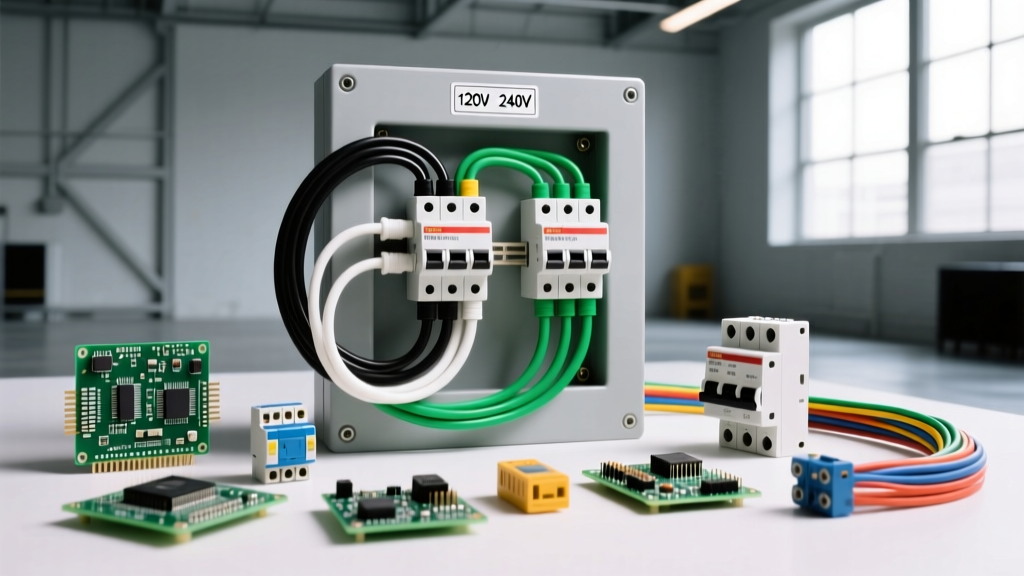
At its most fundamental level, voltage is the electromotive force—the electrical pressure—that pushes current through a conductor. But when a maker, engineer, or electrician asks, "what is the voltage in a circuit?", the theoretical answer (Volts = Amps × Ohms) is less useful than the practical one. The actual voltage in your branch circuit depends entirely on your regional grid standard, the tolerances allowed by your local utility, and the specific equipment you are powering.
In North America, the nominal branch circuit voltage is 120V AC (with a utility tolerance of ±5%, meaning 114V to 126V is acceptable). In most of the rest of the world, the harmonized standard is 230V AC. If you are designing a PCB, importing machinery, or wiring a workshop, you must design for the worst-case tolerance of your region. Below is the definitive reference for global circuit voltages, conductor mapping, and the exact hardware you need to bridge the gaps.
Global Mains Voltage Standards & Tolerances
The International Electrotechnical Commission (IEC) standard 60038 defines the baseline for low-voltage AC systems. Historically, Europe used 220V and the UK used 240V; both harmonized to a nominal 230V to allow for a unified ±10% tolerance band. Here is what you will actually measure at the receptacle.
| Region / Country | Nominal Voltage | Utility Tolerance | Frequency | Standard Plug Type |
|---|---|---|---|---|
| North America (US/CA) | 120V / 240V (Split) | ±5% (ANSI C84.1) | 60 Hz | NEMA 1-15, NEMA 5-15 |
| European Union | 230V | +10% / -6% | 50 Hz | CEE 7/7 (Schuko/French) |
| United Kingdom | 230V | +10% / -6% | 50 Hz | BS 1363 (Type G) |
| Australia / New Zealand | 230V | +10% / -6% | 50 Hz | AS/NZS 3112 (Type I) |
| Japan | 100V | ±6% | 50 Hz (East) / 60 Hz (West) | JIS C 8303 (Type A/B) |
Conductor Color Mapping by Regional Standard
Misidentifying a conductor is a leading cause of catastrophic failure and shock hazards in mixed-standard environments. The US follows the National Electrical Code (NFPA 70 / NEC), while Europe, the UK, and Australia follow IEC 60446. Never assume wire color functionality based on a single standard.
| Function | US / Canada (NEC) | EU / UK / AU (IEC 60446) | Danger Zone / Common Confusion |
|---|---|---|---|
| Line (Hot/Phase) | Black (or Red/Blue for multi-phase) | Brown (L1), Black (L2), Grey (L3) | IEC Black is a hot phase; NEC Black is also hot, but IEC Black in a 3-phase system carries 400V line-to-line. |
| Neutral | White (or Grey) | Blue | Importing EU equipment to the US: A blue wire is Neutral in the EU, but in US DC control circuits, blue is often used as a switched hot or negative. |
| Protective Earth (Ground) | Bare Copper, Green, or Green/Yellow | Green/Yellow Stripe | Never use Green/Yellow for anything other than earth ground. It is universally recognized and strictly enforced by AHJs. |
Equipment Tolerance: Transformers vs. Converters
When moving equipment across regions, your device must tolerate both the voltage delta and the frequency delta. How it handles these depends on the internal power supply topology.
What Your Device Must Tolerate
- Switch-Mode Power Supplies (SMPS): Most modern laptops, phone chargers, and LED drivers accept 100-240V AC at 50/60Hz. They rectify the AC to DC immediately, making them immune to both voltage and frequency differences. They only require a physical plug adapter.
- Resistive Loads (Heaters, Incandescent Bulbs): These only care about RMS voltage. Plugging a 230V heater into a 120V circuit won't break it, but it will only output ~25% of its rated heat ($P = V^2/R$).
- Inductive/Motor Loads: AC motors are locked to the grid frequency. A 60Hz motor run on a 50Hz grid will run 20% slower. Because the back-EMF is lower, it will draw significantly more current and overheat unless the voltage is also reduced by 20% (the V/Hz ratio must be maintained).
Transformer vs. Converter: The Critical Distinction
Travelers and importers frequently buy the wrong adaptation hardware. Here is the exact breakdown:
- Step-Up/Step-Down Transformer: A heavy, magnetic iron-core device. It changes AC voltage (e.g., 120V to 230V) but does not change frequency. Use this for high-wattage resistive loads or simple AC motors.
- Solid-State Frequency Converter: An expensive, active electronic system that rectifies AC to DC, then inverts it back to AC at a new frequency (e.g., 50Hz to 60Hz). Required for precision CNC machines, medical centrifuges, or timing-critical synchronous motors.
- Travel "Converter" (Warning): Most cheap $20 travel "converters" sold online are actually just triac-based choppers. They chop the 230V sine wave to simulate 115V RMS. This will instantly destroy the switch-mode power supply of a laptop or TV. Only use these for simple hair dryers or travel irons.
Decision Path: Sizing for Mixed or Imported Installations
Use this decision tree to select the exact hardware required for your specific cross-border voltage scenario.
| Scenario | Device Type | Required Hardware | Concrete Part / Pick |
|---|---|---|---|
| Traveling internationally with a laptop or phone charger | SMPS (Label reads 'Input: 100-240V ~ 50/60Hz') | Passive Plug Adapter (No voltage change) | CE Compass International Travel Adapter (Type A/C/G/I pins) |
| Importing a 230V 50Hz espresso machine to a US 120V 60Hz kitchen | Resistive heating elements + simple AC pump motor | Step-Up Transformer (120V to 230V, sized at 125% of max wattage) | LiteFuze LT-5000 (5000W capacity, handles 2000W+ heater spikes) |
| Importing a 230V 50Hz industrial lathe to a US 240V 60Hz shop | 3-Phase AC induction motors, timing-sensitive | Motor-Generator Set or Solid-State Frequency Converter | Phase Perfect AI-200 (Digital Phase & Frequency Converter) |
| Designing a custom PCB for global commercial sale | Internal logic and relay control circuits | Universal Input AC-DC Power Module (85-264VAC) | Mean Well IRM-10-24 (10W, 24VDC out, UL/CE listed) |
Governing Standards in Mixed Installations
When you wire a European 230V machine inside a North American facility, which electrical code governs the installation? The rule of thumb enforced by inspectors is based on the Point of Common Coupling (PCC).
The local Authority Having Jurisdiction (AHJ) and the National Electrical Code (NEC) govern everything from the main service panel up to the machine's terminal block or disconnect switch. This means your branch circuit wiring, overcurrent protection (breakers/fuses), and lockout/tagout disconnects must be sized and installed to US standards (e.g., using THHN in conduit, proper torque on lugs, and NEC Article 430 for motor disconnects).
Once inside the machine's chassis, the internal wiring is governed by the standard it was manufactured under (e.g., IEC 60204-1 for machinery). However, to keep the installation legal and safe, you must contain the foreign voltage.