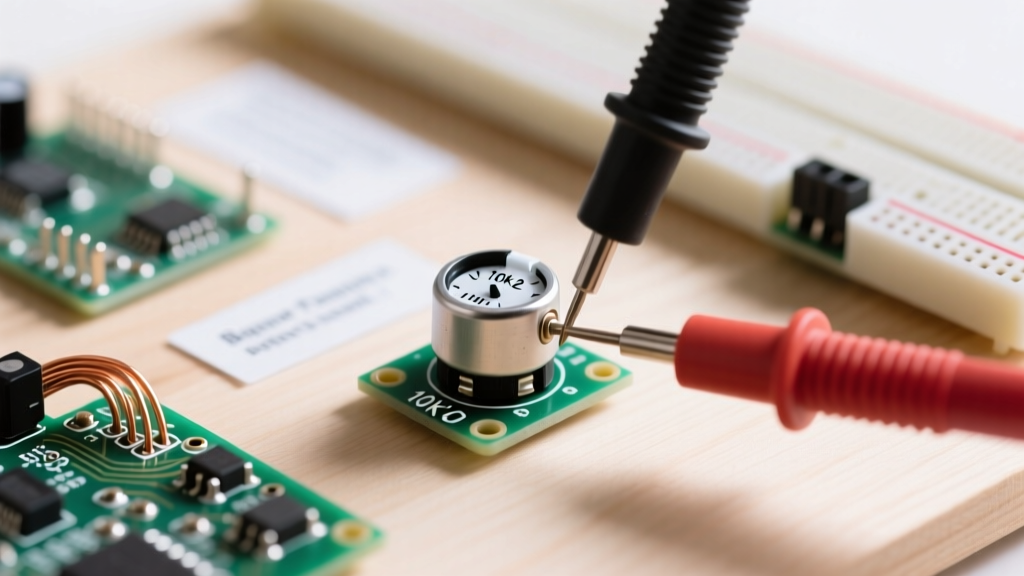
A capacitor search engine is a parametric filtering tool—hosted by distributors like Mouser and Digi-Key or manufacturers like KEMET and Vishay—used to cross-reference obsolete or out-of-stock capacitors. Instead of matching just capacitance and voltage, a proper parametric search matches critical hidden specs: Equivalent Series Resistance (ESR), ripple current rating, dielectric type, and temperature coefficient. If you are repairing a switching power supply or an audio amplifier and the exact original part is discontinued, guessing a replacement based solely on the microfarad (µF) rating will likely result in a catastrophic secondary failure.
The Bench Scenario: A 24V LED Driver Meltdown
Last month, a 15-year-old 24V 10A switching LED driver came across my bench. The symptom was dead-simple: no output voltage and a faint smell of burnt fish. The culprit was a bulging output filter capacitor. The original part was a 1000µF 35V 105°C low-ESR aluminum electrolytic from a legacy Japanese manufacturer that discontinued the line in 2018.
The Setup: Needing a quick fix, I grabbed a generic 1000µF 35V 85°C standard electrolytic from my bench bin. The capacitance and voltage matched perfectly. I soldered it in, applied a 5A dummy load, and walked away.
The Outcome: Fourteen minutes later, the new capacitor vented with a loud pop, spraying crusty electrolyte across the secondary side of the PCB.
What Went Wrong (The Numbers): I ignored the ripple current and ESR specifications. The switching regulator was dumping 2.8A RMS of ripple current into the output filter. The original low-ESR cap had an ESR of 22mΩ. The generic replacement had an ESR of 160mΩ. Using the power dissipation formula ($P = I^2 \times R$), the original cap dissipated roughly 0.17W as heat. The generic replacement dissipated 1.25W inside a tiny 12x20mm metal can with no airflow. The internal temperature spiked, boiled the electrolyte, and exceeded the vent plug's pressure threshold. This is exactly why you must use a parametric capacitor search engine rather than a basic text search when substituting parts.
Decoding the Markings: What the Physical Part Actually Says
Before you can query a capacitor search engine, you have to know what to look for. Physical markings vary wildly by chemistry.
Aluminum Electrolytic (Through-Hole and SMD)
These are usually printed plainly, but the series name is the most critical data point. A Rubycon cap might say 1000µF 35V 105°C ZL. The 'ZL' is the series, which dictates low ESR and high ripple current. A standard 'YXA' series from the same brand will look identical but fail in a switching supply. The negative stripe on the can always indicates the cathode (negative) lead.
Multilayer Ceramic Capacitors (MLCC)
MLCCs use a cryptic 3-digit code. If you see 105K on a tiny brown chip:
- 10: Significant digits.
- 5: Multiplier (number of zeros in picofarads). $10 \times 10^5$ pF = 1,000,000 pF = 1.0µF.
- K: Tolerance (±10%). Other common codes: J (±5%), M (±20%), Z (+80%/-20%).
The dielectric code (like X7R or C0G) is rarely printed on small surface-mount parts; you must rely on the original BOM or schematic to query the search engine.
Film Capacitors
Often printed with explicit values: .1µF J 250V. Here, '.1' is 0.1µF, 'J' is ±5% tolerance, and 250V is the DC rating. Note that film AC ratings (like X2 safety caps) are distinctly marked with the AC voltage and safety agency logos (UL, VDE).
Using a Parametric Capacitor Search Engine for Substitution
When the exact part is missing, here is how to safely substitute using a distributor's parametric capacitor search engine.
- Lock the Chemistry and Form Factor: Filter first by 'Aluminum Electrolytic', 'Ceramic', or 'Film'. Then lock the package size (e.g., Radial Can - 10mm diameter, 16mm length). If you exceed the physical footprint, it won't fit the enclosure.
- Set Hard Electrical Constraints: Filter Capacitance to ±20% of the original. Filter Voltage Rating to at least the original value, ideally 20% higher for derating (e.g., replace a 25V cap with a 35V cap if space permits).
- Filter the Hidden Killers (ESR and Ripple): This is where the search engine earns its keep. If the original datasheet specified a max ESR of 30mΩ, set the search engine filter to 'ESR (Equivalent Series Resistance) < 35mΩ'. Set the 'Ripple Current' filter to greater than your circuit's calculated RMS ripple.
- Check the Life Rating: For electrolytics, filter by 'Life at Temp'. A 2,000-hour @ 105°C cap will last roughly 16,000 hours at 75°C (the rule of thumb is life doubles for every 10°C drop). Do not accept a 1,000-hour cap for industrial or continuous-duty gear.
Capacitor Types and Selection Criteria
Knowing which type for which job prevents you from filtering for the wrong chemistry in the search engine. Here is the definitive breakdown.
| Type | Construction | Typical Tolerance | Tempco / Stability | Typical Use Case |
|---|---|---|---|---|
| Aluminum Electrolytic | Etched aluminum foil, liquid/polymer electrolyte | ±20% | Poor (High tempco, dries out over time) | Bulk power filtering, low-frequency smoothing, high µF needs. |
| MLCC (X7R / X5R) | Stacked ceramic layers, base metal electrodes | ±10% to ±20% | Moderate (Loses capacitance under DC bias) | General decoupling, bypassing, mid-frequency filtering. |
| MLCC (C0G / NP0) | Stacked ceramic layers, precious metal electrodes | ±1% to ±5% | Excellent (Near-zero tempco, no DC bias loss) | RF tuning, precision analog filters, snubber circuits. |
| Polypropylene Film | Metallized polypropylene film wound or stacked | ±1% to ±5% | Excellent (Self-healing, highly stable) | Audio crossovers, high-voltage snubbers, AC line filtering. |
| Tantalum (MnO2) | Porous tantalum pellet, manganese dioxide cathode | ±10% to ±20% | Good (Stable over temp, but high failure risk) | Space-constrained bulk decoupling (Note: Polymer tantalum is preferred in 2026 over MnO2 due to fire risks). |
Failure Modes and Visual Symptoms
When diagnosing a board before opening the search engine, look for these specific visual symptoms tied to capacitor chemistry.
- Aluminum Electrolytic (Thermal Runaway): The rubber vent plug on the bottom bulges outward, or the top cross-scored vent pops open. You will see crusty brown or white electrolyte residue on the PCB. Cause: Excessive ripple current, reverse polarity, or exceeding the 105°C ambient rating.
- MLCC (Mechanical Fracture): Invisible to the naked eye. The capacitor shorts out internally due to board flexure cracking the ceramic layers. Symptom: The power rail is dead-shorted to ground. You must find it using a thermal camera (it will glow hot) or by injecting voltage and listening for a faint hiss.
- Tantalum (Thermal Short): A black scorch mark on the PCB and a melted, charred component body. Cause: A voltage spike exceeding the rated DC voltage, or excessive inrush current. Tantalum caps fail as a dead short and can ignite.
- Film (Corona / Self-Healing): The outer epoxy coating may look slightly melted or discolored, or the capacitance reads 30% lower on your meter. Cause: High dV/dt transients causing internal micro-arcing. The film 'self-heals' by vaporizing the metallization around the fault, slowly reducing total capacitance until it fails open.
Verifying the Substitute on the Bench
Once your capacitor search engine yields a suitable substitute (e.g., swapping a discontinued United Chemi-Con KY series for a modern Panasonic FR series), do not just solder it in and ship it. Follow this verification sequence:
- Pre-Solder ESR Check: Use an ESR meter (like the Peak Atlas ESR70) to verify the new part's ESR out of the box. It should read within 5mΩ of the datasheet spec. A reading over 100mΩ on a fresh 'low ESR' cap indicates counterfeit or degraded stock.
- Thermal Run-In: Solder the component. Apply the maximum expected load to the circuit. Attach a K-type thermocouple directly to the capacitor's metal can (using Kapton tape) or monitor it with an infrared thermal camera.
- Measure the Delta: Let the circuit run for 30 minutes. The capacitor body temperature should not exceed 75°C in a standard ambient room (25°C). If the delta-T is greater than 50°C, your ripple current calculation was wrong, or the substitute's ESR is too high. Go back to the search engine and filter for an even lower ESR or a physically larger can size for better heat dissipation.
For deeper technical references on derating and ripple current calculations, consult the Cornell Dubilier Technical Resources or the KEMET Technical Resource Library. Mastering the parametric search engine transforms capacitor substitution from a guessing game into a precise, repeatable engineering process.