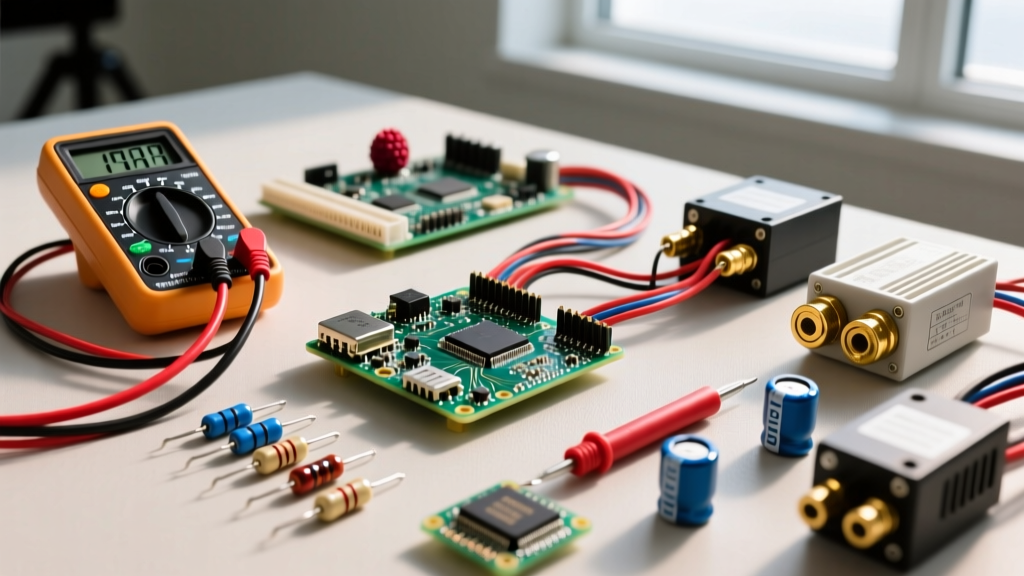

If you need to know how to calculate amp to watts for a standard 15-amp residential branch circuit, the direct answer is 1,800 watts at 120V AC, or 3,600 watts at 240V AC. The foundational DC and single-phase AC formula is Watts = Amps × Volts. Substituting our baseline values: 15A × 120V = 1,800W. However, treating this single calculation as a universal rule is a common DIY mistake. The true wattage depends entirely on three fixed assumptions: the nominal system voltage, the phase configuration, and the load's power factor (PF).
The Core Formula and Fixed Assumptions
At the bench or on the jobsite, converting amps to watts requires you to lock in your assumptions before touching a calculator. The basic power equation is:
DC & Single-Phase AC (Resistive): P (Watts) = I (Amps) × V (Volts)
Single-Phase AC (Inductive): P (Watts) = I (Amps) × V (Volts) × PF (Power Factor)
The assumption that fixes your answer is voltage. In North America, a standard outlet is nominally 120V, but utility tolerances mean it can legally fluctuate between 114V and 126V. If you measure 12A on a circuit that is currently sagging to 114V, your wattage is 1,368W, not the 1,440W you would calculate using the 120V nominal baseline. For precision work, always measure the actual voltage at the receptacle with a multimeter rather than relying on the nominal breaker label.
Furthermore, under NEC Article 210.20 guidelines, a 15-amp breaker is rated for 1,800W mathematically, but continuous loads (those running for 3 hours or more) must be derated to 80%. Therefore, your practical, code-compliant safe wattage for a continuous 15A/120V circuit is actually 1,440W.
Quick-Reference Amp to Watts Chart (12A–18A Range)
The table below provides the exact wattage for currents within a ±20% range of a standard 15A baseline. This covers the typical operating window for 15A and 20A branch circuits. These calculations assume a Power Factor of 1.0 (purely resistive loads like space heaters or incandescent lighting).
| Amps (A) | 120V (1-Phase) | 230V (1-Phase EU/UK) | 240V (1-Phase US) | 208V (3-Phase Commercial) |
|---|---|---|---|---|
| 12A | 1,440 W | 2,760 W | 2,880 W | 4,324 W |
| 13A | 1,560 W | 2,990 W | 3,120 W | 4,684 W |
| 14A | 1,680 W | 3,220 W | 3,360 W | 5,045 W |
| 15A | 1,800 W | 3,450 W | 3,600 W | 5,405 W |
| 16A | 1,920 W | 3,680 W | 3,840 W | 5,765 W |
| 17A | 2,040 W | 3,910 W | 4,080 W | 6,125 W |
| 18A | 2,160 W | 4,140 W | 4,320 W | 6,486 W |
How the Math Shifts: 120V vs 230V vs 3-Phase
When you move between different electrical systems, the relationship between amps and watts shifts dramatically because voltage and phase geometry change the equation.
120V vs 230V/240V Shifts: The shift here is strictly linear. If you double the voltage (moving from a 120V US appliance to a 230V European appliance), you double the wattage for the exact same current draw. This is why high-power appliances like electric dryers or EV chargers use 240V circuits; they can deliver massive wattage (e.g., 7,200W at 30A) without requiring dangerously thick wire that a 120V equivalent (60A) would demand.
The 3-Phase Shift: In commercial and industrial settings, 3-phase power is standard. The formula changes to incorporate the square root of 3 (approximately 1.732), which accounts for the 120-degree phase shift between the three voltage waveforms. The formula becomes:
3-Phase Watts: P = √3 × V(Line-to-Line) × I × PF
If you measure 15A on a 208V 3-phase system, the math is 1.732 × 208V × 15A = 5,404W. You get significantly more real power out of the same current draw compared to single-phase, which is why 3-phase motors run cooler and more efficiently than their single-phase counterparts of the same horsepower.
When Amp-to-Watt Conversion is Meaningless
There is a specific scenario where simply multiplying amps by volts gives you a dangerously misleading number: when the Power Factor (PF) is unknown on an inductive AC load.
If you clamp a multimeter around the feed wire of an air compressor motor and read 10A on a 120V circuit, the naive calculation (10 × 120) tells you 1,200W. But motors are inductive; they store energy in magnetic fields, causing the current waveform to lag behind the voltage waveform. This creates a PF of less than 1.0 (often around 0.6 to 0.8 for smaller motors).
If that motor has a PF of 0.65, the Real Power (the actual mechanical work and heat generated) is only 780W (1200 × 0.65). The remaining 420W is Reactive Power bouncing back and forth between the motor and the grid. According to the US Department of Energy, ignoring power factor when sizing generators or UPS systems for inductive loads leads to severe undersizing and immediate system failure upon motor startup. If you do not know the PF, your amp-to-watt conversion only yields Volt-Amps (VA), not Watts.
Frequently Asked Questions
How to calculate amp to watts for a 20-amp breaker?
For a standard 20-amp breaker on a 120V circuit, the absolute maximum mathematical wattage is 2,400W (20A × 120V). However, for continuous loads (running 3+ hours), NEC-style guidance requires an 80% derating. Therefore, your practical safe limit is 1,920W. If this is a 240V double-pole 20-amp breaker (like for a window AC unit), the maximum is 4,800W, derated to 3,840W for continuous duty.
How many amps is 1500 watts at 120 volts?
To find amps when you know watts and voltage, rearrange the formula to I = P / V. Dividing 1,500W by 120V yields exactly 12.5 amps. This is why 1,500W is the standard maximum rating for portable space heaters in the US; it draws 12.5A, which safely fits on a 15A breaker without tripping, while leaving 2.5A of headroom for minor voltage sags.
Does a higher wattage always mean higher amps?
No, because wattage is the product of both current and voltage. A 2,400W baseboard heater running on a 240V circuit draws only 10 amps. A 2,400W portable AC unit running on a 120V circuit draws 20 amps. The higher voltage system delivers the exact same wattage (work) while drawing half the current, which minimizes I²R (heat) losses in the copper wiring.
How do I calculate watts if I only know ohms and amps?
If you have measured the current (Amps) and the resistance (Ohms) of a purely resistive component like a heating element, you bypass voltage entirely using Joule's Law: Watts = Amps² × Ohms (P = I²R). For example, if a heating element has a resistance of 10 ohms and you measure 12 amps flowing through it, the wattage is 12² (144) × 10 = 1,440W. This is highly useful for bench-testing burnt-out elements with a multimeter before re-energizing the circuit.


