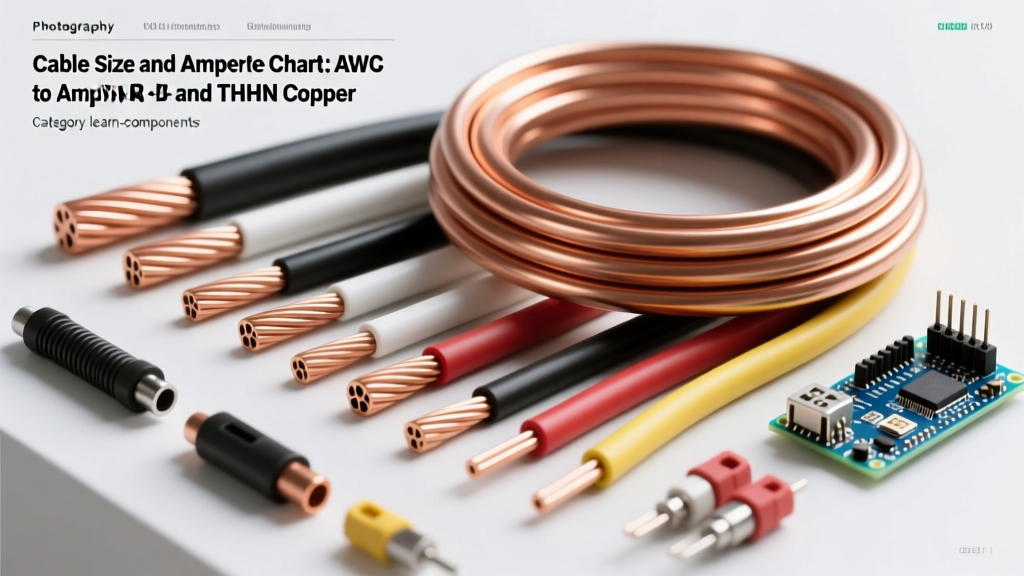

For standard residential branch circuits using NM-B (Romex) cable, use the 60°C column: 14 AWG is 15A, 12 AWG is 20A, and 10 AWG is 30A. For individual THHN wires in conduit, use the 90°C column for derating calculations, but limit your final breaker size to the 75°C column values due to termination ratings. Sizing wire correctly prevents insulation meltdown, voltage drop, and nuisance breaker trips.
How to Read the Cable Size and Amperage Chart
The most common mistake DIYers and junior electricians make is looking at the highest ampacity number on a chart and sizing the breaker to match. Ampacity is strictly governed by the weakest link in your circuit's thermal chain. Here is how to read the temperature columns in the chart below:
- 60°C Column (NM-B / Romex): Even though modern NM-B cable insulation is rated for 90°C, NEC Article 334.80 explicitly mandates that the ampacity of NM-B cable must be determined using the 60°C column. If you are running standard white/yellow/orange Romex, this is your column.
- 75°C Column (Terminations): Most modern circuit breakers, lugs, and receptacles are rated for 75°C. Per NEC 110.14(C), your circuit's final overcurrent protection cannot exceed the ampacity of the 75°C column, even if the wire insulation is rated higher.
- 90°C Column (THHN Derating Base): Individual THHN/THWN-2 wires in conduit can handle more heat. We use the 90°C column as our starting baseline for derating calculations (adjusting for multiple wires in a pipe or high ambient temperatures), but we still cap the final breaker size at the 75°C limit.
• 14 AWG: 15 Amps max (60°C col) — Standard lighting circuits.
• 12 AWG: 20 Amps max (60°C col) — Standard receptacle and kitchen small-appliance circuits.
• 10 AWG: 30 Amps max (60°C col) — Dryers, water heaters, and AC disconnects.
• 6 AWG: 55 Amps max (60°C col) / 65 Amps (75°C col) — Subpanel feeders and heavy EV chargers.
Complete AWG Cable Size and Amperage Chart (NEC Table 310.16)
The following data is extracted from NEC Table 310.16 for copper conductors. The values assume an ambient temperature of 30°C (86°F) and no more than three current-carrying conductors in a raceway or cable.
| AWG / kcmil Size | 60°C (NM-B / Romex) | 75°C (Termination Limit) | 90°C (THHN Derating Base) |
|---|---|---|---|
| 14 AWG | 15A | 20A | 25A |
| 12 AWG | 20A | 25A | 30A |
| 10 AWG | 30A | 35A | 40A |
| 8 AWG | 40A | 50A | 55A |
| 6 AWG | 55A | 65A | 75A |
| 4 AWG | 70A | 85A | 95A |
| 3 AWG | 85A | 100A | 115A |
| 2 AWG | 95A | 115A | 130A |
| 1 AWG | 110A | 130A | 145A |
| 1/0 AWG | 125A | 150A | 170A |
| 2/0 AWG | 145A | 175A | 195A |
| 3/0 AWG | 165A | 200A | 225A |
| 4/0 AWG | 195A | 230A | 260A |
Derating Rules and What This Chart Cannot Tell You
The chart above assumes ideal conditions: exactly three current-carrying conductors in a raceway, and an ambient air temperature of 30°C (86°F). Real-world jobsites rarely match this perfectly.
How Derating Modifies the Base Value
When you pull more than three current-carrying conductors through a single conduit, the wires heat each other up. You must apply a derating factor from NEC Table 310.15(C)(1) to the 90°C column, then verify the result against your breaker size.
Worked Example: You are pulling four 12 AWG THHN wires (two hots, one neutral, one ground) through a 1/2-inch EMT conduit for a multi-wire branch circuit.
1. Base ampacity (90°C column) = 30A.
2. Derating factor for 4 conductors = 80%.
3. Adjusted ampacity = 30A × 0.80 = 24A.
4. Termination limit (75°C column) = 25A.
Since 24A is greater than your 20A breaker requirement, 12 AWG THHN is perfectly legal and safe here.
What the Table Cannot Tell You: Voltage Drop
Ampacity charts only tell you the size required to prevent the wire from melting or starting a fire. They do not account for distance. According to the Copper Development Association, excessive voltage drop causes motors to overheat, LED drivers to flicker, and electronics to brown out.
For a standard 120V branch circuit, a 3% voltage drop limit means you lose roughly 3.6V. If you are running a 20A circuit 150 feet from the panel using 12 AWG copper, your voltage drop will exceed 5%. The ampacity chart says 12 AWG is fine for 20A, but physics dictates you must upsize to 10 AWG or even 8 AWG to maintain usable voltage at the receptacle. Always calculate voltage drop for any branch circuit run exceeding 50 feet.
Cable Size and Amperage Chart FAQ
Can I use 14 AWG wire on a 20-amp breaker?
No. While 14 AWG wire might physically handle 20 amps for a short time without catching fire, NEC Article 240.4(D) explicitly sets a hard limit: 14 AWG copper must be protected at 15 amps maximum. There are very specific exceptions for motor circuits and welding transformers, but for general lighting and receptacle branch circuits, putting 14 AWG on a 20A breaker is a severe code violation and a fire hazard.
Why does my 8 AWG NM-B cable only allow 40 amps when the chart says 50 amps?
You are likely looking at the 75°C column, which lists 8 AWG at 50A. However, because NM-B cable is governed by NEC 334.80, you are legally forced to use the 60°C column for ampacity. In the 60°C column, 8 AWG is rated for exactly 40 amps. If you need a 50A circuit (like for a hot tub or heavy welder), you must use individual THHN wires in conduit or upgrade to 6 AWG NM-B.
Does the ground wire count towards derating in conduit?
No. Equipment grounding conductors (bare copper or green insulated) do not carry current under normal operating conditions. According to NEC 310.15(C)(1), you do not count the ground wire when determining the number of current-carrying conductors for derating. Furthermore, if you have a multi-wire branch circuit (e.g., two hots on opposite phases sharing one neutral), the neutral carries only the unbalanced current and is also excluded from the derating count.
How far can I run 10 AWG wire before voltage drop requires a larger cable?
It depends on the voltage and the load. On a 240V circuit pulling 30 amps (like a water heater), you can run 10 AWG copper about 75 feet before hitting the recommended 3% voltage drop threshold. However, on a 120V circuit pulling 30 amps, that distance is cut in half to roughly 38 feet. Always use a dedicated voltage drop calculator using the exact one-way length of the wire and the continuous expected load, not just the breaker size.


