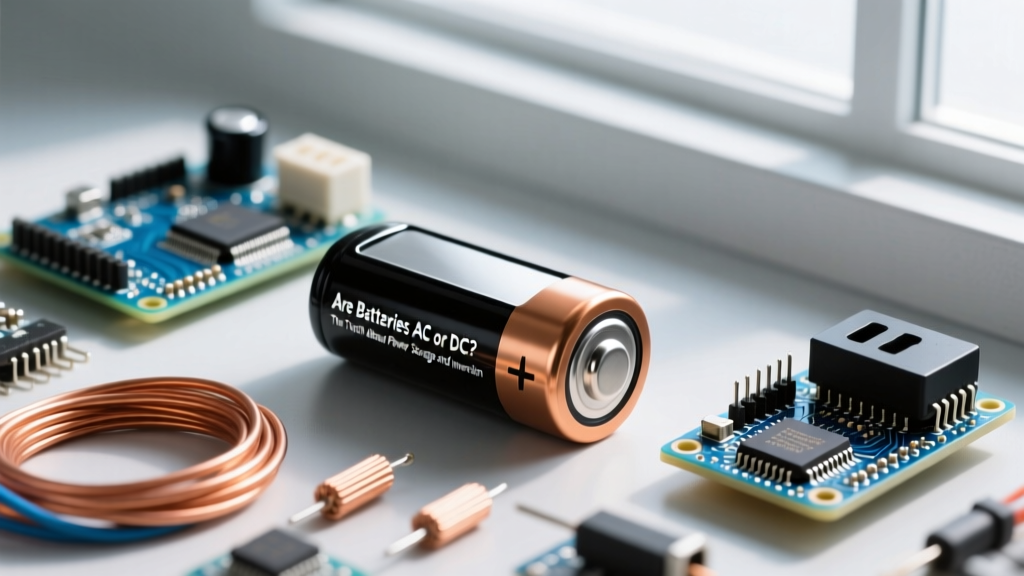

The Short Answer: Batteries Are Strictly DC
A battery is an electrochemical device that stores and releases energy exclusively as Direct Current (DC), meaning electrons flow in only one direction from the negative to the positive terminal. There is no such thing as a native Alternating Current (AC) battery. The chemical reactions inside a lithium-ion, lead-acid, or NiMH cell inherently produce a unidirectional flow of electrons.
When beginners ask if batteries are AC or DC, the confusion almost always stems from consumer marketing. If you plug a laptop into a "battery backup" or buy a portable "AC power station," you are not using an AC battery. You are using a DC battery paired with an internal electronic circuit called an inverter, which rapidly switches the DC polarity to simulate an AC sine wave.
Why the "AC Battery" Myth Exists (And What's Actually Inside)
People commonly confuse standalone batteries with integrated power systems. When you buy an EcoFlow Delta Pro or a CyberPower UPS, the marketing materials heavily feature AC outlets (NEMA 5-15R), leading consumers to think of the whole unit as an "AC battery."
In reality, these units contain three distinct stages:
- The DC Storage: A bank of 3.2V LiFePO4 or 3.7V NMC cylindrical cells wired in series/parallel to create a high-voltage DC bus (often 48V to 51.2V internally).
- The BMS (Battery Management System): A DC-only circuit board that balances cells and prevents over-discharge.
- The Inverter/Charger: A high-frequency switching circuit that converts the DC bus to 120V/240V AC for the outlets, and rectifies AC wall power back to DC to recharge the cells.
If you crack open a standard 12V 100Ah LiFePO4 battery (like a Renogy or Ampere Time), you will find zero AC components. It is purely DC, and connecting it directly to an AC mains panel will result in catastrophic failure, as DC cannot pass through standard AC transformers and will weld AC breaker contacts shut during a fault.
The Math: Converting Battery DC to Mains AC
Understanding that batteries are DC is critical for wire sizing. Because power (Watts) equals Voltage times Current ($P = V \times I$), dropping from a high AC voltage to a low DC voltage forces the current to spike massively on the battery side. If you undersize your DC wiring, you will experience severe voltage drop, inverter shutdowns, or a terminal fire.
Worked Numeric Example: Running a Space Heater
Let’s say you want to run a 1,500W space heater off a 12V battery bank using a standalone inverter.
- AC Side (120V): $1500W \div 120V = 12.5A$. A standard 14 AWG household extension cord handles this easily.
- DC Side (12V): Inverters are not 100% efficient. Assuming a realistic 90% efficiency rating (source: Department of Energy Inverter Guidelines), the DC draw is calculated as: $1500W \div (12V \times 0.90) = 138.8A$.
You are now pushing nearly 139 amps of continuous DC current out of the battery. According to standard chassis wiring ampacity tables, you must use 1/0 AWG or 2 AWG pure copper welding cable for the battery-to-inverter run. If you attempt to use 8 AWG wire because "it's thick enough for a car battery," the wire will overheat, the insulation will melt, and the voltage drop will cause the inverter's low-voltage cutoff to trip instantly.
Where You Meet This in Practice
The DC-only nature of batteries dictates the architecture of almost every modern power system:
- Off-Grid Solar: Solar panels output DC. The charge controller regulates this DC to charge the DC battery bank. Only at the very end of the chain does a hybrid inverter convert the DC to AC for your wall outlets.
- Electric Vehicles (EVs): The massive 400V or 800V pack under your car is strictly DC. The car uses an internal inverter to drive the AC traction motors, and an onboard rectifier to convert AC grid power to DC when you plug in at home.
- Uninterruptible Power Supplies (UPS): Data centers use massive DC battery strings. During an outage, industrial inverters synthesize 3-phase AC power to keep the servers running without a millisecond of downtime.
Decision Tree: Raw DC Bank vs. All-in-One AC Power Station
Because batteries are inherently DC, you must decide how to handle the AC conversion. Use this decision matrix to select the right hardware for your project.
| Scenario / Requirement | Choose Raw DC Battery Bank + Standalone Inverter | Choose All-in-One "AC" Portable Power Station |
|---|---|---|
| Primary Use Case | Permanent off-grid cabin, whole-home backup, DIY solar array. | Camping, job-site power, temporary apartment backup, mobile medical. |
| Scalability | High. You can wire multiple 48V batteries in parallel and swap inverters. | None. You are locked into the internal battery capacity and inverter size. |
| Maintenance & Repair | Modular. If the inverter dies, you replace just the inverter. | Sealed unit. If the inverter board fails, the whole unit requires factory service. |
| Cost per kWh | ~$150 - $250 per kWh (e.g., SOK 48V 100Ah server rack battery). | ~$400 - $700 per kWh (e.g., Jackery or Bluetti integrated units). |
| Concrete Pick (2026) | Default Pick: SOK 48V 100Ah Server Rack Battery paired with a Victron MultiPlus-II 48/3000 inverter. | Default Pick: EcoFlow Delta 2 Max (2kWh capacity, 2400W internal inverter). |
Frequently Asked Questions
Can I charge a DC battery directly from an AC generator?
No. You must place a battery charger (which is essentially a rectifier and DC step-down converter) between the AC generator and the DC battery. Connecting AC directly to DC battery terminals will destroy the battery, trip the generator's breaker, and likely cause a fire.
Why do some multimeters read AC voltage on a battery?
If your multimeter reads AC voltage across a battery, you are either measuring "ripple" from a connected inverter/charger, or your meter is picking up phantom induced voltage from nearby AC wiring. A healthy, disconnected battery should read 0.0V AC. For accurate diagnostics, always refer to the Victron Wiring Unlimited guide for proper DC measurement techniques.
Are "AC batteries" being developed for the future?
Researchers are experimenting with integrated storage where the inverter is built directly into the battery casing at the cell level, but the fundamental electrochemistry remains DC. The storage medium will always be DC; only the packaging and output interface will change.


