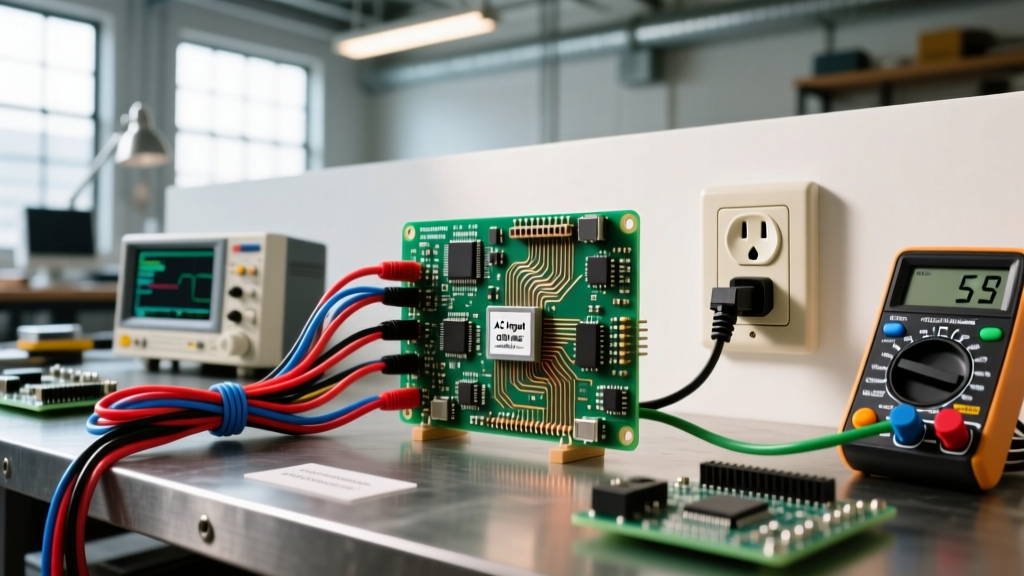
If you are sizing wire or a breaker for a 500W AC-DC converter stepping 120V AC down to 12V DC, here are your exact numbers. Assuming a standard 90% efficiency and a 0.90 Power Factor (PF), the converter will output exactly 37.5 Amps of DC current and draw 4.63 Amps of AC current from the wall. These numbers are your baseline for selecting a 15A branch circuit and 14 AWG copper wire, but they shift dramatically if your input voltage, efficiency, or PF assumptions change.
The Quick Conversion: 500W AC-DC Converter Math
To get from the AC wall outlet to the DC load, we have to account for real power, apparent power, and conversion losses. Here are the exact formulas with the values substituted for a 500W unit:
1. DC Output Amps (The Load Side)
Formula: I_DC = (P_AC × η) / V_DC
Substituted: I_DC = (500W × 0.90) / 12V
Result: 450W / 12V = 37.5A
2. AC Input Amps (The Mains Side)
Formula: I_AC = P_AC / (V_AC × PF)
Substituted: I_AC = 500W / (120V × 0.90)
Result: 500W / 108 = 4.63A
Below is a reference table showing how these currents scale across a ±20% power range (400W to 600W), which covers common off-the-shelf models like the Mean Well LRS-600-12 or smaller 400W DIN-rail units.
| AC Input Power (W) | DC Output Power (W) @ 90% η | DC Output Current (A) @ 12V | AC Input Current (A) @ 120V, 0.90 PF |
|---|---|---|---|
| 400W | 360W | 30.0A | 3.70A |
| 450W | 405W | 33.75A | 4.17A |
| 500W | 450W | 37.5A | 4.63A |
| 550W | 495W | 41.25A | 5.09A |
| 600W | 540W | 45.0A | 5.55A |
The Assumptions That Fix Your AC-DC Converter Calculations
The math above is only as good as the assumptions feeding it. In power electronics, three variables dictate your actual wire and breaker sizing: Efficiency (η), Power Factor (PF), and Input Phase/Voltage.
Efficiency (η): Modern switched-mode AC-DC converters with active Power Factor Correction (PFC) typically hit 88% to 93% efficiency at full load. If you buy a cheap, unbranded linear or older switching supply, efficiency might drop to 75%. At 75% efficiency, that same 500W AC input only yields 31.25A of DC output. Always check the manufacturer's datasheet for the specific load curve; efficiency usually peaks around 50-75% load and drops off at the extremes.
Power Factor (PF): This is where most DIYers get their AC input calculations wrong. Real power (Watts) does what you pay for, but apparent power (Volt-Amps) is what your wires actually carry. A high-quality unit with Active PFC (like those complying with EN61000-3-2 standards) will hold a PF of 0.95 or higher. A cheap unit without PFC might sit at 0.65. If your PF is 0.65, your 500W unit suddenly draws 6.41 Amps from a 120V wall, pushing you closer to breaker trip thresholds.
How the Answer Shifts for 120V vs 230V vs 3-Phase:
Input voltage fundamentally changes your AC amp draw, which dictates your upstream wiring gauge.
- 120V Single-Phase (US Standard): Draws 4.63A (assuming 0.90 PF). Easily handled by a standard 15A breaker and 14 AWG wire.
- 230V Single-Phase (EU/UK/AU Standard): The current halves.
500W / (230V × 0.90) =2.41A. You can run this on much smaller conductors, though local codes usually mandate a minimum wire size (e.g., 1.5mm² or 2.5mm²) regardless of load. - 208V 3-Phase (US Industrial): For large industrial racks using 3-phase AC-DC converters, the formula divides by √3.
500W / (1.732 × 208V × 0.90) =1.54A per phase.
When AC-DC Converter Conversions Become Meaningless
There are three scenarios where doing this continuous-state math will lead you to undersize your infrastructure and trip breakers:
- Ignoring Inrush Current: When you flip the switch on a 500W AC-DC converter, the internal bulk capacitors are completely discharged. They look like a dead short for the first few milliseconds. According to Fluke's power quality guidelines, measuring true RMS current during startup requires specialized equipment because standard multimeters miss the spike. A 500W unit can pull 40A to 60A of inrush current for 2ms. If your breaker is a sensitive Type B or you have multiple converters on one circuit turning on simultaneously, they will trip a 15A breaker instantly, even though the continuous math says 4.63A.
- Peak vs. Continuous Ratings: Many LED drivers and hobby power supplies advertise '500W' but mean '500W peak for 30 seconds'. If your load requires a continuous 500W, you actually need to buy a 600W or 700W rated converter to avoid thermal shutdown.
- Thermal Derating: If your converter is mounted inside a sealed NEMA enclosure in a hot garage or attic, ambient temperature destroys your math. Most industrial supplies (like Texas Instruments reference designs or Mean Well units) derate their output linearly above 50°C (122°F). At 60°C ambient, a 500W converter might only safely output 300W. If your DC load demands 37.5A, the converter will fold back its voltage or trigger over-temperature protection.
AC-DC Converter Conversion FAQs
How do I calculate the AC input current for a 24V DC output AC-DC converter?
The AC input current calculation does not care about your DC output voltage; it only cares about AC input watts, AC voltage, and Power Factor. If you have a 500W AC-DC converter outputting 24V, it still draws 4.63A from a 120V AC wall (assuming 0.90 PF). The only number that changes is your DC output current: (500W × 0.90) / 24V = 18.75A. You will use smaller wire on the DC side (e.g., 12 AWG instead of 8 AWG) because the higher voltage pushes the same power at half the current.
Why does my AC-DC converter trip the breaker on startup if the continuous math says it is fine?
This is caused by capacitive inrush current. The large electrolytic capacitors on the primary side of the converter draw massive current to charge up in the first half-cycle of AC power. To fix this, you have three options: switch to a converter with a built-in NTC thermistor or active inrush limiting relay, upgrade to a breaker with a 'C' or 'D' trip curve (common in industrial panels) that tolerates magnetic spikes, or use a soft-start circuit on the AC input side. Never simply swap a 15A breaker for a 20A breaker without verifying the wall wiring is rated for 12 AWG/20A; doing so is a fire hazard.
Can I use a 120V AC to 12V DC converter on a 230V European mains supply?
Only if the unit has a physical 115V/230V input selector switch or a universal 90-264V AC input range printed on the spec label. Many older or cheaper enclosed power supplies have a red voltage selector switch on the side. If you plug a unit hard-set to 115V into a 230V outlet, the input varistor (MOV) will violently short and blow the internal fuse to protect the downstream circuitry, often with a loud pop and a flash of smoke. Always verify the input voltage rating with a multimeter or by reading the chassis label before applying power in a new region.