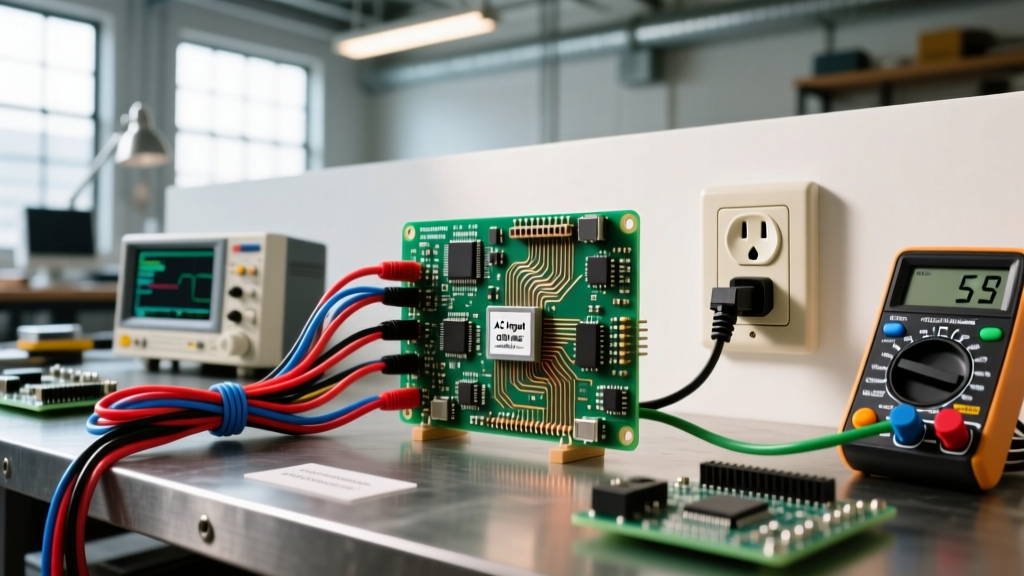

The standard AC voltage in the US is 120V for general-purpose branch circuits and 240V for high-power appliances, operating at a nominal frequency of 60Hz. According to ANSI C84.1, the acceptable utility tolerance for a 120V residential service is 114V to 126V (Range A). If you are importing equipment or traveling, your gear must either natively support a 100-240V AC input or be paired with a properly sized step-down transformer. Attempting to run 230V/50Hz European or Asian equipment directly on US mains will result in immediate component failure, severe overheating, or fire.
US AC Voltage Standards and Conductor Mapping
While the US relies on a 120V/240V split-phase residential system, global standards vary significantly in nominal voltage, tolerance bands, and frequency. When evaluating imported equipment or designing for international deployment, you must reference the local grid parameters rather than assuming universal compatibility.
| Region | Nominal Voltage | Tolerance (Range A) | Frequency | Standard Plug Type |
|---|---|---|---|---|
| US / Canada | 120V / 240V | 114-126V / 228-252V | 60Hz | NEMA 1-15, 5-15, 14-50 |
| UK | 230V | 216.2-253V | 50Hz | BS 1363 (Type G) |
| EU (Harmonized) | 230V | 216.2-253V | 50Hz | CEE 7/7 (Type E/F) |
| Japan (East/West) | 100V | 95-107V | 50Hz / 60Hz | Type A / B |
| Australia / NZ | 230V | 216.2-253V | 50Hz | AS/NZS 3112 (Type I) |
Source: IEC World Plugs and regional grid standards.
Conductor Color Mapping: NEC vs. IEC
One of the most dangerous pitfalls in mixed installations is the clash between US National Electrical Code (NEC) and International Electrotechnical Commission (IEC) wiring colors. Misidentifying a neutral conductor can lead to lethal shock hazards or dead shorts.
- US (NEC): Hot conductors are Black, Red, or Blue. The grounded Neutral is strictly White or Gray. Equipment Ground is Green, Green/Yellow, or Bare copper.
- International (IEC 60446): Hot conductors are Brown, Black, or Gray. The Neutral is strictly Blue. Equipment Ground is Green/Yellow stripe.
If you are hardwiring an imported IEC-compliant machine into a US facility, the blue neutral wire must be re-identified with white heat-shrink tubing or white phase tape at every termination point to comply with NEC 200.6. Leaving blue wires in a US panel is an automatic inspection failure.
Equipment Tolerance: Transformers vs. Converters for Imported Gear
When operating foreign equipment on US AC voltage, you must first determine what the device's internal power supply can tolerate. Look at the manufacturer's data plate for the 'INPUT' specification.
Switching Power Supplies vs. Linear Loads
Modern electronics (laptops, phone chargers, LED drivers, and most consumer AV equipment) use switched-mode power supplies (SMPS). These natively tolerate a wide input range, typically marked as 100-240V AC, 50/60Hz. For these devices, you only need a cheap physical plug adapter to match the US NEMA 5-15 receptacle; no voltage conversion is required.
However, equipment with linear transformers, resistive heating elements, or AC induction motors requires strict voltage and frequency matching. This is where the distinction between a converter and a transformer becomes critical.
Frequency dictates the synchronous speed of an AC motor. If you use a step-down transformer to run a European 230V/50Hz centrifugal pump or compressor on US 240V/60Hz power, the voltage is matched, but the motor will spin 20% faster (60/50 = 1.2). According to pump affinity laws, power consumption scales with the cube of the speed ratio ($1.2^3 = 1.728$). A pump that normally draws 10A at 50Hz will attempt to draw 17.3A at 60Hz, instantly tripping the overload relay or burning out the windings. Conversely, running a US 60Hz motor on 50Hz power reduces cooling fan efficacy and torque, leading to thermal failure.
Transformer vs. Converter Decision Framework
- Travel Converters (Triac Phase-Cutting): These are lightweight, solid-state devices that chop the AC waveform to lower the RMS voltage. They are strictly for simple resistive heating loads (hair dryers, travel irons, coffee makers). Never use a phase-cut converter on electronics, motors, or compressors; the distorted waveform will destroy the input capacitors and cause severe overheating.
- Step-Down Transformers (Copper/Iron Core): These use magnetic induction to cleanly step 240V down to 120V (or vice versa) while maintaining a pure sine wave. They are mandatory for any imported appliance with a circuit board, motor, or compressor. When sizing a transformer, calculate the total running wattage of the load and multiply by 1.5 to account for inrush current (LRA) during motor startup.
Governing Mixed Installations and Code Compliance
When integrating international equipment into a US facility, or when a US-based company exports machinery, the question arises: which standard governs the installation?
The universal rule is that the local Authority Having Jurisdiction (AHJ) dictates the governing standard based on the physical location of the installation. If a factory in Ohio imports a German CNC machine wired with IEC color codes and metric cable glands, the machine must be integrated into the US electrical system in strict accordance with NFPA 70 (the NEC).
Rules for Mixed-Voltage and Mixed-Standard Panels
- Re-identification at Terminations: As mentioned, IEC Blue (neutral) must be sleeved with white at the panel busbar and the machine disconnect. IEC Brown/Black/Gray hots must be sleeved with black/red/blue to match US phase identification.
- Overcurrent Protection: Imported equipment often specifies protection using metric breaker curves (e.g., IEC 60898 Type C or D). US panels use UL-listed breakers with imperial amp ratings and different trip curves (HACR, SWD). You must install a local UL-listed disconnect switch or breaker panel ahead of the machine, sized according to NEC Article 430 for motor loads, rather than relying solely on the machine's internal metric breakers.
- Grounding vs. Bonding: European machines often rely on a TN-S or TT earthing system. In the US, the equipment grounding conductor (EGC) must be bonded to the service neutral at the main disconnect only. Ensure the imported machine's internal ground bus is isolated from the neutral bus once it crosses the US service entrance.
Understanding the precise ANSI C84.1 voltage tolerances and the physical realities of 60Hz AC power ensures that your imported equipment operates safely, efficiently, and legally within the US grid. Always verify the nameplate data, calculate inrush currents for inductive loads, and respect local conductor color codes before energizing any mixed-standard circuit.


