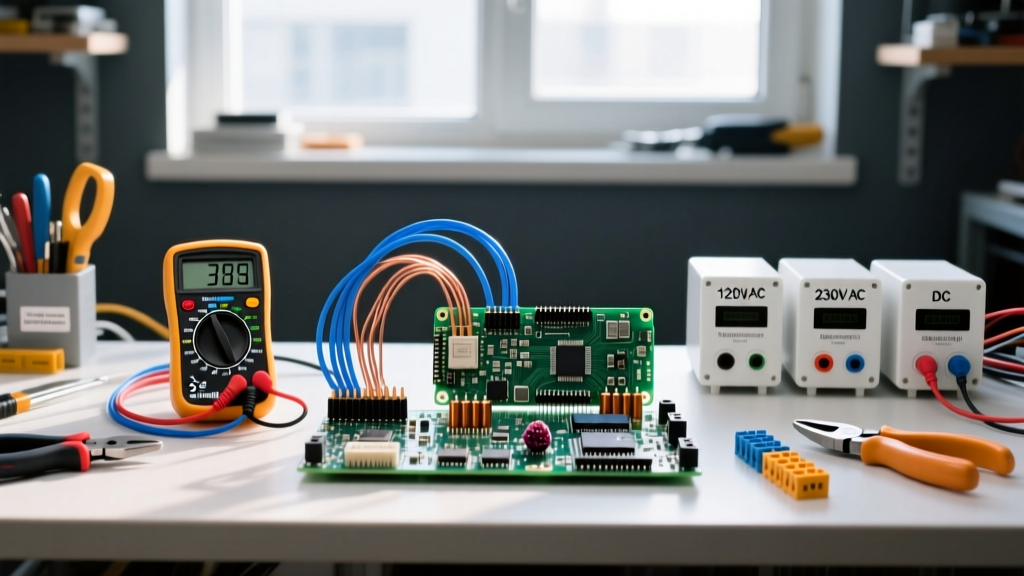
At a standard US household voltage of 120V AC with a purely resistive load (Power Factor = 1.0), 800 watts draws 6.67 amps. If you are on a 230V AC European or UK mains supply, that same 800W load pulls only 3.48 amps. For a 12V DC off-grid solar or automotive system, 800 watts demands a massive 66.67 amps.
The foundational formula for DC and single-phase AC (resistive) is I = P / V. Substituting our target values for a US standard outlet: I = 800W / 120V = 6.67A. However, treating this single calculation as a universal constant is a fast track to tripped breakers or melted wire insulation. The actual amp draw shifts dramatically based on three hidden variables: system voltage, phase configuration, and power factor.
The Master Conversion Chart: 800W Across Standard Voltages
Because watts measure real power and amps measure current flow, voltage acts as the multiplier. Higher voltage pushes the same wattage with less current. Below is the exact amp draw for an 800-watt load across the most common global electrical standards, assuming a Power Factor (PF) of 1.0.
| System Type | Voltage | Phase | Formula Used | Resulting Amps |
|---|---|---|---|---|
| Automotive / 12V Solar | 12V DC | N/A | I = P / V | 66.67 A |
| Marine / Truck / 24V Solar | 24V DC | N/A | I = P / V | 33.33 A |
| US Household (NEMA 5-15) | 120V AC | 1-Phase | I = P / (V × PF) | 6.67 A |
| US Commercial / Multi-family | 208V AC | 1-Phase | I = P / (V × PF) | 3.85 A |
| EU / UK / AU Mains | 230V AC | 1-Phase | I = P / (V × PF) | 3.48 A |
| US Commercial Lighting | 277V AC | 1-Phase | I = P / (V × PF) | 2.89 A |
| US Industrial Machinery | 480V AC | 3-Phase | I = P / (√3 × V × PF) | 0.96 A |
Note: For the 3-phase 480V calculation, the formula incorporates the square root of 3 (≈1.732) to account for the phase angles. 800 / (1.732 × 480 × 1.0) = 0.96A.
The Hidden Variables: Power Factor and Phase Shift
The tables above assume a Power Factor (PF) of 1.0, which is true for purely resistive loads like incandescent heaters, toasters, or basic coffee makers. But what happens when your 800W device has a motor, a compressor, or a switching power supply?
When the Conversion Becomes Meaningless
If you are looking at the nameplate of an inductive load—like an 800W AC motor or a transformer—and the manufacturer does not list the Power Factor or the efficiency rating, converting watts to amps is essentially a guess.
Inductive components cause the current waveform to lag behind the voltage waveform. This creates a divergence between Real Power (Watts, which does the actual work) and Apparent Power (Volt-Amps, VA, which the wire must carry). According to Fluke's power quality guidelines, a typical motor might have a PF of 0.8. If your 800W load has a PF of 0.8 on a 120V circuit, the formula shifts to I = 800 / (120 × 0.8), resulting in 8.33 amps—nearly 25% more current than the resistive calculation suggested. If you sized your wire for 6.67A, you are now undersized and risking a thermal event.
The 3-Phase Advantage
In industrial settings, 3-phase power delivers energy in three overlapping sine waves. Because power delivery is continuous rather than pulsing, 3-phase systems transmit the same wattage at significantly lower amperages. As shown in the master table, an 800W load on a 480V 3-phase system draws less than 1 amp, allowing factories to use much smaller gauge conductors for heavy machinery.
Neighboring Loads: Sizing Breakers for the 640W–960W Range
In practical DIY and electrical work, loads rarely sit at exactly 800W. Heating elements fluctuate with line voltage (which can swing from 114V to 126V), and motors draw surge currents on startup. Below is a reference table for the ±20% range around 800W on a standard 120V circuit, alongside the required breaker sizing based on the National Electrical Code (NEC) continuous load rules.
| Wattage (W) | Amps @ 120V (PF=1.0) | Continuous Load Multiplier (125%) | Minimum Standard Breaker |
|---|---|---|---|
| 640W | 5.33 A | 6.66 A | 15 A |
| 720W | 6.00 A | 7.50 A | 15 A |
| 800W | 6.67 A | 8.34 A | 15 A |
| 880W | 7.33 A | 9.16 A | 15 A |
| 960W | 8.00 A | 10.00 A | 15 A |
The 80% Rule Explained: NEC Article 210.20 dictates that if a load will run continuously for 3 hours or more (like a space heater or a grow light), you must multiply the amp draw by 1.25. An 800W continuous load draws 6.67A. Multiplied by 1.25, the circuit must be rated for at least 8.34A. A standard 15-amp breaker and 14 AWG copper wire safely handle this, but you are approaching the upper limit of what a 15A circuit should handle continuously alongside any other parasitic draws.
Frequently Asked Questions
Can I run an 800W appliance on a standard 15-amp household circuit?
Yes. At 120V, 800W draws 6.67 amps, which is well below the 15-amp limit of a standard US NEMA 5-15 receptacle. Even if the appliance runs continuously for hours (triggering the NEC 125% derating rule), the adjusted draw of 8.34A is safely within the capacity of a 15A breaker and 14 AWG wire. Just ensure you do not have other high-draw devices (like a vacuum or microwave) running on the same branch circuit simultaneously.
How many amps is 800 watts on a 12V car inverter, and what wire do I need?
At 12V DC, 800 watts requires 66.67 amps (and potentially up to 75A when accounting for inverter inefficiencies, which typically run around 85-90%). This is a massive amount of current for a vehicle's electrical system. You must use a minimum of 4 AWG copper wire for runs under 4 feet, and step up to 2 AWG for longer runs to prevent severe voltage drop. You must also install an 80A or 100A ANL fuse within 18 inches of the battery positive terminal to protect against a dead short.
Why does my 800W UPS say it only handles 480W?
This is the difference between Watts and Volt-Amps (VA). Many Uninterruptible Power Supplies (UPS) are rated in VA (Apparent Power). An '800VA' UPS typically has a Power Factor limit of 0.6 for its internal inverter, meaning it can only safely deliver 480 Watts of Real Power. Always check the nameplate for the explicit 'W' or 'Watts' rating, not just the VA rating, when sizing battery backups for PC or networking gear.