3-phase voltage is an alternating current power distribution method that uses three separate AC waveforms, each offset by 120 electrical degrees, to deliver constant power to a load. Unlike single-phase power, which pulses and drops to zero 120 times a second on a 60Hz grid, 3-phase power overlaps its waveforms so the total power delivery never hits zero—much like a three-cylinder engine where at least one piston is always on a power stroke. This fundamental shift changes everything in a real installation: it dictates your panel busbar configuration, requires 3-pole breakers, alters wire sizing calculations, and introduces the square root of 3 (1.732) multiplier into your electrical math.
The Core Math and Standard Voltage Configurations
The most critical concept to grasp when working with 3-phase volts is the relationship between line-to-line (phase-to-phase) voltage and line-to-neutral voltage. In a Wye (Y) configured system, the line-to-line voltage is always the line-to-neutral voltage multiplied by 1.732. If you measure 120V from any phase to neutral, the voltage between any two phases will be 208V (120 x 1.732), not 240V. This geometric relationship is dictated by the 120-degree phase shift and is the source of most troubleshooting errors on the jobsite.
| System Configuration | Line-to-Line Volts | Line-to-Neutral Volts | Primary Region | Typical Applications |
|---|---|---|---|---|
| 208Y/120V (Wye) | 208V | 120V | North America | Commercial lighting, standard receptacles, small HVAC rooftop units. |
| 480Y/277V (Wye) | 480V | 277V | North America | Industrial motors, large commercial HVAC, high-bay LED lighting. |
| 400Y/230V (Wye) | 400V | 230V | EU / IEC Regions | Standard commercial/industrial equipment, EV fast chargers. |
| 240V Delta (High-Leg) | 240V | 120V / 208V / 120V | North America (Legacy) | Older manufacturing, mixed motor and 120V lighting loads. |
Worked Numeric Example: Sizing a 3-Phase Heater Circuit
The Scenario: You need to wire a 15 kW balanced resistive duct heater on a 208Y/120V 3-phase system. The run is 100 feet, and the heater operates continuously (over 3 hours).
Step 1: Calculate Full Load Amps (FLA)
Formula: I = P / (V_LL × √3 × Power Factor)
Since it is a resistive load, Power Factor = 1.0.
I = 15,000W / (208V × 1.732 × 1.0) = 15,000 / 360.25 = 41.63 Amps
Step 2: Apply Continuous Load Multiplier
NEC requires continuous loads to be sized at 125%.
41.63A × 1.25 = 52.04 Amps
Step 3: Select Breaker and Wire
The next standard breaker size above 52.04A is 60 Amps (3-pole).
Using the 75°C column of NEC Table 310.16 (standard for terminations), 6 AWG copper THHN is rated for 65 Amps, which safely covers the 52.04A requirement. A quick voltage drop check (using 1.732 × 12.9 × 41.63 × 100 / 26240) yields a 1.7% drop, well under the 3% recommended limit.
What 3-Phase Volts Change in a Real Installation
Transitioning from single-phase to 3-phase power fundamentally alters the physical hardware and code requirements of an installation. First, your panelboard must be specifically rated for the 3-phase busbar arrangement, which typically staggers the breaker stabs to accommodate 3-pole breakers. You cannot simply snap a 3-pole breaker into a standard single-phase residential load center.
Conductor identification is another major shift. According to industry standards and NEC guidelines, 277/480V 3-phase systems must use Brown, Orange, and Yellow for phases A, B, and C respectively. For 120/208V systems, the standard industry practice (and NEC 210.5(C) mandate for feeders) is Black, Red, and Blue. The neutral is always white or gray, and the ground is green or bare. Mixing these up or failing to label them at the panel can lead to catastrophic faults when future technicians troubleshoot the circuit.
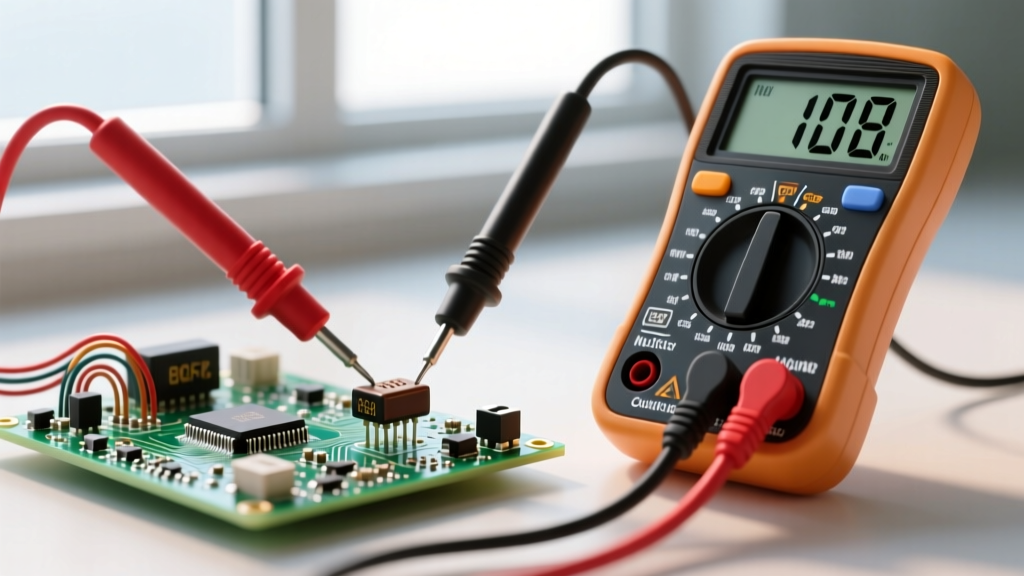
Furthermore, 3-phase systems change how you measure and verify power. You must measure both phase-to-neutral (to verify the transformer secondary and neutral bond integrity) and phase-to-phase (to verify the transformer winding outputs). A 5% voltage imbalance between the three phase-to-phase readings can cause a 3-phase induction motor to overheat and fail prematurely, making a true-RMS multimeter and a phase rotation meter mandatory tools for the bench.
Where You Meet 3-Phase Power in Practice
While residential homes in North America almost exclusively use 120/240V split-phase, 3-phase volts dominate the commercial, industrial, and modern high-power sectors.
- Commercial HVAC Rooftop Units (RTUs): Most strip malls and office buildings use 208Y/120V or 480Y/277V to run compressor motors. 3-phase motors are smaller, run cooler, and don't require the heavy run/start capacitors that single-phase motors rely on to get moving.
- EV Level 3 DC Fast Chargers: A 150 kW to 350 kW DC fast charger requires massive power. These pedestals are fed directly from 480V 3-phase utility transformers. The internal rectifiers convert the 480V AC to the 400V-800V DC required by modern electric vehicle battery architectures.
- Workshop Machinery and VFDs: Heavy lathes, CNC mills, and large dust collectors use 3-phase power for torque and speed control. When a shop only has single-phase utility power, makers use a Variable Frequency Drive (VFD) or a rotary phase converter to generate a synthetic third leg, creating 240V 3-phase power on the bench.
Common Confusions and Troubleshooting Mistakes
The most dangerous confusion in 3-phase systems involves the 240V High-Leg Delta (also known as a red-leg or wild-leg system). Common in older North American manufacturing, this system provides 240V phase-to-phase for motors, but uses a center-tapped transformer winding to provide 120V to neutral for lighting.
If an electrician blindly assumes every phase-to-neutral connection in a 240V delta panel is 120V and wires a standard receptacle to the B-phase, they will feed 208V into a 120V appliance. The result is immediate component failure, melted wiring, and a severe fire hazard. The NEC strictly requires the high leg (Phase B) to be identified with orange insulation to prevent this exact mistake.
Another frequent error is confusing line-to-line voltage with line-to-ground voltage in ungrounded or corner-grounded delta systems. In a 480V corner-grounded delta, one phase is intentionally bonded to ground. Measuring that specific phase to ground will read 0V, while the other two phases will read 480V to ground. Technicians unfamiliar with this configuration often misdiagnose the 0V reading as a blown fuse or open winding. Always consult the panel schematic and refer to foundational AC theory resources to understand the specific transformer topology before troubleshooting.
Frequently Asked Questions
Can I run a 3-phase motor on single-phase power?
Not directly. You must use a Variable Frequency Drive (VFD) rated for single-phase input and 3-phase output, or a rotary/static phase converter. The motor will need to be wired for the lower voltage configuration (e.g., 230V instead of 460V) to match the converter's output.
Why is 208V used instead of 240V in commercial buildings?
208V is the natural mathematical result of a 120V line-to-neutral Wye system (120 x 1.732 = 208). It allows a facility to power both standard 120V office equipment and larger 208V HVAC units from the exact same transformer and panel without needing a separate step-up transformer.
Does a 3-phase system require a neutral wire?
Not always. A purely balanced 3-phase load (like a 480V motor or a delta-wired heater) does not draw neutral current and only requires three phase conductors and a ground. However, Wye systems supplying mixed line-to-neutral loads (like 277V lighting) absolutely require a properly sized and bonded neutral conductor.