Converting 16 amps to watts requires a fixed voltage and phase assumption. At a standard US 120V single-phase supply, 16 amps equals exactly 1,920 watts. At a standard European 230V single-phase supply, 16 amps equals 3,680 watts. The foundational DC and single-phase AC formula is Watts = Volts × Amps. Substituting the US standard values yields: 1,920W = 120V × 16A.
Because amperage is a measure of current flow and wattage is a measure of total power, any single-voltage answer presented as universal is incorrect. The final wattage shifts dramatically depending on whether you are measuring a 120V branch circuit, a 240V split-phase appliance feed, or a 400V three-phase industrial line.
Global 16-Amp Wattage Reference and Neighboring Values
The table below maps 16 amps across standard global voltages and phase configurations. All single-phase values assume a Power Factor (PF) of 1.0 (purely resistive loads like space heaters or incandescent lighting). Three-phase values use the formula Watts = √3 × Volts × Amps.
| System Voltage | Phase Type | Formula Used | Calculated Watts (PF=1) | Common Application |
|---|---|---|---|---|
| 120V | Single-Phase | 120 × 16 | 1,920 W | US standard 20A receptacle (NEMA 5-20) |
| 230V | Single-Phase | 230 × 16 | 3,680 W | EU/UK standard Schuko/BS1363 circuits |
| 240V | Single-Phase | 240 × 16 | 3,840 W | US split-phase baseboard heaters |
| 208V | Three-Phase | √3 × 208 × 16 | 5,765 W | US commercial HVAC / light machinery |
| 400V | Three-Phase | √3 × 400 × 16 | 11,085 W | EU industrial 3-phase motor feeds |
Neighboring Amp Values at 120V (Single-Phase)
If your multimeter reads slightly off from exactly 16.0A, use this ±20% reference chart to find your true wattage draw on a standard 120V circuit.
| Measured Amps | Watts at 120V | Breaker Status (20A Circuit) |
|---|---|---|
| 13.0 A | 1,560 W | Safe (Below 80% continuous limit) |
| 14.0 A | 1,680 W | Safe (Below 80% continuous limit) |
| 15.0 A | 1,800 W | Safe (Below 80% continuous limit) |
| 16.0 A | 1,920 W | Max Continuous Limit (80%) |
| 17.0 A | 2,040 W | Warning: Exceeds continuous limit |
| 18.0 A | 2,160 W | Danger: Nearing trip threshold |
| 19.0 A | 2,280 W | Trip Imminent (Thermal overload) |
The Hidden Variables: Power Factor and Phase Angles
The conversions above assume a Power Factor (PF) of 1.0, which is true for resistive loads like a 1,500W space heater or a toaster. However, if you are measuring an inductive load—such as an AC compressor, a bench grinder motor, or a transformer—the conversion from amps to watts becomes meaningless without knowing the PF.
Inductive loads cause the current waveform to lag behind the voltage waveform. This creates Apparent Power (measured in Volt-Amps, or VA) and Real Power (measured in Watts). The formula shifts to: Watts = Volts × Amps × PF.
- Example: You clamp your meter around a 230V European dust collector motor and read 16A. The apparent power is 3,680 VA. But if the motor's nameplate lists a PF of 0.82, the real power doing actual work is 230 × 16 × 0.82 = 3,017 Watts.
- When to ignore Watts: When sizing wire, breakers, and inverters, you must size for Amps (or VA), not Watts. A 16A motor drawing 3,017W still requires wire and a breaker rated for the full 16A of current flow, otherwise the conductors will overheat despite the lower real wattage.
For a deeper look at how global regions handle plug configurations and nominal voltages for these circuits, refer to the IEC World Plugs and Voltages database.
Practical Bench and Jobsite Rules for 16A Circuits
Knowing the wattage is only half the battle. If you are designing a circuit or troubleshooting a tripped breaker at the 16A mark, keep these physical constraints in mind:
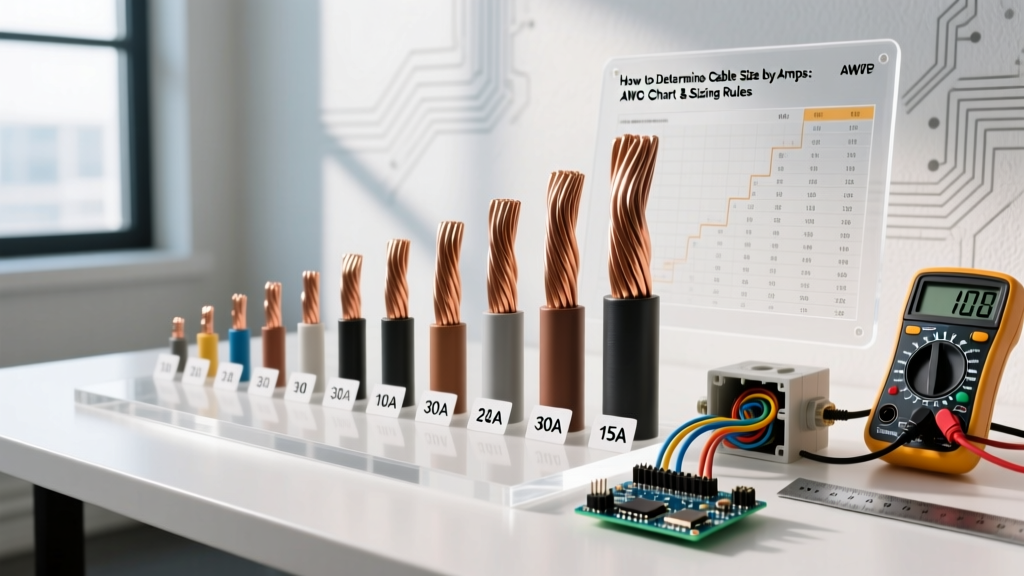
- Wire Sizing (US): A 16A continuous load requires a 20A breaker. Under NEC 310.16, you must use a minimum of 12 AWG copper THHN or NM-B wire. Never use 14 AWG (rated for 15A) on a 20A breaker, even if the actual measured load is only 16A.
- Wire Sizing (EU/UK): A 16A continuous load on a 230V system typically requires 2.5mm² copper cable routed in standard clipping or conduit, protected by a 16A or 20A Type B/C MCB.
- Voltage Drop: At 1,920W (16A at 120V), voltage drop becomes a factor on long runs. If you are running a 12 AWG extension cord or branch circuit longer than 50 feet to a 16A load, expect a 3% to 5% voltage drop. The load will draw slightly higher amperage to compensate for the lower voltage, potentially pushing a 16A nominal load into the 17A danger zone.
- EV Chargers: Many Level 2 EV chargers are configurable. If you are hardwiring a charger to a 20A breaker, you must configure the charger's internal DIP switches or software to limit the draw to 16A (3,840W at 240V) to comply with the 80% continuous load rule.
Quick Conversion FAQs
How many watts is 16 amps at 12 volts?
At 12V DC (common in automotive and solar systems), 16 amps equals 192 watts (12 × 16 = 192). This is roughly the draw of a large 12V portable car fridge or a high-power amateur radio transceiver transmitting at full output.
Can a standard US 15-amp outlet handle 16 amps?
No. A standard NEMA 5-15R receptacle is physically and legally rated for a maximum of 15 amps (1,800 watts at 120V). Drawing 16 amps will cause the receptacle contacts to overheat, potentially melting the plastic faceplate and creating a fire hazard. You must upgrade to a 20A circuit with 12 AWG wire and a NEMA 5-20R receptacle.
Why does my 16A inverter keep shutting down at 1,900 watts?
If you are running a 12V inverter, 1,900 watts requires roughly 158 amps of DC current from the battery bank (1900W / 12V = 158A), not 16 amps. Inverter input current is vastly higher than output current. Ensure your DC-side wiring is rated for 2/0 AWG or larger, and that your BMS (Battery Management System) is configured to allow >150A continuous discharge.