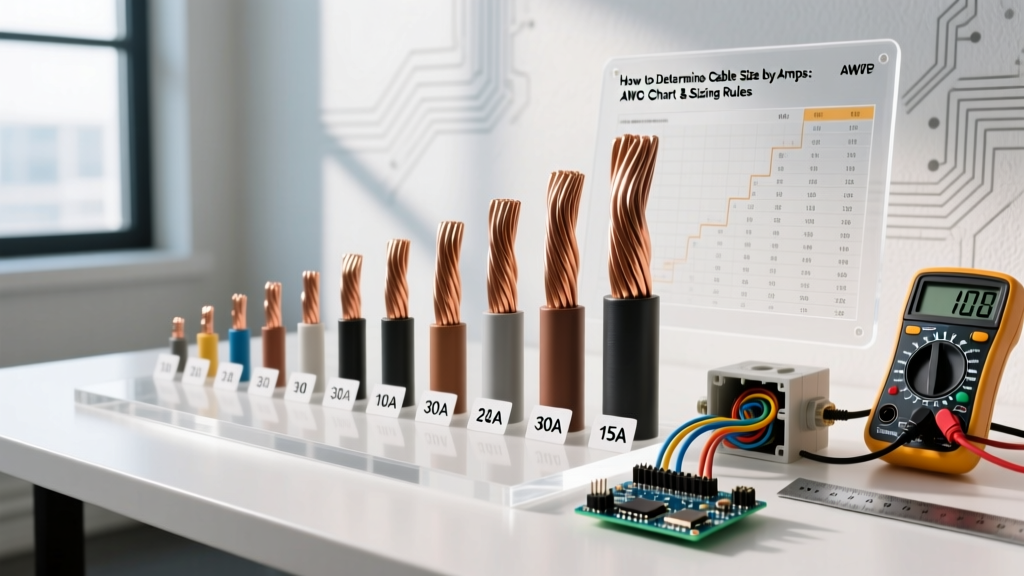

Cable size by amps is the practice of selecting a wire gauge (AWG or kcmil) whose rated ampacity safely exceeds the maximum expected current of the circuit, adjusted for continuous loads and terminal temperature ratings. Getting this right dictates the physical heat the wire can safely dissipate without melting its insulation, and it ensures your overcurrent protective device (breaker) trips before the wire becomes a fire hazard. When you calculate cable size by amps correctly, you are fundamentally coordinating the thermal limits of the copper or aluminum conductor with the magnetic and thermal trip curves of the breaker protecting it.
The Core Rule: Matching Cable Size by Amps
The relationship between current and wire size is governed by Joule heating ($I^2R$). As current flows through a conductor, resistance generates heat. If the wire is too thin for the current, the heat builds up faster than the insulation can dissipate it into the surrounding air or conduit. The National Electrical Code (NEC) solves this by publishing ampacity tables—specifically NEC Table 310.16—which list the maximum continuous current a specific wire gauge can carry under defined conditions.
14 AWG = 15A | 12 AWG = 20A | 10 AWG = 30A | 8 AWG = 40A | 6 AWG = 55A
However, you cannot simply match the load current to the table value. The NEC requires you to distinguish between continuous loads (expected to run for 3 hours or more) and non-continuous loads. For continuous loads, you must multiply the expected current by 1.25 (125%) before looking up your cable size by amps. This 25% safety margin prevents the breaker from experiencing thermal fatigue and nuisance tripping over long run times.
The Temperature Column Trap
The most common mistake DIYers and junior electricians make when sizing wire is looking at the wrong temperature column in the ampacity table. Modern THHN/THWN-2 wire has insulation rated for 90°C. Looking at the 90°C column, an 8 AWG copper wire is rated for 55A. It is tempting to use this number to save money on copper.
You must size your wire based on the lowest temperature rating of any connected component in the circuit. Most standard residential breakers and panel lugs are rated for 75°C. Therefore, even if you use 90°C THHN wire, you must use the 75°C ampacity column to size the breaker and wire. Furthermore, if you are using NM-B (Romex) cable, NEC 334.80 strictly limits you to the 60°C column, regardless of the fact that the individual conductors inside the sheath might have 90°C insulation.
If you size an 8 AWG NM-B cable for 50A using the 90°C column, you are violating code. In the 60°C column, 8 AWG is only rated for 40A. Pushing 50A through it will overheat the cable, and a 50A breaker will not trip in time to prevent insulation failure.
Worked Example: Sizing a 40A EV Charger Circuit
Let us apply these rules to a real-world scenario: installing a Level 2 home EV charger that draws a continuous 40A at 240V. The run is 60 feet from the main panel through a finished garage wall (30°C ambient temperature).
Step 1: Calculate Minimum Circuit Ampacity
Because an EV charger is a continuous load, we apply the 125% rule.
40A × 1.25 = 50A minimum circuit ampacity.
Step 2: Select the Breaker
The next standard breaker size up from 50A is a 50A two-pole breaker.
Step 3: Select the Cable Size by Amps
We need a wire that can safely carry 50A based on its termination temperature limits.
- Option A (NM-B Cable): Restricted to the 60°C column. Looking at the table, 8 AWG is only 40A. We must step up to 6 AWG NM-B, which is rated for 55A at 60°C.
- Option B (THHN in Conduit): Terminations are 75°C, so we use the 75°C column. 8 AWG THHN is rated for exactly 50A at 75°C.
Step 4: Verify Voltage Drop
While the NEC does not strictly enforce voltage drop for branch circuits (it recommends a maximum of 3%), it is best practice to check. Using 8 AWG copper (0.778 ohms per 1,000 ft) for a 60-foot run (120 feet total out-and-back):
Resistance = 0.778 × (120 / 1000) = 0.093 ohms.
Voltage Drop = 40A × 0.093 ohms = 3.72V.
Percentage Drop = (3.72V / 240V) × 100 = 1.55%.
This is well under the 3% threshold, confirming our wire size is electrically sound.
Where You Meet This in Practice
Understanding how to determine cable size by amps is not just for EV chargers. You will use this exact decision framework across several common electrical installations:
- Subpanel Feeders: Sizing a 100A subpanel feeder requires calculating voltage drop over longer distances, often pushing you from 3 AWG copper up to 1/0 AWG aluminum to save money while maintaining ampacity.
- Solar Inverter AC Disconnects: Solar inverters output continuous current. A 40A inverter output requires sizing the disconnect wiring for 50A (40 × 1.25), usually mandating 6 AWG NM-B or 8 AWG THHN.
- HVAC Condensers: Air conditioners are unique. You do not use the 125% rule here; instead, you read the nameplate for 'Minimum Circuit Ampacity' (MCA) to size the wire, and 'Maximum Overcurrent Protection' (MOCP) to size the breaker, which are often mismatched (e.g., 28A MCA wire on a 40A MOCP breaker).
- Workshop Welders: Welders have specific duty cycle exceptions in NEC Article 630, allowing you to size the cable smaller than the nameplate primary current if the duty cycle is low (e.g., 20%).
Decision Tree: Picking Your Exact Wire Gauge
Use this decision-tree-table to quickly terminate your sizing process into a concrete material pick for standard residential copper circuits at 30°C ambient.
| Load Type & Continuous Current | Breaker Size | Temp Column Used | Concrete Wire Pick (Copper) |
|---|---|---|---|
| 15A Lighting (Non-continuous) | 15A | 60°C | 14 AWG NM-B |
| 20A Kitchen/Bath Receptacles (Non-continuous) | 20A | 60°C | 12 AWG NM-B |
| 30A Electric Dryer (Continuous/Non-continuous mix) | 30A | 60°C | 10 AWG NM-B (or 10/3 with ground) |
| 40A EV Charger (Continuous) | 50A | 60°C / 75°C | 6 AWG NM-B OR 8 AWG THHN |
| 50A Electric Range (Non-continuous demand) | 50A | 60°C | 6 AWG NM-B (or 6/3 with ground) |
| 100A Subpanel Feeder (Continuous/Non-continuous) | 100A | 75°C | 3 AWG THHN (in conduit) |
FAQ: Edge Cases and Code Caveats
What if I am using Aluminum wire instead of Copper?
Aluminum has higher resistance and lower thermal conductivity than copper. You must use the aluminum-specific columns in NEC Table 310.16. As a rule of thumb, aluminum wire needs to be two AWG sizes larger than copper for the same ampacity. For example, a 100A subpanel feeder requires 3 AWG copper, but it requires 1/0 AWG aluminum. Always use anti-oxidant paste (like Noalox) on aluminum terminations to prevent galvanic corrosion and high-resistance heating.
Do I need to derate if I pull multiple cables through the same conduit?
Yes. If you have more than three current-carrying conductors in a single raceway or conduit, they heat each other up. NEC Table 310.15(C)(1) requires you to apply a derating factor. For 4-6 conductors, you multiply the 90°C ampacity by 80%. For 7-9 conductors, you multiply by 70%. If you are running two separate 240V circuits (4 current-carrying hot wires) in one PVC conduit, your 8 AWG THHN (55A at 90°C) derates to 44A, which is still sufficient for a 40A breaker, but 10 AWG would fail the math.
Does the National Electrical Code apply exactly the same everywhere?
The NEC is a model code published by the NFPA. While most US jurisdictions adopt it, local Authorities Having Jurisdiction (AHJs) can and do amend it. Some municipalities require 12 AWG minimum for all branch circuits, banning 14 AWG entirely. Others may require arc-fault (AFCI) protection on circuits where standard practice does not. Always check your local municipal building department website or call the inspector before pulling a permit. When in doubt, sizing up one AWG gauge is a cheap insurance policy against both voltage drop and future code changes.


