
When designing a circuit, selecting the right wire is just as critical as choosing the right microcontroller or power supply. But to make informed, safe decisions, we must first answer a fundamental question: what are the electrical conductors at the atomic level, and why do we rely on specific metals for our wiring infrastructure?
In electrical engineering and physics, a conductor is any material that permits the free flow of electrical current (electrons) with minimal resistance. While metals are the most common conductors in DIY and industrial wiring, the category also includes electrolytes, plasmas, and certain non-metals like graphite. This guide explores the quantum mechanics of conduction, compares real-world wiring materials, and provides actionable data for both hobbyists and professional electricians.
The Physics of Conduction: The Electron Sea Model
To understand what makes a material conductive, we have to look at atomic structure. In metallic bonding, atoms arrange themselves in a crystalline lattice. The outermost electrons (valence electrons) of these atoms are only loosely bound to their parent nuclei. Instead of orbiting a single atom, these electrons detach and form a shared 'electron sea' or 'electron gas' that flows freely through the lattice.
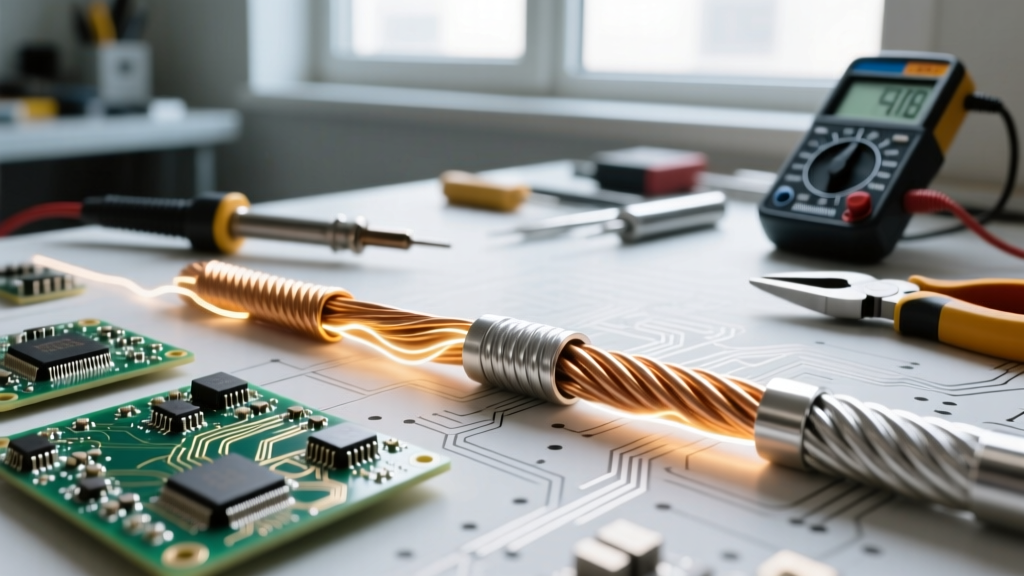
When a voltage potential is applied across a conductor, it creates an electric field. This field exerts a force on the free electrons, causing them to drift in a unified direction. This directed drift is what we measure as electrical current. According to Georgia State University's HyperPhysics, the ease with which these electrons move is determined by the material's resistivity ($\rho$), which is heavily influenced by lattice vibrations (phonons) and atomic impurities that scatter the electrons.
Band Theory in Brief
In solid-state physics, conductors are defined by their band structure. The 'valence band' (where electrons normally reside) and the 'conduction band' (where electrons are free to move) overlap in conductors. Because there is no 'bandgap' to overcome, even a tiny amount of thermal energy or applied voltage allows electrons to jump into the conduction band and flow. Insulators, by contrast, have a massive bandgap, preventing electron flow under normal conditions.
Classifying Conductive Materials: A Data Comparison
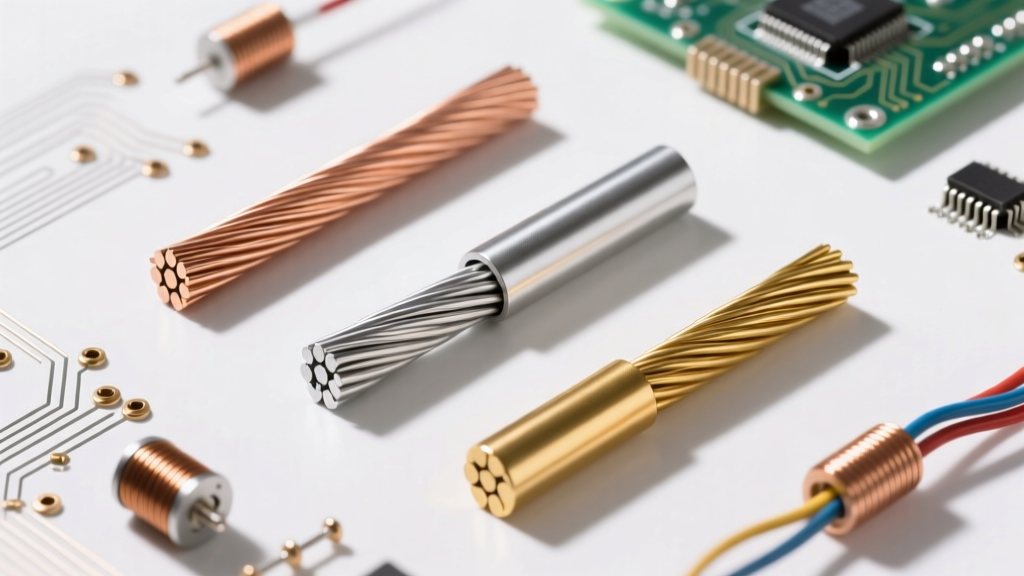
Not all conductors are created equal. When sizing wires or selecting materials for busbars, PCB traces, and high-current applications, engineers look at resistivity, temperature coefficients, and mechanical strength. Below is a comparison of the most critical conductive elements used in electrical engineering.
| Material | Resistivity at 20°C ($\Omega\cdot m$) | Temp. Coefficient ($\alpha$) | Primary Use Case |
|---|---|---|---|
| Silver (Ag) | $1.59 \times 10^{-8}$ | 0.0038 /°C | RF connectors, high-end audio, satellite components |
| Copper (Cu) | $1.68 \times 10^{-8}$ | 0.0039 /°C | Standard building wire, PCB traces, motor windings |
| Gold (Au) | $2.44 \times 10^{-8}$ | 0.0034 /°C | Edge connectors, IC bonding wires, aerospace contacts |
| Aluminum (Al) | $2.82 \times 10^{-8}$ | 0.0039 /°C | High-voltage transmission lines, heavy feeder cables |
Copper vs. Aluminum: The Real-World Wiring Debate
When asking what are the electrical conductors best suited for building wiring, the debate almost always narrows down to copper and aluminum. Copper is the undisputed king of residential and commercial branch circuits, prized for its high conductivity, ductility, and tensile strength. The Copper Development Association (CDA) notes that copper's durability makes it ideal for repeated bending and termination.
However, aluminum is significantly lighter and cheaper. For high-voltage overhead transmission lines, aluminum (often reinforced with a steel core, known as ACSR) is the industry standard because the weight savings on support towers outweigh the need for a slightly thicker cable.
The Historical Failure of Solid Aluminum Branch Circuits
In the 1960s and 1970s, a spike in copper prices led electricians to use solid aluminum wire for residential 15A and 20A branch circuits. This resulted in widespread electrical fires. The failures were driven by three specific material properties:
- Thermal Expansion: Aluminum expands and contracts much more than copper or steel when heated. Over time, this caused connections at steel terminal screws to loosen, increasing contact resistance and generating dangerous heat.
- Galvanic Corrosion: When aluminum was connected directly to copper in the presence of moisture, galvanic corrosion rapidly degraded the connection.
- Oxidation: Aluminum oxide forms instantly on exposed aluminum. Unlike copper oxide (which is somewhat conductive), aluminum oxide is a hard electrical insulator.
To resolve this, the National Electrical Code (NFPA 70) now mandates that aluminum conductors for branch circuits must be of the AA-8000 series alloy. This specific alloy includes iron and rare earth elements that drastically reduce 'creep' (the slow deformation of metal under mechanical stress). Furthermore, modern installations require the use of anti-oxidant pastes (like Noalox) and AL/CU rated terminals torqued to exact manufacturer specifications.
Exotic Conductors: Silver, Gold, and the Skin Effect
While silver has the lowest bulk resistivity of any metal at room temperature, its high cost prohibits its use in bulk wiring. Instead, silver is utilized in high-frequency Radio Frequency (RF) applications due to a phenomenon known as the skin effect.
As the frequency of an alternating current (AC) increases, the electrons are forced toward the outer surface (the 'skin') of the conductor. The skin depth ($\delta$) shrinks inversely with the square root of the frequency. At microwave frequencies, the current flows almost entirely on the outermost micrometers of the wire. By plating a cheap copper core with a microscopically thin layer of silver, engineers achieve the RF performance of solid silver wire at a fraction of the cost.
Gold's Role in Microelectronics
Gold is actually a worse bulk conductor than both silver and copper. So why is it ubiquitous in electronics? Gold is entirely immune to oxidation and corrosion. In low-voltage, low-current applications—such as the edge connectors on a RAM stick or the bonding wires inside a microcontroller package—even a microscopic layer of copper oxide would block the signal. Gold ensures a pristine, reliable contact surface over decades of use.
Expert Insight: When troubleshooting high-impedance sensor circuits or audio DACs, never assume a connector is clean just because it looks shiny. Base metals can migrate through porous gold plating over time, causing intermittent signal loss. Always use dedicated contact cleaners and burnishing tools on critical data lines.
Temperature's Impact on Conductivity
A common misconception among DIYers is that a wire's resistance is a static value. In reality, conductivity is highly dependent on ambient and operational temperature. As a conductor heats up, its atomic lattice vibrates more violently. These vibrations (phonons) act as physical obstacles to the drifting electrons, increasing scattering events and raising resistance.
For copper, the resistance increases by approximately 0.39% for every 1°C rise in temperature. In high-current applications like EV battery busbars or solar inverter feeds, a wire operating at 90°C will have significantly higher resistance—and therefore higher $I^2R$ (heat) losses—than the same wire operating at 20°C. This positive feedback loop is why thermal derating tables in the NEC are strictly enforced; failing to account for ambient heat can lead to thermal runaway and insulation meltdown.
Summary: Choosing the Right Conductor for Your Project
Understanding what are the electrical conductors at a fundamental level allows you to move beyond basic wire gauge charts and make physics-based decisions for your projects:
- For standard DC and 50/60Hz AC wiring: Stick to stranded or solid copper. It offers the best balance of conductivity, mechanical strength, and termination reliability.
- For heavy feeder cables (100A+): Consider AA-8000 series aluminum to save weight and cost, but only if you have the proper AL/CU rated lugs, anti-oxidant paste, and a calibrated torque screwdriver.
- For RF and high-frequency AC: Utilize silver-plated copper or Litz wire to combat the skin effect and minimize high-frequency resistive losses.
- For low-voltage data and IC contacts: Rely on gold-plated connectors to prevent oxidation from destroying sensitive, low-current signals.
By respecting the atomic properties and environmental limitations of these materials, you ensure that your electrical designs are not only functional but inherently safe and efficient over their entire operational lifespan.