
When an instructor or certification examiner asks you to state the law of electric charges, the textbook answer is straightforward: like charges repel, opposite charges attract, and the total electrical charge in an isolated system remains constant. However, on the electronics workbench or in industrial wire harness troubleshooting, this fundamental law of physics manifests as fried gate drivers, erratic sensor readings, and mysterious microcontroller resets.
As a DIYer or electrical technician, memorizing Ohm’s Law is not enough. You must understand how charge separation, conservation, and attraction cause real-world failures. This guide bridges the gap between fundamental electrostatic theory and practical troubleshooting, focusing on Electrostatic Discharge (ESD), triboelectric cable noise, and grounding anomalies.
The Core Physics: Charge Conservation on the Workbench
According to Georgia State University's HyperPhysics, charge cannot be created or destroyed; it can only be transferred. When you walk across a carpeted room and reach for an ungrounded aluminum chassis, you are not 'creating' a spark. You are witnessing the law of conservation of charge in action.
Friction between your rubber soles and the synthetic carpet strips electrons from one surface and deposits them on the other. Your body becomes an isolated system holding a massive negative charge (often exceeding 10,000 volts). When your finger approaches the grounded chassis, the sheer potential difference overcomes the dielectric breakdown threshold of air (approximately 3kV per millimeter). The opposite charges attract, resulting in a rapid, destructive equalization event.
Why Standard Multimeters Fail Here
A common troubleshooting mistake is attempting to measure static charge buildup with a standard digital multimeter (DMM). DMMs measure continuous current and steady-state voltage. They cannot capture the nanocoulomb-level transient charge transfers governed by electrostatic laws. To properly troubleshoot charge accumulation in wire harnesses or on PCBs, you need an electrostatic field meter (such as the Extech 755) to measure the electric field gradient before a discharge occurs.
Troubleshooting Scenario 1: Microcontroller ESD Failures
Imagine you are prototyping an I2C sensor network using an ESP32. You connect a wire to the SDA pin, and the microcontroller instantly bricks. The USB connection drops, and the voltage regulator overheats. What happened?
The Human Body Model (HBM) and Attraction
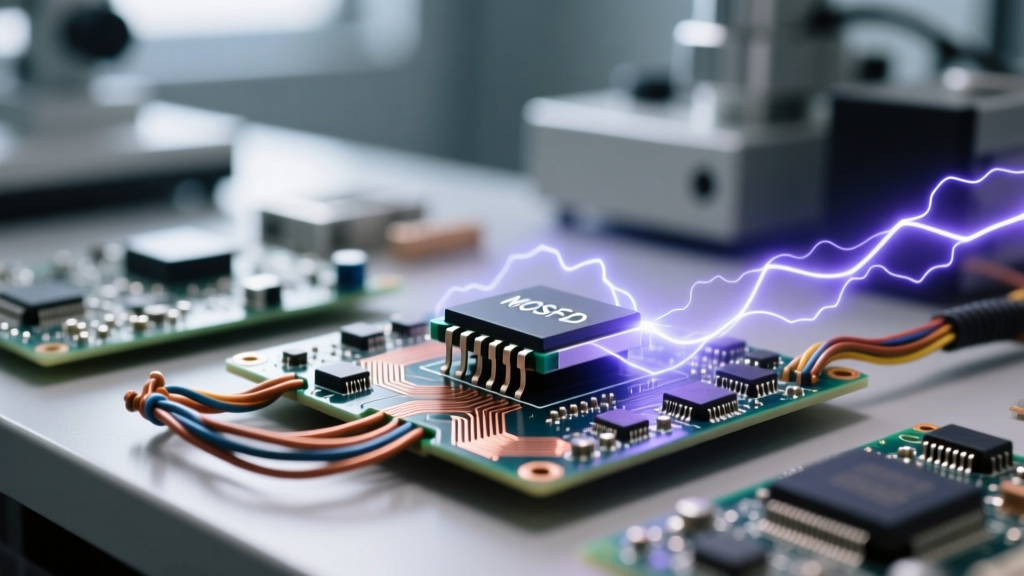
Because opposite charges attract, the highly charged wire you were holding acted as a lightning rod for your body's static potential. The charge sought the lowest impedance path to ground, which happened to be through the ESP32's delicate CMOS gate oxides. The gate oxide on a modern 3.3V microcontroller is only a few nanometers thick and will rupture at voltages as low as 20V.
Troubleshooting & Mitigation Steps:
- Implement TVS Diodes: Solder Transient Voltage Suppression (TVS) diodes (e.g., Littelfuse SMAJ5.0CA) directly at the connector entry points. When the voltage spike exceeds 5V, the TVS diode avalanches, shunting the conserved charge safely to ground in picoseconds.
- Bleeder Resistors: Place 1MΩ to 10MΩ resistors on floating I/O lines. This provides a high-impedance path for static charges to slowly dissipate, honoring the conservation of charge without allowing a destructive current surge.
- Verify Workbench Grounding: Ensure your ESD mat is connected to earth ground. According to ESD Association standards, a proper static-dissipative mat must have a surface resistivity between 10^6 and 10^9 ohms per square, allowing charges to bleed off slowly rather than repelling or arcing.
Troubleshooting Scenario 2: Triboelectric Noise in Sensor Wiring
If you are building high-impedance audio equipment, piezoelectric sensors, or low-frequency EEG monitors, you will eventually encounter 'cable noise.' This is a direct violation of what many assume about wire insulation, but it perfectly aligns with the law of electric charges.
The Triboelectric Effect in Coaxial Cables
When a coaxial or shielded cable bends, the inner dielectric insulation (often PTFE or PVC) rubs against the metallic shield. Because of their different positions on the triboelectric series, electrons are transferred between the dielectric and the shield.
Since charge is conserved and trapped within the cable's capacitance, this separation creates a voltage spike (V = Q/C). In a high-impedance circuit (where resistance is in the mega-ohms), this charge has nowhere to go, resulting in massive low-frequency popping sounds or sensor drift.
How to Troubleshoot Triboelectric Noise:
- Swap Dielectric Materials: Replace standard PVC cables with low-noise cables featuring graphite-impregnated dielectrics or specialized FEP (Fluorinated Ethylene Propylene) that minimizes charge transfer.
- Lower the Source Impedance: If the law of electric charges dictates that V = Q/C, you can minimize the voltage impact by lowering the impedance of your amplifier's input stage, giving the accumulated charge a path to dissipate.
- Secure the Harness: Physically immobilize the wire harness. If the cable cannot flex, the dielectric cannot rub against the shield, preventing charge separation from occurring in the first place.
Diagnostic Matrix: Identifying Charge-Related Faults
Use the following table to diagnose field failures that stem from electrostatic principles rather than traditional current overloads.
| Symptom Observed | Governing Law Principle | Probable Root Cause | Actionable Troubleshooting Fix |
|---|---|---|---|
| Random MCU resets when user touches plastic enclosure | Like charges repel / Field induction | Static field on plastic inducing voltage on internal floating traces | Apply internal conductive copper tape connected to chassis ground |
| Dust accumulation leading to HV insulator flashover | Opposite charges attract | Corona discharge ionizing air; charged dust creates a conductive tracking path | Clean with isopropyl alcohol; apply silicone conformal coating to insulators |
| Unexplained gate driver failure in motor controllers | Conservation of charge (Inductive kick) | Parasitic capacitance in long motor wires storing charge and reflecting back | Install RC snubber networks at the motor terminals to absorb reflected charge |
| Popping noise in high-Z piezo sensor cables | Charge separation (Triboelectric) | Dielectric rubbing against shield during cable movement | Use low-noise graphite-coated cables; secure cable routing |
The 'Isolated System' Trap: Ground Loops and Floating Chassis
The most misunderstood part of the law of electric charges is the concept of the isolated system. In electrical engineering, an ungrounded metal chassis is an isolated system. If a switching power supply with high parasitic capacitance (Y-capacitors) is mounted to this chassis, continuous micro-currents will transfer charge to the metal.
Because the system is isolated, the charge accumulates. The voltage will continue to rise until it finds a weak point—often a bearing in a connected motor or the delicate isolation barrier of an RS-485 transceiver. When troubleshooting a 'ghost voltage' or a tingling sensation when touching a metal appliance, you are feeling the conservation of charge demanding a path to earth.
Resolving Floating Chassis Faults
Never leave a high-voltage or mains-powered chassis floating. Always establish a dedicated equipment grounding conductor (EGC). If you are troubleshooting a system where a direct ground connection causes dangerous ground loops (e.g., in medical equipment or sensitive audio), use an isolation transformer or a high-value capacitor (e.g., 4.7nF Y-rated) paired with a 1MΩ bleeder resistor to provide a safe, high-impedance path for the conserved charges to equalize without creating a shock hazard.
Expert Insight: According to SparkFun's ESD guidelines, the damage caused by electrostatic discharge is often cumulative. A component may not fail immediately after a charge equalization event; instead, the gate oxide is weakened, leading to a 'latent defect' that will cause the device to fail weeks later in the field. Always treat the law of electric charges as a persistent threat, not just an immediate spark.
Summary: Moving From Theory to the Workbench
To successfully troubleshoot modern electronics, you must do more than simply state the law of electric charges on a test. You must actively look for where charges are separating, where they are being conserved in isolated systems, and how their mutual attraction is forcing them through sensitive silicon. By utilizing TVS diodes, managing the triboelectric properties of your wire harnesses, and ensuring proper static-dissipative grounding, you can eliminate the most elusive, physics-driven faults on your workbench.