
The Physics of Static: Why Charge Accumulates
At its core, the accumulation of electric charges on an object occurs when there is an imbalance of electrons on the surface of a material. In electrical engineering and DIY electronics, we usually focus on the controlled flow of electrons (current) through conductors. However, uncontrolled static electricity—specifically electrostatic discharge (ESD)—is a silent killer of microcontrollers, MOSFETs, and sensitive integrated circuits.
When two dissimilar materials come into contact and separate, electrons transfer from one surface to the other. This is known as the triboelectric effect. The material that gains electrons becomes negatively charged, while the material that loses electrons becomes positively charged. If the materials are insulators, the charges cannot easily recombine, leading to a localized accumulation of electric charges on an object. The voltage potential ($V$) generated is dictated by the formula $V = Q/C$, where $Q$ is the charge and $C$ is the capacitance of the object. Because insulators often have very low capacitance, even a microscopic transfer of charge can result in voltage potentials exceeding 10,000 volts.
The Triboelectric Effect and Material Vulnerabilities
Understanding which materials are prone to charge accumulation is the first step in establishing a safe workbench environment. The triboelectric series ranks materials based on their tendency to gain or lose electrons. When designing a workspace or selecting wire insulation, you must account for how these materials interact.
| Material Tendency | Common Workshop Materials | Charge Polarity When Separated |
|---|---|---|
| Highly Positive (Loses Electrons) | Human Skin, Glass, Nylon, Animal Fur | Positive (+) |
| Neutral / Moderate | Cotton, Paper, Steel, Wood | Variable |
| Highly Negative (Gains Electrons) | Polyurethane, PVC (Wire Insulation), Teflon, Silicone | Negative (-) |
Note: PVC and Teflon are ubiquitous in wire insulation and soldering iron stands. Dragging a PVC-insulated cable across a nylon carpet or cotton workbench is a primary driver for the accumulation of electric charges on an object in a DIY lab.
Real-World Hazards: From Microelectronics to Combustibles
The dangers of static accumulation are generally divided into two categories: component degradation and catastrophic ignition.
Microelectronics and Latent Failures
The human body can easily accumulate 3,000 to 5,000 volts simply by walking across a synthetic carpet in low humidity. While a human cannot feel a static shock below roughly 3,000V, modern CMOS logic gates and MOSFET gate oxides can be permanently ruptured by as little as 30V to 100V. Worse, ESD often causes latent defects. A microcontroller might survive the initial programming phase but fail in the field weeks later because the dielectric layer was microscopically compromised during handling.
Combustible Dust and Vapor Ignition
In environments involving flammable solvents (like isopropyl alcohol used for PCB cleaning) or combustible dust, a static spark carries enough thermal energy to trigger an explosion. The NFPA 77 Recommended Practice on Static Electricity explicitly outlines how the accumulation of electric charges on an object like an ungrounded solvent dispenser can generate an incendive spark upon approaching a grounded metal vessel.
Actionable Safety Protocols for the Workbench
Preventing the accumulation of electric charges on an object requires a multi-tiered approach focusing on dissipation, neutralization, and environmental control. The ESD Association provides the baseline standards (ANSI/ESD S20.20) that professional labs use, which can be scaled down for advanced DIYers.
Equipotential Bonding vs. Grounding
Many hobbyists confuse grounding with bonding. Grounding connects an object to the earth (via the building's earth ground rod). Bonding connects two or more objects together so they share the same electrical potential. If you are working on a drone frame or a custom aluminum chassis, bonding all metallic components together prevents a potential difference from forming between them, eliminating the risk of a spark jumping across a gap, even if the entire assembly is floating above true earth ground.
The Critical Role of the 1 Megohm Resistor
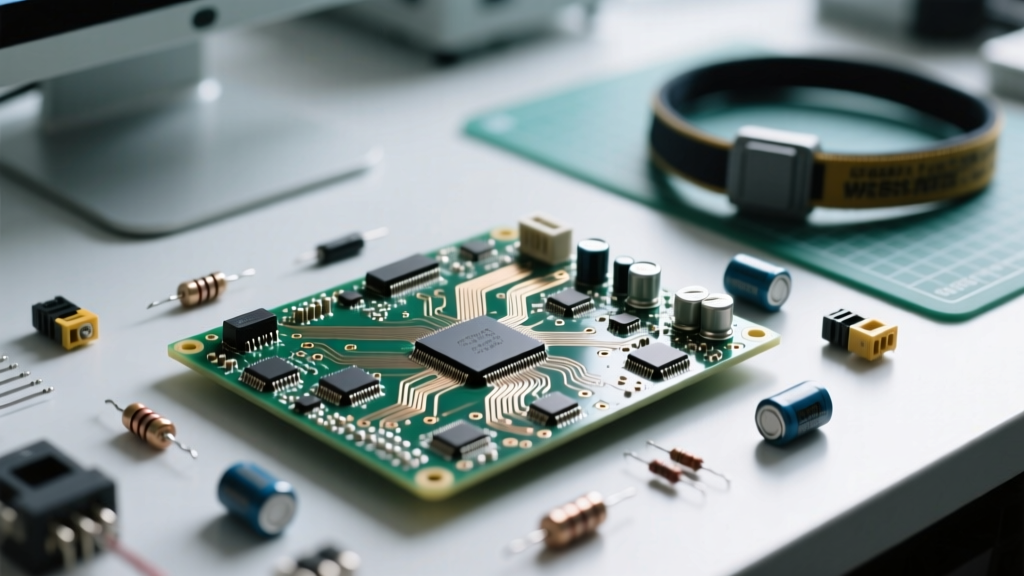
When wearing an ESD wrist strap, you must never connect yourself directly to earth ground. Commercial wrist straps incorporate a 1 Megohm ($1M\Omega$) resistor in the snap connector. This resistor serves a vital dual-purpose:
- ESD Dissipation: It allows static charges to bleed off slowly over a few milliseconds, preventing a rapid Charged Device Model (CDM) discharge that could damage sensitive ICs.
- Personal Safety: If you accidentally touch a live 120V or 240V AC mains wire while troubleshooting a power supply, the 1M ohm resistor limits the current passing through your heart to a non-lethal micro-amp range, preventing ventricular fibrillation.
Ionization and Humidity Control
You cannot ground an insulator. If you are working with plastic enclosures, Kapton tape, or fiberglass PCBs, grounding a mat will not pull the charge off the plastic. To neutralize the accumulation of electric charges on an object made of insulative material, you must use an air ionizer, which floods the workspace with balanced positive and negative ions to neutralize surface charges. Additionally, maintaining ambient humidity between 40% and 60% RH naturally increases the surface conductivity of the air and materials, allowing charges to dissipate harmlessly.
Troubleshooting Hidden Static Accumulation
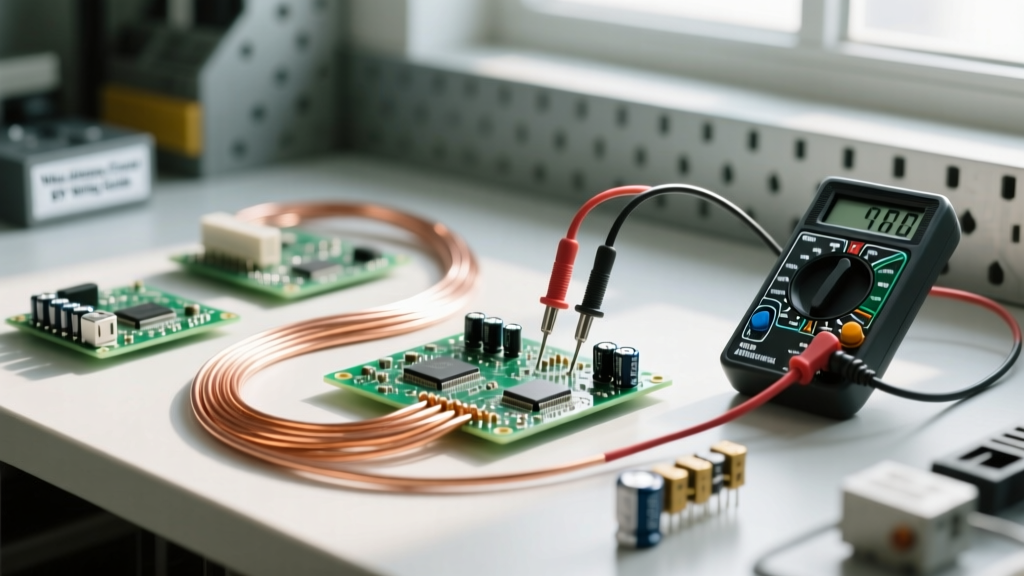
If you suspect static is destroying your prototypes, standard multimeters are useless for measuring static voltage because they require a continuous current flow and have relatively low input impedance. To properly diagnose the accumulation of electric charges on an object, you need a non-contact electrostatic field meter (electrometer). These devices measure the electric field gradient and calculate the surface voltage without drawing current or discharging the object.
When auditing your workspace, test the surface resistivity of your workbench mats. A proper ESD mat should be static dissipative, meaning its surface resistance falls between $10^6$ and $10^9$ ohms per square. If your mat measures below $10^4$ ohms (conductive), it will discharge objects too rapidly, risking CDM damage to your components. If it measures above $10^{11}$ ohms (insulative), it is trapping charges and contributing to the hazard.
Summary Checklist for ESD Safety
- Wear a 1M ohm wrist strap connected to a common ground point when handling bare ICs and PCBs.
- Use dissipative mats ($10^6$ to $10^9 \Omega$) on your workbench and ground them to the building's electrical earth.
- Bond metal chassis components together before attaching sensitive logic boards to prevent potential differences.
- Avoid high-risk insulators like standard plastics, Styrofoam, and PVC near your ESD-safe zone.
- Monitor humidity and utilize air ionizers when handling non-conductive enclosures or flexible circuits.
By respecting the physics of charge accumulation and implementing these engineered safeguards, you protect both your intricate electronic designs and your physical safety in the workshop.