
Microcontrollers like the ATmega328P (found in the Arduino Uno) or the ESP32 are computational powerhouses, but they possess a critical blind spot: they have no innate concept of human time. When you remove power, their internal millisecond counters instantly reset to zero. If you are building a weather station, a smart irrigation system, or a data logger, relying on the microcontroller's internal clock is a recipe for failure. This is where a real time clock module (RTC) becomes indispensable. An RTC is a specialized integrated circuit designed to do one thing exceptionally well: keep track of seconds, minutes, hours, days, months, and years, even when the main system power is completely severed. In this fundamentals guide, we will dissect the silicon, the quartz physics, and the I2C protocols that make real time clock modules the unsung heroes of embedded electronics.
The Anatomy of a Real Time Clock Module
The 32.768 kHz Quartz Crystal
At the heart of almost every RTC lies a tiny, tuning-fork-shaped quartz crystal. If you look closely at a standard DS1307 module, you will see a silver cylinder labeled 32.768 kHz. But why this highly specific, seemingly arbitrary number? The answer lies in binary mathematics. Quartz crystals vibrate at a precise frequency when subjected to an alternating electric field. By choosing a frequency of exactly 32,768 Hz (which is 2 to the power of 15), the RTC's internal 15-stage binary ripple counter can divide the signal perfectly in half, fifteen times in a row. The final output of this divider chain is exactly 1 Hz—one pulse per second. This elegant binary division requires minimal silicon area and consumes microscopic amounts of power, allowing the RTC to run for years on a coin cell battery.
Temperature Compensation and the TCXO
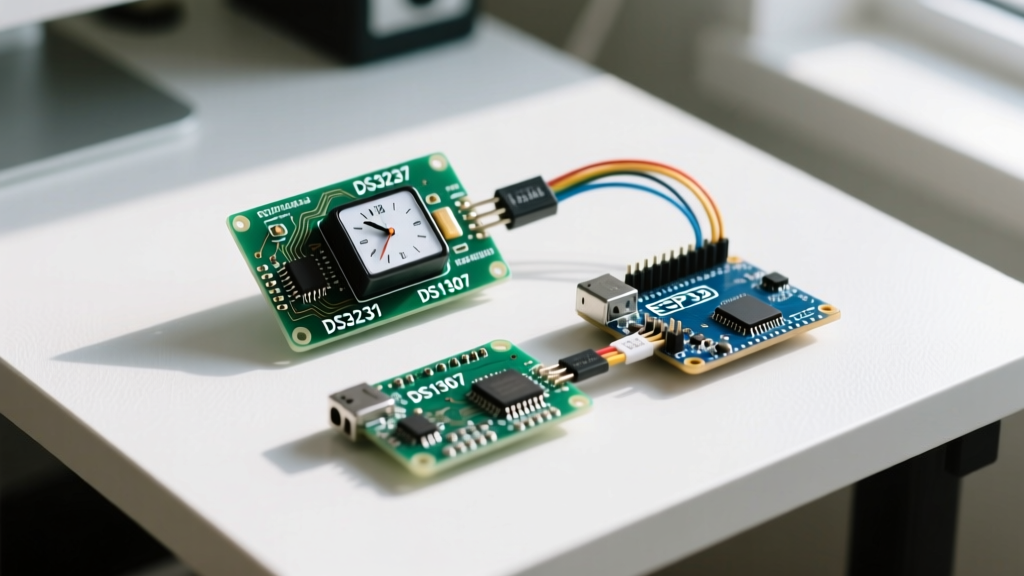
Standard quartz crystals are highly sensitive to ambient temperature fluctuations. A standard 32.768 kHz crystal will experience thermal drift, typically parabolic in nature, meaning it will run slower at both extreme high and low temperatures. In a standard DS1307 chip, this drift can result in the clock losing or gaining up to 20 parts per million (ppm), translating to roughly a minute of error per month. To solve this, advanced modules utilize a Temperature-Compensated Crystal Oscillator (TCXO). The DS3231 chip, for example, contains an internal temperature sensor and a programmable capacitor array. It continuously measures the die temperature and adjusts the oscillator's load capacitance in real-time to maintain a staggering accuracy of ±2 ppm, ensuring your project loses less than a minute per year.
Silicon Showdown: DS1307 vs. DS3231 vs. PCF8523
When sourcing a real time clock module for your workbench, you will predominantly encounter three silicon architectures. Choosing the right one depends on your environmental constraints and budget.
| Feature | DS1307 | DS3231 | PCF8523 |
|---|---|---|---|
| Accuracy | ±20 ppm | ±2 ppm | ±10 ppm |
| Oscillator Type | External Crystal | Internal TCXO | External Crystal |
| Temp. Compensation | No | Yes | No |
| Typical Module Price | $1.50 | $3.50 | $2.50 |
| Best Use Case | Indoor hobby projects | Outdoor / Precision logging | Low-cost consumer goods |
As noted in the Maxim Integrated DS3231 Datasheet, the integration of the crystal inside the IC package not only saves board space but also shields the oscillator from external noise and physical tampering, making the DS3231 the undisputed king of precision timing for DIY electronics.
The Battery Backup Dilemma: CR2032 vs. LIR2032
One of the most dangerous pitfalls for beginners working with real time clock modules is the battery backup circuit. To maintain time during power outages, RTCs require a secondary voltage source, typically a 20mm coin cell. However, not all coin cells are created equal, and cheap clone modules from online marketplaces often feature a hazardous design flaw.
Many generic ZS-042 RTC modules include a surface-mount diode and a 200Ω resistor connected to the VCC line. This is a rudimentary charging circuit designed specifically for the LIR2032, a rechargeable lithium-ion coin cell. The problem? The LIR2032 has a meager capacity of roughly 35mAh, meaning it will only keep the RTC alive for a few days without main power. Most hobbyists naturally swap this out for a standard CR2032 non-rechargeable lithium-manganese dioxide cell, which boasts a massive 220mAh capacity. However, if you insert a non-rechargeable CR2032 into a module with the charging circuit intact, the module will attempt to charge it. This can lead to battery swelling, toxic leakage, and in extreme cases, a fire hazard.
Pro-Tip: If you are using a generic DS3231 or DS1307 module with a CR2032 battery, inspect the board for a diode (often marked with a stripe) near the battery holder. Desolder the diode or cut the trace connecting the VCC to the battery positive terminal to disable the charging circuit. Alternatively, purchase premium modules like the Adafruit DS3231 Precision RTC Breakout, which utilize safe, dedicated power-path management ICs.
I2C Communication and Binary Coded Decimal (BCD)
Real time clock modules communicate with microcontrollers via the I2C (Inter-Integrated Circuit) bus. The standard I2C address for almost all DS-series and PCF-series RTCs is 0x68. When your Arduino or ESP32 requests the current time, the RTC does not send standard binary numbers; it sends Binary Coded Decimal (BCD).
Understanding BCD is crucial for low-level register manipulation. In standard binary, the number 59 is represented as 00111011. However, in BCD, each decimal digit is represented by its own 4-bit nibble. Therefore, 59 seconds is encoded as 0101 (5) and 1001 (9), resulting in 01011001 (or 0x59 in hexadecimal). This encoding scheme was chosen by silicon designers because it maps directly to seven-segment displays and simplifies the logic required to roll over from 59 to 00 without complex binary-to-decimal conversion algorithms. When writing custom I2C drivers, you must remember to apply bitwise shift operations to decode these nibbles back into usable integers.
For a deeper dive into the physical layer of this protocol, including the necessity of 4.7kΩ pull-up resistors on the SDA and SCL lines, refer to the I2C Overview on All About Circuits.
Real-World Failure Modes and Troubleshooting
Even with a robust real time clock module, embedded systems can experience timing anomalies. Here is a diagnostic framework for the most common RTC failure modes:
1. Time Resets on Power Cycle
Symptom: The clock works perfectly while powered via USB, but resets to January 1, 2000, or the default compile time every time the main power is removed.
Diagnosis: The VBAT (battery backup) pin is not receiving voltage. Use a multimeter to measure the voltage across the coin cell. A healthy CR2032 should read between 2.8V and 3.2V. If the voltage is below 2.0V, replace the battery. If the battery is new but the VBAT pin on the IC reads 0V, check for a broken trace or a blown diode on the module's battery circuit.
2. Severe Time Drift
Symptom: The clock loses or gains several minutes a week.
Diagnosis: You are likely using a DS1307 module in an environment with wide temperature swings, such as an outdoor greenhouse or an automotive dashboard. The external 32.768 kHz crystal is suffering from thermal parabolic drift. The only reliable fix is to upgrade your hardware to a DS3231 TCXO module.
3. I2C Bus Hangs or Freezes
Symptom: The microcontroller freezes entirely when attempting to call Wire.requestFrom(0x68, 7).
Diagnosis: The I2C bus is stuck in a low state, usually due to missing pull-up resistors. While many RTC modules include 4.7kΩ surface-mount pull-ups on the SDA and SCL lines, some ultra-cheap variants omit them to save fractions of a cent. Ensure your main microcontroller breakout board has pull-ups enabled, or solder external 4.7kΩ resistors between the SDA/SCL lines and the 3.3V or 5V logic rail.
Mastering Time in Embedded Systems
A real time clock module is far more than a simple accessory; it is the temporal anchor of your embedded project. By understanding the physics of the 32.768 kHz crystal, the critical differences between TCXO and standard oscillators, and the hidden hazards of clone battery circuits, you elevate your designs from fragile prototypes to robust, deployment-ready systems. Whether you are logging soil moisture data over a six-month agricultural season or building a retro-computing clock, respecting the fundamentals of RTC silicon ensures your microcontroller never loses a second.