
The Anatomy of Voltage Measurement: Why Your Meter Matters
Whether you are troubleshooting a flickering LED circuit, diagnosing a dead car battery, or verifying mains wiring, understanding exactly how to read volts on a multimeter is the foundational skill of electrical work. Voltage represents the electrical potential difference—or "pressure"—pushing electrons through a conductor. However, not all multimeters interpret this pressure equally. As an electrical DIY hub, we frequently see hobbyists and professionals alike misdiagnose circuits because their tool lacks the proper input impedance, safety ratings, or True RMS capabilities.
Before we dive into the step-by-step methodology, it is critical to understand input impedance. A standard digital multimeter (DMM) features an input impedance of roughly 10 Megohms (10MΩ) on its voltage settings. This high resistance ensures the meter draws virtually zero current from the circuit under test, preventing the meter itself from altering the voltage reading (a phenomenon known as "circuit loading"). If you are using a cheap, aging analog meter or a damaged digital unit with compromised impedance, your readings will be artificially low, leading to hours of misguided troubleshooting.
In this guide, we will teach you the precise technique for reading both AC and DC voltage, while simultaneously reviewing the top three multimeters on the market to help you decide which tool deserves a spot in your workbench.
Step-by-Step: How to Read Volts on a Multimeter (DC & AC)
Voltage is always measured in parallel with the circuit. Unlike current (amps), which requires you to break the circuit and place the meter in series, voltage testing simply requires you to touch the probes across two points of potential difference.
Measuring DC Voltage (Direct Current)
DC voltage is found in batteries, solar panels, and the low-voltage logic sides of microcontrollers like Arduino or Raspberry Pi.
- Probe Placement: Insert the black probe into the COM (common) port. Insert the red probe into the VΩ (Volts/Ohms) port. Never use the Ampere (A) port for voltage testing.
- Dial Selection: Turn the dial to DC Voltage, denoted by a V with a solid line and dashed line beneath it (V⎓). If your meter is not auto-ranging, select a range higher than your expected voltage (e.g., select 20V when testing a 12V car battery).
- Testing: Touch the red probe to the positive terminal and the black probe to the negative terminal. If you reverse them, a digital meter will simply display a negative sign (e.g., -12.4V), which is harmless.
- Interpretation: A fully charged 12V lead-acid car battery should read between 12.6V and 12.8V at rest. A reading below 11.9V indicates a deeply discharged or sulfated cell.
Measuring AC Voltage (Alternating Current)
AC voltage is found in wall outlets, HVAC systems, and household wiring. Because AC polarity alternates (typically 50 or 60 times a second), probe orientation does not matter.
- Dial Selection: Turn the dial to AC Voltage, denoted by a V with a wavy line (V~).
- Safety Check: Ensure your meter and test leads are rated for the environment (minimum CAT III for indoor panels and outlets). Inspect probe insulation for cracks.
- Testing: Insert the probes into the outlet slots or touch them across the hot and neutral/ground wires. Keep your fingers behind the probe finger guards.
- Interpretation: In North America, a standard residential outlet should read between 110V and 125V. In Europe and many other regions, expect 220V to 240V. Readings outside a 5% tolerance of the nominal voltage indicate a wiring fault, loose neutral, or transformer issue.
Tool Review: Top 3 Multimeters for Voltage Reading
To execute the steps above safely and accurately, you need the right hardware. We have tested dozens of units to bring you the top three recommendations based on user experience, accuracy, and safety.
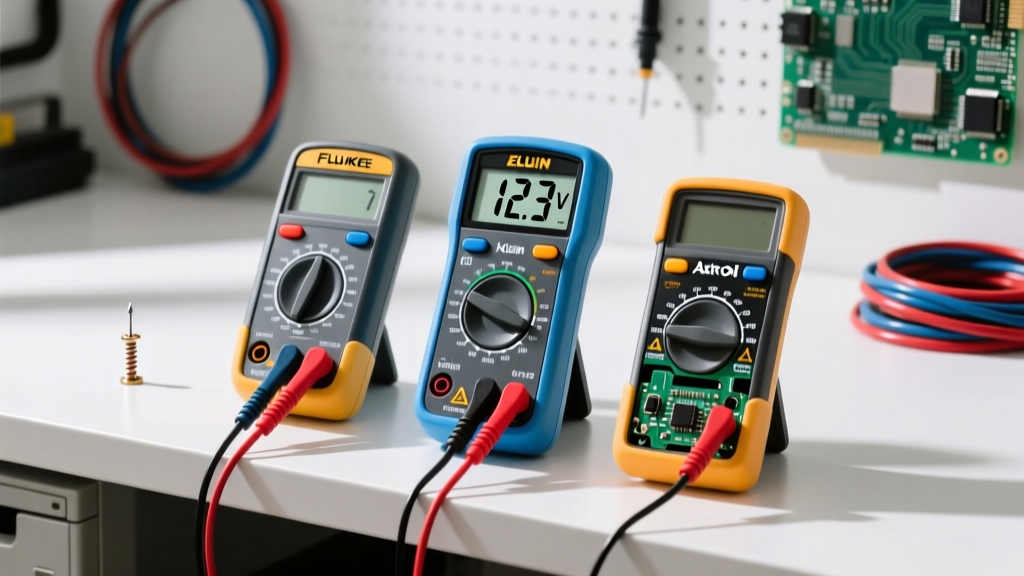
1. The Professional Standard: Fluke 117 True RMS
Priced around $190, the Fluke 117 is the undisputed champion for electricians and advanced DIYers. Its standout feature for voltage reading is AutoVolt, which automatically detects and selects AC or DC voltage, eliminating the risk of frying your meter by accidentally testing an AC outlet on a DC setting. Furthermore, it features LoZ (Low Impedance) mode. LoZ intentionally drops the input impedance to bleed off "ghost voltages"—stray capacitive voltages induced in parallel unenergized wires that can trick standard meters into showing 40V on a dead wire. Combined with non-contact voltage detection (VoltAlert) and CAT III 600V safety ratings, it is an indispensable tool.
2. The Mid-Tier Workhorse: Klein Tools MM400
At approximately $45, the Klein Tools MM400 bridges the gap between budget toys and professional instruments. It is an auto-ranging True RMS meter capable of measuring up to 600V AC/DC. While it lacks the advanced LoZ mode of the Fluke, its 10MΩ input impedance and rugged drop-testing (rated for a 1-meter drop) make it highly reliable for automotive diagnostics, appliance repair, and basic residential wiring. The CAT III 600V rating provides genuine peace of mind when working near the service panel, a rarity in this price bracket.
3. The Budget Benchmark: AstroAI AM33D
Selling for roughly $12, the AstroAI AM33D is a manual-ranging meter designed strictly for low-voltage DC electronics and basic household battery testing. It features a 2000-count display and basic continuity testing. Expert Warning: We do not recommend using this meter for mains AC voltage or any high-energy circuit. It lacks the internal High Rupture Capacity (HRC) fuses and proper CAT safety ratings required for lethal voltage environments. Buy this for your Arduino workbench, not your breaker panel.
Comparative Analysis: Voltage Reading Features Breakdown
| Model | Price (Approx.) | DC Voltage Accuracy | Safety Rating | Key Voltage Feature |
|---|---|---|---|---|
| Fluke 117 | $190 | ±0.5% | CAT III 600V | AutoVolt & LoZ Mode |
| Klein MM400 | $45 | ±0.7% | CAT III 600V | True RMS Auto-Ranging |
| AstroAI AM33D | $12 | ±1.5% | Unclassified | Manual Range Battery Test |
Common Voltage Reading Pitfalls and How to Avoid Them
Even with the best tools, operator error can lead to catastrophic failures. Avoid these common mistakes:
- The "Amp Jack" Dead Short: The most dangerous mistake a beginner can make is leaving the red probe in the current (Amps) port while attempting to read voltage. The Amp port contains a low-resistance shunt. Plugging this across a 120V outlet creates a dead short, resulting in a massive arc flash. Always verify your probe is in the VΩ port. Professional meters like the Fluke 117 use specialized HRC (High Rupture Capacity) ceramic fuses to contain this blast, but cheap meters will simply explode.
- Misinterpreting Ghost Voltages: When testing multi-conductor cables (like 12/3 Romex), a disconnected wire running parallel to a live wire will act as a capacitor, inducing a phantom voltage of 30V to 60V. A standard high-impedance meter will read this as "live." To verify, switch to a LoZ setting or connect a small load (like an incandescent bulb) across the wires; a ghost voltage will instantly collapse to zero under load.
- Ignoring True RMS Requirements: If you are measuring the voltage output of a variable frequency drive (VFD), a dimmer switch, or solar inverters, the sine wave is distorted. An averaging meter will give wildly inaccurate readings. You must use a True RMS meter (like the Klein MM400 or Fluke 117) to calculate the actual heating equivalent of the complex waveform. For a deeper dive into waveform mathematics, consult All About Circuits.
Final Verdict: Which Meter Should You Buy?
Knowing how to read volts on a multimeter is only half the battle; possessing a tool that protects your life and provides unassailable data is the other. If your work involves mains electricity, HVAC, or professional electrical contracting, the Fluke 117 is a mandatory investment. The AutoVolt and LoZ features alone will save you hours of diagnostic guesswork. For automotive mechanics, home DIYers, and appliance repair technicians, the Klein Tools MM400 offers the perfect balance of safety and affordability. Finally, reserve the AstroAI AM33D strictly for low-voltage hobbyist electronics where CAT ratings are irrelevant.
For further reading on electrical safety standards and understanding multimeter categories, we highly recommend reviewing the official Fluke guide on CAT ratings and the comprehensive multimeter safety tutorials provided by industry leaders. Always prioritize safety, verify your meter on a known live source before testing a dead circuit (Live-Dead-Live test), and never compromise on probe insulation.