
Decoding the NEC: How Codes Govern the Electricity Conductor and Insulator
The relationship between an electricity conductor and insulator forms the bedrock of safe power distribution, yet the physical properties of these materials are only half the equation. The other half is dictated by rigorous regulatory frameworks. In the United States, the National Electrical Code (NEC), or NFPA 70, establishes the baseline for how conductive metals and dielectric insulators must perform under real-world electrical and thermal stress. Understanding the intersection of material science and electrical codes is critical for engineers, electricians, and DIYers aiming to pass inspections and prevent catastrophic thermal failures.
According to NFPA 70 National Electrical Code, Article 100 defines the fundamental requirements for wiring methods, but it is Article 310 that dives deep into the specifications for conductors, cables, and their insulating jackets. This guide explores the strict code mandates governing material selection, temperature ratings, and environmental tolerances.
Conductor Material Mandates: Copper, Aluminum, and the AA-8000 Rule
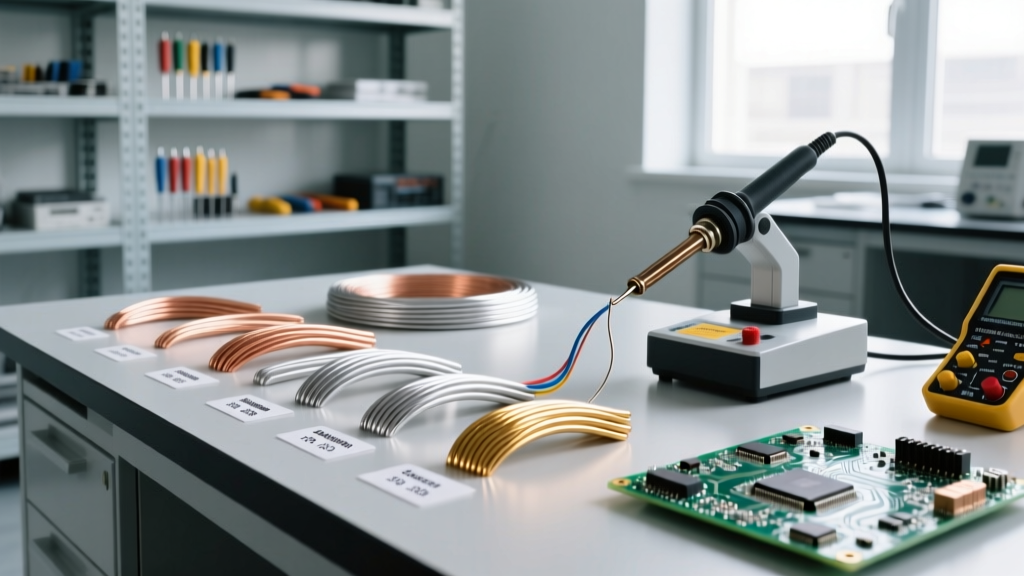
While copper remains the undisputed king of branch circuit wiring due to its high conductivity and tensile strength, aluminum is heavily utilized in service entrance cables and large feeder runs. However, the NEC strictly regulates aluminum to prevent the fire hazards that plagued the industry in the 1970s.
The AA-8000 Series Requirement
Under NEC Section 310.106(B), aluminum conductors must be made of an AA-8000 series electrical grade aluminum alloy. Pure aluminum (AA-1350) is explicitly banned for branch circuit wiring because it suffers from thermal creep and cold flow, leading to loose connections under lugs and subsequent arcing. The AA-8000 series incorporates iron and other trace elements to dramatically increase tensile strength and reduce creep, matching the mechanical reliability of copper under screw terminals.
The CCA Prohibition
Copper-Clad Aluminum (CCA) wire is a frequent point of confusion. While CCA is acceptable for telecommunications and coaxial cables, it is not recognized by the NEC as a compliant conductor for AC branch circuits or feeders. Inspectors will immediately fail an installation if CCA is used in place of solid copper or approved aluminum alloys, as the outer copper layer is too thin to prevent aluminum oxidation at termination points.
Insulation Chemistry and Code-Approved Dielectrics
An insulator's primary job is to confine the electrical current to the conductor and prevent phase-to-phase or phase-to-ground faults. However, the NEC evaluates insulators not just on dielectric strength, but on thermal endurance and chemical resistance. Modern wire insulation primarily relies on two chemical families: Polyvinyl Chloride (PVC) and Cross-Linked Polyethylene (XLPE).
PVC and the Plasticizer Migration Problem
Thermoplastic insulations like THHN and THWN-2 are PVC-based. To make PVC flexible, manufacturers add chemical plasticizers. A known failure mode in the field is 'plasticizer migration,' where the oils in the PVC leach out when the wire is in prolonged contact with certain types of rigid foam insulation or specific petroleum-based oils. This leaves the insulation brittle, cracked, and prone to dielectric breakdown. To combat this, THHN wires are coated with an outer jacket of Nylon, which acts as a chemical barrier and reduces pulling friction in conduits.
XLPE and Superior Thermal Stability
Cross-Linked Polyethylene (XLPE), used in XHHW-2 wire, undergoes a chemical or radiation process that creates a three-dimensional molecular bond. This thermoset material cannot melt, even when exposed to temperatures far exceeding its rated limit. Because it does not require plasticizers, XLPE is inherently immune to plasticizer migration, making it the preferred choice for commercial and industrial environments where chemical exposure is a concern.
Comparing NEC Table 310.104(A) Insulation Types
NEC Table 310.104(A) is the master reference for insulator applications. Selecting the wrong type for a specific environment is one of the most common code violations. Below is a breakdown of the most common building wire insulations.
| Insulation Type | Material Base | Max Temperature | Wet Location Rated? | Outer Covering | Primary Application |
|---|---|---|---|---|---|
| THHN | PVC + Nylon | 90°C (Dry) | No | Nylon Jacket | Dry indoor conduits, control panels |
| THWN-2 | PVC + Nylon | 90°C (Wet/Dry) | Yes | Nylon Jacket | General purpose, wet/damp locations |
| XHHW-2 | XLPE | 90°C (Wet/Dry) | Yes | None (Thermoset) | Commercial feeders, high-fill conduits |
| UF-B | PVC (Solid) | 60°C | Yes | Integral Jacket | Direct burial, outdoor residential |
| USE-2 | XLPE / EPR | 90°C (Wet) | Yes | Sunlight Resistant | Service entrance, direct burial |
Notice that XHHW-2 lacks a separate nylon jacket. Because XLPE is naturally slick and highly resistant to moisture, it boasts a smaller outer diameter than an equivalently sized THWN-2 wire. This allows electrical contractors to pull more XHHW-2 conductors into a single conduit while remaining compliant with NEC Chapter 9 conduit fill tables.
Ampacity Derating and the 90°C vs. 75°C Termination Trap
A critical concept in code compliance is understanding how the insulator's temperature rating interacts with the conductor's ampacity. Most modern insulators (THWN-2, XHHW-2) are rated for 90°C. However, a massive code trap exists regarding terminations.
The NEC 110.14(C) Rule
While the wire's insulator can handle 90°C, the lugs on breakers, panels, and disconnects are typically only rated for 75°C. Therefore, NEC 110.14(C) mandates that the final allowable ampacity of the circuit must be based on the 75°C column of NEC Table 310.16, regardless of the 90°C wire used.
So, why use 90°C insulators at all? The 90°C rating is legally permitted to be used for ampacity derating. If you are bundling multiple current-carrying conductors in a single raceway, NEC 310.15(C)(1) requires you to reduce the wire's ampacity. You start your derating math from the 90°C column, apply the derating factor (e.g., 80% for 4-6 conductors), and as long as the final derated number is equal to or greater than the 75°C ampacity requirement of your breaker, the installation is fully code-compliant.
Expert Insight: Never size your breaker based on the 90°C column. A 4 AWG THWN-2 copper wire has an ampacity of 95A in the 90°C column, but you must protect it at the 75°C limit of 85A, meaning the next standard breaker size down is 80A. Using a 90A or 100A breaker here is a direct violation of OSHA and NEC safety standards, as detailed in OSHA Wiring Design and Protection Standards.
Environmental Codes: Wet, Damp, and Direct Burial Mandates
The NEC strictly defines environmental conditions, and the insulator must be matched to the environment. A 'Dry Location' is an interior space not normally subject to dampness. A 'Damp Location' includes areas protected from weather but still subject to moderate moisture (like indoor pools or basements). A 'Wet Location' includes direct exposure to weather, underground installations, and concrete slabs in direct contact with the earth.
Concrete and the 'Wet Location' Classification
A common mistake among DIYers and junior electricians is running standard THHN wire through underground PVC conduit encased in a concrete slab. The NEC classifies concrete in direct contact with the earth as a wet location. Over time, moisture wicks through the concrete and enters the conduit via condensation. If the wire is not rated for wet locations (like THWN-2 or XHHW-2), the PVC insulation will absorb moisture, drastically lowering its dielectric strength and eventually causing a ground fault. Furthermore, direct burial cables like UF-B must be buried at specific depths (typically 24 inches for residential branch circuits) as mandated by NEC Table 300.5.
Sunlight Resistance and UV Degradation
When insulators are exposed to direct sunlight, ultraviolet (UV) radiation breaks down the molecular chains of standard PVC, leading to chalking, cracking, and ultimate failure. Standard THHN/THWN-2 is not inherently sunlight resistant unless specifically marked 'Sunlight Resistant' or 'SR' on the jacket. For outdoor, above-ground applications where the wire is not enclosed in a UV-blocking raceway, contractors must use cables rated for UV exposure, such as USE-2 or specific outdoor-rated tray cables (TC-ER), aligning with NEMA WC-70 Power Cables Standard testing protocols for weather resistance.
Summary Checklist for Code-Compliant Selection
- Verify the Alloy: Ensure all aluminum conductors are stamped AA-8000 series.
- Match the Environment: Use THWN-2 or XHHW-2 for any conduit that may accumulate condensation or is buried underground.
- Respect the Terminations: Base your final overcurrent protection sizing on the 75°C column, using the 90°C column strictly for bundling derations.
- Check the Jacket: Look for the 'Gas/Vapor Resistant' or 'Sunlight Resistant' printing on the wire jacket if installing in industrial or outdoor environments.
- Avoid CCA: Never use Copper-Clad Aluminum for AC mains wiring; stick to pure copper or approved aluminum alloys.
By treating the electricity conductor and insulator not just as physical commodities, but as engineered systems bound by strict legal codes, you ensure the longevity, safety, and compliance of your electrical infrastructure.