
The Physics of Electric Charge: Core Concepts
At the most fundamental level of electronics and electrical engineering, electric charge is the physical property of matter that causes it to experience a force when placed in an electromagnetic field. For DIYers, hobbyists, and professional electricians, understanding how charge behaves is the bedrock of circuit design, wire sizing, and safety protocols.
In 2019, the scientific community redefined the SI base units, anchoring the Ampere directly to the elementary charge (e). The elementary charge is now defined as exactly 1.602176634 × 10⁻¹⁹ Coulombs. This means that one Coulomb (C) is equivalent to the charge of approximately 6.242 × 10¹⁸ electrons. When we discuss wire ampacity or circuit current, we are fundamentally discussing the controlled movement of these discrete charge carriers.
According to the NIST Fundamental Physical Constants, the exact fixing of the elementary charge ensures that global electrical measurements remain universally consistent, directly impacting how we calibrate multimeters and design precision microcontroller circuits.
Quick Reference Table: Charge Carriers in Electronics
While electrons are the primary charge carriers in standard copper wiring, semiconductor physics and specialized environments rely on different carriers. Below is a quick reference chart detailing the primary charge carriers you will encounter in electrical fundamentals.
| Carrier Type | Symbol | Charge (Coulombs) | Primary Domain |
|---|---|---|---|
| Electron | e- | -1.602 × 10⁻¹⁹ | Copper/Aluminum Wiring, Vacuum Tubes |
| Hole | h+ | +1.602 × 10⁻¹⁹ | P-type Semiconductors, Microcontrollers |
| Proton | p+ | +1.602 × 10⁻¹⁹ | Nuclear Physics, Ionized Gases |
| Cation (e.g., Cu2+) | Ion | +3.204 × 10⁻¹⁹ | Electroplating, Battery Electrolytes |
Dynamic Charge (Current) vs. Static Charge (ESD)
In practical electrical work, electric charge manifests in two distinct ways: dynamic flow (current) and static accumulation (voltage potential). Differentiating between the two is critical for both wire sizing and component protection.
Dynamic Charge and Wire Sizing
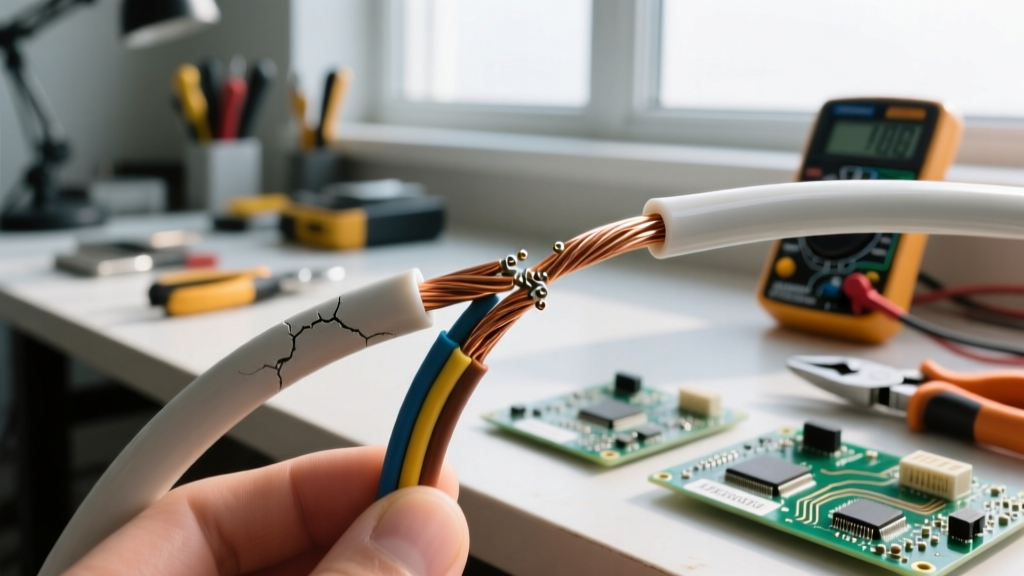
Electric current (I) is simply the rate of electric charge flow over time. One Ampere equals one Coulomb of charge passing a given cross-sectional point per second. When you size a 14 AWG THHN copper wire for a 15-Amp residential circuit, you are engineering a pathway capable of safely accommodating 15 Coulombs of charge per second. The resistance of the copper lattice causes collisions between moving electrons and stationary atoms, generating phonons (heat). If the charge flow exceeds the wire's thermal dissipation capacity, the insulation degrades, leading to thermal runaway and potential fire hazards.
Static Charge and Dielectric Insulation
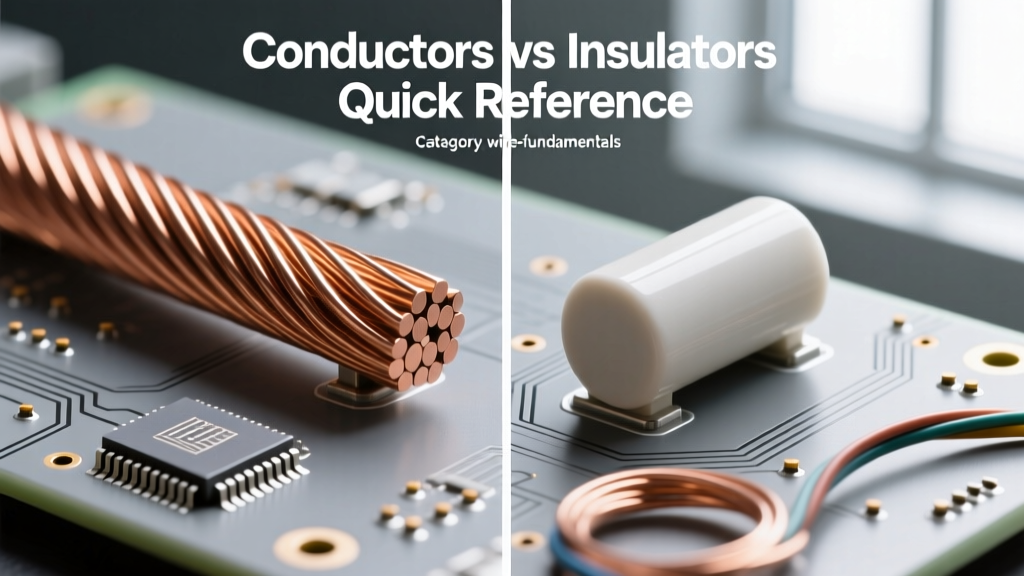
Static electric charge occurs when electrons accumulate on a surface without a continuous path to ground. In wiring systems, the insulation material acts as a dielectric, separating conductors and allowing them to store static charge in the form of stray capacitance. This is heavily influenced by the dielectric constant (κ) of the wire's insulation. For high-frequency data cables (like Cat6 or RG6 coaxial), minimizing stored charge is vital to prevent signal degradation and phase shift.
- PVC (Polyvinyl Chloride): κ ≈ 3.5 to 4.0. Higher charge storage, suitable for low-frequency power wiring.
- XLPE (Cross-linked Polyethylene): κ ≈ 2.3. Moderate charge storage, standard for medium/high voltage power distribution.
- PTFE (Teflon): κ ≈ 2.1. Extremely low charge storage, ideal for high-speed RF and aerospace microcontroller wiring.
Essential Formulas Cheat Sheet
Keep these fundamental equations handy for quick circuit analysis, capacitor sizing, and electrostatic troubleshooting.
- Charge from Current: Q = I × t
(Where Q is charge in Coulombs, I is current in Amps, t is time in seconds) - Charge in a Capacitor: Q = C × V
(Where C is capacitance in Farads, V is voltage potential) - Coulomb's Law (Force): F = k × (|q1 × q2|) / r2
(Calculates the electrostatic force between two point charges; critical for understanding high-voltage busbar repulsion) - Electric Field Strength: E = F / q
(Force per unit charge, measured in Volts per meter; used to calculate dielectric breakdown thresholds in wire insulation)
For a deeper mathematical breakdown of electrostatic forces and field lines, the HyperPhysics electric charge database provides excellent interactive vector diagrams and calculus-based derivations.
Real-World Troubleshooting: Managing Stray Charge
One of the most common failure modes in DIY microcontroller projects and sensitive audio equipment is damage or noise caused by unmanaged static electric charge. Electrostatic Discharge (ESD) occurs when a high-voltage, low-charge static buildup rapidly equalizes.
The Human Body Model (HBM)
Engineers use the Human Body Model to simulate how human electric charge transfers to sensitive electronics. The standard HBM circuit uses a 100 picofarad (pF) capacitor discharged through a 1.5 kilo-ohm (kΩ) resistor. A human walking across a synthetic carpet can generate upwards of 10,000 Volts of static potential. While the total charge (Q = CV) is microscopically small (around 1 microcoulomb), the rapid discharge creates a massive instantaneous current spike capable of vaporizing the microscopic gold bonding wires inside an integrated circuit or puncturing the gate oxide of a MOSFET at voltages as low as 20V.
Best Practices for Charge Dissipation
- Use 1MΩ Grounding Straps: Never ground yourself directly. A 1-megaohm resistor in your ESD wrist strap safely bleeds off static electric charge over a few milliseconds, protecting both the component and you from accidental mains contact.
- Equipotential Bonding: Ensure your workbench mat, soldering iron tip, and oscilloscope ground are all bonded to the same single-point earth ground. This prevents potential differences (voltage) from existing between your tools and the circuit, eliminating the driving force for charge transfer.
- Humidity Control: Maintain workshop humidity between 40% and 60%. Moisture in the air creates a microscopic conductive layer on surfaces, allowing static charge to dissipate naturally rather than accumulating to destructive levels.
By mastering the behavior of electric charge—from the macro-scale thermal limits of copper wiring to the micro-scale electrostatic vulnerabilities of silicon gates—you transition from simply following wiring diagrams to truly engineering robust, fault-tolerant electrical systems.