
The Fundamental Duality: Conductors vs. Insulators
Every electrical circuit relies on the delicate, engineered balance between two opposing forces: the uninhibited flow of electrons and their absolute containment. Understanding the relationship between the conductor insulator pairing is the bedrock of electrical safety and efficiency. While the conductor provides the low-resistance pathway for current, the insulator acts as the dielectric barrier, preventing leakage, short circuits, and fatal ground faults. In this comprehensive reference guide, we dissect the material science, thermal limits, and real-world failure modes of modern wiring materials.
Atomic Architecture: Why Materials Behave Differently
At the quantum level, the distinction between a conductor and an insulator comes down to band theory. Conductors, like copper and silver, possess overlapping valence and conduction bands. This allows valence electrons to move freely through the atomic lattice when an electromotive force (voltage) is applied. Insulators, conversely, feature a wide 'band gap'—often exceeding 5 electron volts (eV)—which tightly binds electrons to their parent atoms, requiring massive voltage to force a dielectric breakdown.
For DIYers and professional electricians, this physics lesson translates into practical metrics: conductivity (measured against the International Annealed Copper Standard, or IACS) for the wire core, and dielectric strength (measured in kilovolts per millimeter, kV/mm) for the outer jacket.
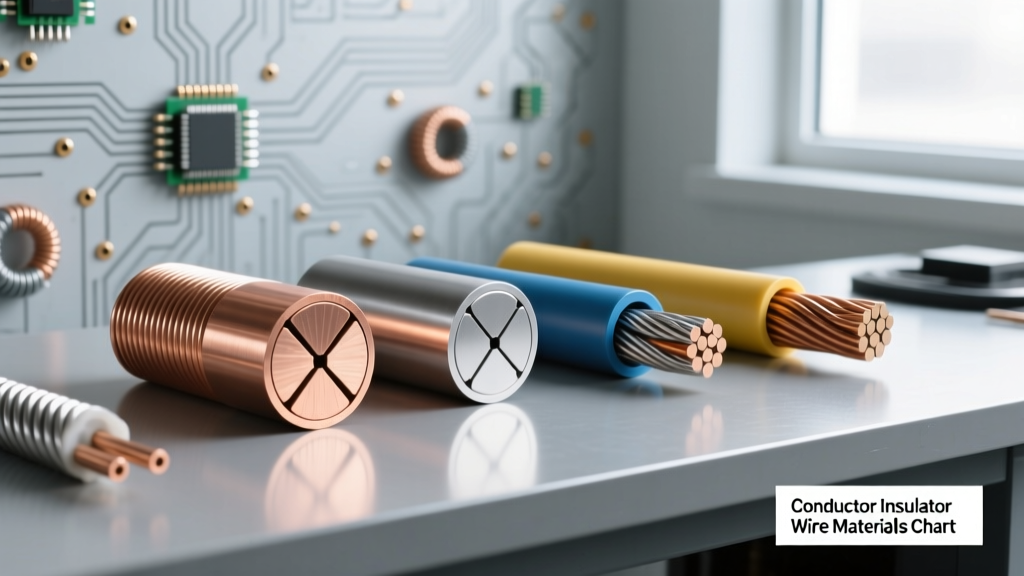
Comprehensive Conductor Insulator Material Reference Chart
Below is a quick-reference matrix detailing the most common materials used in residential, commercial, and industrial wiring, compliant with NEC Article 310 standards.
| Core Material | Conductivity (% IACS) | Tensile Strength | Primary Insulation Pairing | Max Temp Rating |
|---|---|---|---|---|
| C11000 ETP Copper | 100% (Baseline) | 210-350 MPa | PVC (THHN) / Nylon | 90°C |
| AA-8000 Aluminum | 61% | 110-150 MPa | XLPE (XHHW-2) | 90°C |
| Silver-Plated Copper | 105% (Surface) | 210-350 MPa | PTFE (Teflon) | 200°C+ |
| Tinned Copper | 97% | 200-300 MPa | Rubber (EPR) / Silicone | 125°C |
Deep Dive: Conductor Alloys and Real-World Performance
C11000 Electrolytic Tough Pitch (ETP) Copper
ETP copper (UNS C11000) is the undisputed king of branch circuit wiring. Comprising 99.90% pure copper with trace oxygen, it sets the 100% IACS baseline for conductivity. However, pure copper is relatively soft. To survive the mechanical stress of being pulled through conduit, it is often hard-drawn. According to the Copper Development Association, hard-drawn copper increases tensile strength by up to 60% compared to annealed copper, though it sacrifices a fraction of a percent in conductivity due to lattice deformation.
AA-8000 Series Aluminum: Correcting Historical Failures
Older aluminum wiring (AA-1350) used in the 1960s and 70s was notorious for 'cold creep' and galvanic corrosion at termination points, leading to countless residential fires. Modern NEC code strictly mandates the use of AA-8000 series aluminum alloys for branch circuits. By alloying pure aluminum with trace amounts of iron and copper, AA-8000 exhibits vastly superior creep resistance and thermal stability. When paired with CO/ALR rated terminals and antioxidant paste, AA-8000 aluminum paired with XLPE insulation is a highly reliable, cost-effective alternative to copper for heavy feeder cables (e.g., 2 AWG to 4/0 AWG).
Insulation Polymers: Dielectric Strength and Thermal Limits
The insulator must withstand not just the operating voltage, but the thermal byproduct of the conductor's resistance (I²R losses) and ambient environmental heat.
PVC and the THHN/THWN Dual Rating
Polyvinyl Chloride (PVC) is the most ubiquitous wire insulation due to its low cost and excellent flame retardancy (chlorine atoms inherently quench combustion). Standard THHN (Thermoplastic High Heat-resistant Nylon) features a PVC base with a thin nylon outer jacket. The nylon provides exceptional abrasion resistance for conduit pulls but is highly susceptible to degradation when exposed to hydrocarbons or continuous moisture. This is why modern wire is dual-rated as THWN-2, indicating the PVC compound has been chemically modified to resist water and hydrolysis up to 90°C in wet locations.
XLPE (Cross-Linked Polyethylene)
Unlike thermoplastic PVC, which melts under extreme heat, XLPE is a thermoset polymer. Through irradiation or chemical peroxide curing, the polymer chains are cross-linked into a 3D mesh. This gives XHHW-2 (XLPE insulated) wire superior dielectric strength (approx. 50 kV/mm compared to PVC's 40 kV/mm) and prevents melting during short-circuit events. For high-amperage DIY projects like EV charger installations or subpanel feeders, XLPE is the superior choice.
Troubleshooting: Identifying Insulator Degradation and Failure
Insulators do not last forever. Environmental stress, voltage spikes, and thermal cycling degrade the polymer matrix over time. Here is how to identify the most common failure modes:
- Ozone Cracking: Common in older rubber (EPR) or natural rubber insulations near high-voltage equipment or brush-type motors. Ozone attacks the double bonds in the polymer chain, creating microscopic, perpendicular fissures that eventually expose the conductor.
- Thermal Tracking: When dust and moisture accumulate on PVC insulation near heat sources, a conductive carbon path can form. This 'tracking' creates localized arcing, eventually burning a hole through the dielectric barrier.
- Hydrolysis and Plasticizer Migration: Over decades, the chemical plasticizers that keep PVC flexible can leach out, especially in high-heat attic environments. The insulation becomes brittle, cracking when bent, which compromises the dielectric seal.
Expert Troubleshooting Tip: If you are retrofitting a mid-century home and the cloth-braided or early PVC insulation flakes off when you bend the wire at the receptacle, the plasticizers have fully migrated. You must either rewire the circuit or install heat-shrink tubing over the exposed conductors inside the junction box before terminating.
High-Frequency Applications: Skin Effect and PTFE
In low-frequency (60Hz) AC power, current flows relatively evenly through the conductor's cross-section. However, in high-frequency applications (like RF antennas, data lines, or inverter-driven motor leads), the 'skin effect' forces electrons to travel only on the outermost surface of the wire. For these scenarios, a conductor insulator pairing of silver-plated copper and PTFE (Teflon) is ideal. Silver has the highest bulk conductivity of any metal, maximizing surface flow, while PTFE offers an incredibly low dielectric constant (approx. 2.1), minimizing signal attenuation and capacitive losses at high frequencies.
Selection Framework for DIY and Professional Projects
Choosing the right wire requires matching the environment to the material properties. Use this decision framework before purchasing your next spool:
- Standard Indoor Branch Circuits (15A/20A): Solid C11000 Copper with THHN/THWN-2 (PVC/Nylon). Cost-effective, easy to terminate, and perfectly suited for dry, climate-controlled interiors.
- Heavy Feeders & Subpanels (60A-200A): Stranded AA-8000 Aluminum with XHHW-2 (XLPE). Saves up to 50% on material costs compared to copper, while the XLPE insulation handles the higher thermal mass and provides excellent moisture resistance for underground conduit runs.
- High-Heat / Industrial Environments (Ovens, Kilns): Nickel-plated Copper with PTFE or Fiberglass braided insulation. Standard PVC will melt and emit toxic hydrogen chloride gas at temperatures exceeding 105°C; PTFE remains stable up to 260°C.
- Direct Burial / Wet Trenches: Copper or Aluminum with UF-B (Underground Feeder) or XHHW-2. Never use standard THHN in continuous wet locations, as the nylon jacket will absorb moisture and wick it along the wire via capillary action, leading to ground faults.
For exhaustive code requirements regarding conductor ampacity and insulation temperature derating, always consult the latest edition of the NFPA 70 National Electrical Code (NEC), specifically Table 310.16. Additionally, manufacturers like Southwire provide excellent technical data sheets detailing the exact bending radii and pulling tensions for specific conductor insulator combinations to prevent mechanical damage during installation.